
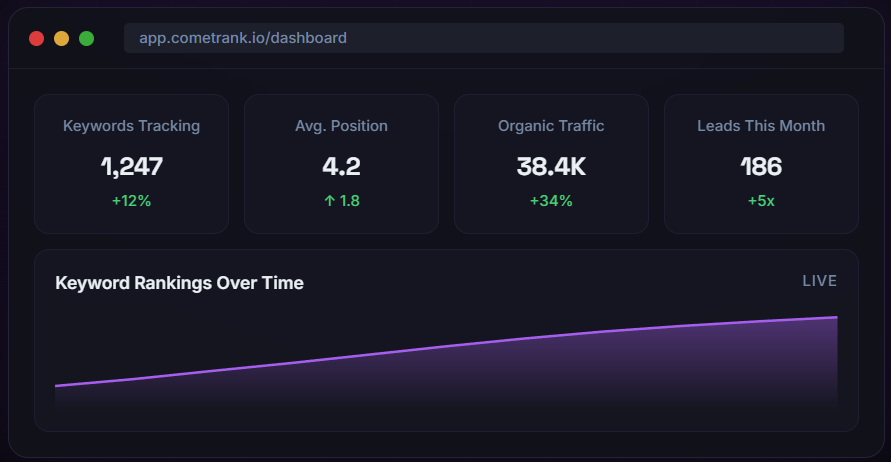
Every SEO consultant hands you the same report:
- Keyword rankings
- Domain authority
- Impressions
- Backlinks
However, these metrics bring zero clarity on whether SEO brought in any business this month. Those aren’t important SEO metrics. They’re activity metrics, built to make SEO look busy, not to prove it’s working.
The seven metrics below are a different list:
- Each one connects directly to leads or revenue
- Each one tells you something a business owner actually needs to know
- Each one moves when your pipeline moves
If yours aren’t moving, you’ll know exactly what to fix.
How Many Leads Does Organic Search Bring In?
Organic conversions are the people who found you through Google and did something valuable:
- Filled a form
- Called
- Booked a demo
This is the single most important SEO metric on the list.
Set it up in Google Analytics 4. Mark valuable actions as conversion events. Filter by the “Organic Search” channel.
Most reports show traffic instead. Traffic counts visitors. Conversions count buyers. Those are not the same number.
If your team can’t pull last month’s organic lead count in 60 seconds, that’s the first gap to fix. High traffic with zero conversions means the content is attracting the wrong audience. Researchers, not buyers.
What Is the Cost Per Lead From Organic Search?
Take your monthly SEO spend. Divide by organic leads. That number settles the “is SEO worth it” question in one calculation.
Example:
| Monthly SEO spend | $4,000 |
| Organic leads | 16 |
| Cost per lead | $250 |
| Google Ads cost per lead | $480 |
SEO wins by $230 per lead. And unlike paid ads, SEO content keeps working after you publish it.
Stop a Google Ads campaign and leads stop within 24 hours. Stop publishing SEO content and leads keep arriving for months.
That’s why the volume of pages published matters more than most businesses realize.
How Good Are the Leads From Organic Search?
This is the metric most reports skip. A site can generate 80 organic leads in a month and still have a failing SEO program. Seventy of those leads can be wrong-fit.
Pull organic leads from the last 90 days. Ask your sales team two questions:
- How many became qualified opportunities?
- How many closed?
Organic leads should close at least as well as paid search. If they don’t, the content is targeting research-stage searches instead of buying-intent searches. Fix it by mapping content to commercial-intent keywords, searches where someone is ready to evaluate or purchase.
Which Keywords Drive Buyers, Not Just Traffic?
Ranking for 2,400 keywords sounds impressive. It isn’t, unless the right 10 to 20 of those keywords bring in buyers.
There are four keyword types. Three of them generate revenue. One doesn’t.
| Type | Example | Brings In |
| Transactional | best CNC machining USA | Buyers ready to act |
| Comparison | Google Ads vs SEO | Buyers ready to decide |
| Local | metal fabricator Chicago | Buyers nearby |
| Informational | what is CNC machining | Researchers |
Most reports combine all four into one “keywords ranked” number. That’s why a site can rank for thousands of keywords while pipeline stays empty.
Track rank position specifically for transactional, comparison, and local keywords. Those are the only three that move revenue.
Which Pages Bring In Leads, Not Just Traffic?
A blog post with 10,000 monthly visitors and zero leads is a cost, not an asset. The top five pages by traffic are rarely the top five by leads.
In GA4: pull conversions by landing page, filter to organic, sort by conversions. That list is your real SEO portfolio.
The pattern is consistent:
- High-traffic pages are usually top-of-funnel blog posts
- High-converting pages are service pages, comparison pages, and local landing pages
Pages that convert should get more internal links pointing to them. Pages that don’t convert should be merged with related content or rewritten to target buying-intent searches.
Is Your Branded Search Volume Growing?
Branded search counts how many people type your company name directly into Google. It’s the slowest metric on this list. It’s also the most honest signal that SEO is compounding.
Measure it free in Google Search Console. Filter queries by your brand name. Track month over month.
Steady branded search growth means new people are discovering you, looking you up, and arriving ready to buy. Those are the warmest leads in the pipeline.
Most agencies don’t report this metric because it moves slowly. Agencies doing real work put it on every report.
How Often Does AI Search Cite Your Brand?
This is the newest of the important SEO metrics, and increasingly the most consequential.
If ChatGPT, Perplexity, and Gemini don’t mention your brand when buyers ask questions in your category, you’re invisible to a growing share of the market. By 2026, B2B buyers are as likely to start a search in ChatGPT as in Google. A brand that never appears in AI results never reaches those buyers at all.
Track it manually with a list of 15 to 20 buyer prompts. Ask each AI tool monthly. Note which brands get cited. Note whether yours does.
This connects directly to GEO KPIs, the measurement layer most agencies haven’t built yet.
Where Comet Rank Fits In
Tracking these metrics is straightforward. Moving them is where execution stalls.
Comet Rank runs the full workflow through six AI agents and a human SEO captain. Intent mapping, 150 to 400 pages every six months, internal linking, and AI-driven authority building all run as one system. A quality guardian agent checks every page before it ships.
If your numbers aren’t moving, the gap is execution, not strategy. Book a Comet Rank demo and get a clear picture of what’s stalling your pipeline.
Conclusion
Most SEO dashboards are loud. Thirty numbers, none of them tied to leads. The important SEO metrics are a much shorter list, seven to be exact. Each one moves when your business moves. Trade the noise for these seven and the decisions get sharper immediately.
Frequently Asked Questions About Important SEO Metrics
What’s the difference between an important SEO metric and a vanity metric?
A vanity metric goes up when activity goes up but doesn’t connect to leads or revenue. Impressions, total keywords ranked, and domain authority are examples. An important SEO metric ties directly to pipeline.
How long before these metrics start moving?
Organic conversions and lead quality can shift in 60 to 90 days if you focus on commercial-intent pages. Branded search growth and AI citations take 6 to 12 months because they compound slowly. Cost per organic lead drops most between months 6 and 18 as content stacks up.
How often should you check these metrics?
Once a month is enough. These seven metrics aren’t built for daily review. Daily checking creates noise. A monthly review with a 90-day trend line is what drives decisions.
Can you track all seven with free tools?
Yes. Google Search Console covers branded search, keyword rankings, and impressions. Google Analytics 4 covers organic conversions, lead quality, and lead-generating pages. AI search citations require manual checking in ChatGPT, Perplexity, and Gemini. The full dashboard costs nothing.