
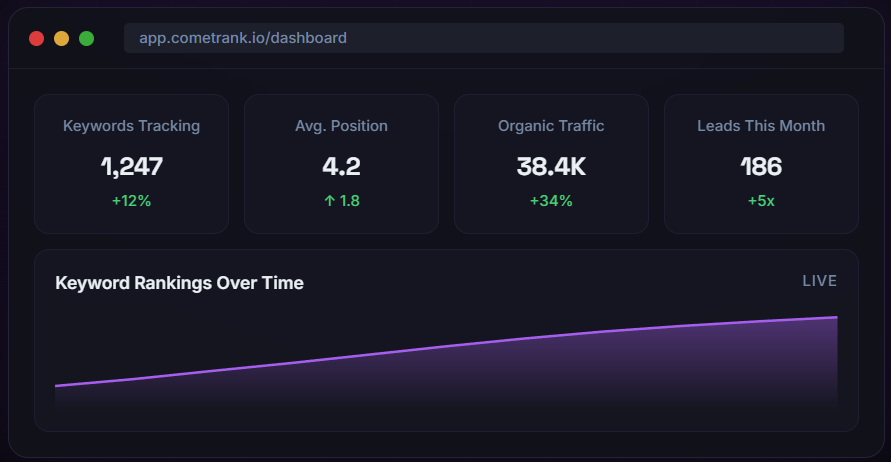
Most companies invest heavily in SEO, see traffic growth, and assume success. But traffic without conversions is a vanity metric. The real goal is turning SEO to leads, and that’s where most strategies break down.
This article explains why your SEO traffic isn’t converting—and how to fix it with a structured, intent-driven approach.
The Core Problem: Traffic ≠ Buying Intent
Not all traffic is created equal.
Many websites rank for high-volume, low-intent keywords that attract visitors who are not ready to buy. This creates a mismatch between what users want and what your business offers.
Example
A B2B SaaS company ranks for:
- “what is CRM software” (informational intent)
But tries to convert that traffic into:
- demo requests or sales calls (commercial intent)
Result: High traffic, low conversions.
Fix
Map keywords to buyer intent stages:
- Informational → Blog content
- Commercial → Comparison pages
- Transactional → Service or product pages
This ensures your SEO strategy aligns with how buyers actually search.
You’re Targeting the Wrong Keywords
Many SEO campaigns prioritize volume over intent.
High-intent keywords are more specific and often lower in volume—but they convert significantly better.
Example of High-Intent Keywords
Instead of:
- “SEO tools”
Target:
- “AI SEO platform for SaaS companies USA”
- “enterprise SEO automation software pricing”
These reflect users closer to a buying decision.
How to Fix It
Use an intent-first keyword strategy supported by tools like an how can an ai search monitoring platform improve seo strategy to identify:
- ranking gaps
- high-conversion queries
- emerging buyer intent signals
Your Pages Don’t Match Search Intent
Even if you rank for the right keyword, your page may fail if it doesn’t match what users expect.
Common Mismatch Issues
- Blog content ranking for transactional queries
- Thin service pages for complex B2B searches
- Generic content for niche queries
Implementation Example
A page targeting:
“precision CNC machining supplier for aerospace components USA”
Should include:
- materials (aluminum, titanium, etc.)
- tolerance levels (e.g., ±0.0005 inches)
- certifications (ISO 9001, AS9100)
- industries served
- real applications
Without this depth, users won’t convert.
Weak Conversion Paths
Many SEO pages don’t guide users toward action.
Traffic lands → reads → leaves.
Why This Happens
- No clear CTA
- No logical next step
- No internal linking to conversion pages
How to Fix It
Create conversion pathways:
- Blog → comparison page → product page → demo
- Guide → use case → case study → contact form
For example, a reader learning about performance tracking should naturally navigate to how to measure the success of generative engine optimization campaigns as part of evaluating SEO effectiveness.
You’re Not Measuring the Right Metrics
Many teams track:
- traffic
- impressions
- rankings
But ignore:
- lead conversion rate
- assisted conversions
- pipeline contribution
What You Should Track
- Conversion rate by page
- Revenue per keyword
- Lead quality by traffic source
Use frameworks like generative engine optimization kpis and metrics to connect SEO performance directly to business outcomes.
Poor Internal Linking Strategy
Internal links are not just for SEO—they guide users through your funnel.
Common Mistakes
- Random linking
- No strategic flow
- Links that don’t match user intent
How to Fix It
Structure internal links around decision progression.
Example:
A user researching SEO costs should move toward evaluation via average cost of seo for small business before considering vendors.
This keeps users engaged and moves them closer to conversion.
You’re Making Fundamental SEO Strategy Mistakes
Many businesses repeat the same errors:
- focusing on traffic instead of leads
- ignoring intent
- publishing low-depth content
- not updating pages
These issues compound over time.
A breakdown of these pitfalls can be seen in mistakes small business owners make when using seo which highlights why most SEO efforts fail to generate real pipeline.
How CometRank Fixes the SEO-to-Leads Gap
CometRank operates as an AI SEO Command Center designed to turn traffic into revenue.
Its system includes:
- Analyst → identifies high-intent keywords
- Strategist → maps intent to page types
- Creator → builds conversion-focused content
- Optimizer → improves rankings and internal links
- Authority Builder → strengthens domain authority
Instead of chasing traffic, it builds a system where SEO to leads becomes predictable and scalable.
Strategic Takeaway
If your SEO isn’t generating leads, the issue isn’t traffic—it’s alignment.
To fix it:
- Target high-intent keywords
- Match content to search intent
- Build conversion pathways
- Track revenue-driven metrics
- Structure internal linking around decisions
SEO works when it mirrors how buyers search, evaluate, and decide.