
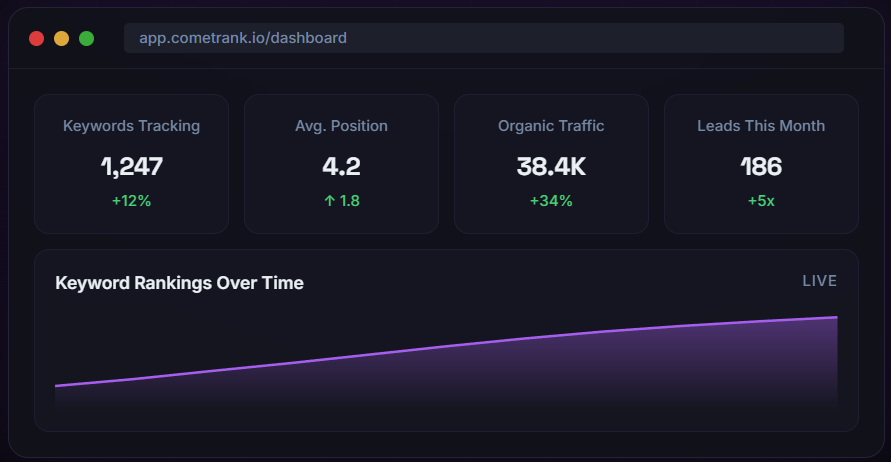
How are newer plastic surgery clinics outranking yours on Google?
It’s not reputation. It’s not results. It’s structure.
The practices at the top of local search built more intent-matched pages, optimized their Google Business Profile, and covered the technical fundamentals that most clinic websites skip entirely.
In this article, we cover exactly what those top-ranking practices are doing differently and how to replicate it so your clinic stops losing consultations to whoever ranks above you.
What Is SEO for Plastic Surgeons?
SEO for plastic surgeons is the process of optimizing a practice’s website to rank in Google when patients search for procedures, surgeons, and clinics in their area. Done right, it turns search visibility into booked consultations without paying for every click.
The goal is not traffic. The goal is patients. Those are different targets, and most plastic surgery SEO fails because it optimizes for the first instead of the second.
Plastic surgery also sits in what Google calls a YMYL category (Your Money or Your Life). Google holds these pages to a higher trust standard. Board certification, surgeon credentials, and patient safety signals on your website directly affect whether Google considers your pages credible enough to rank.
Why Most Plastic Surgery Websites Fail to Rank in Google
Most clinics build a home page, an about page, a few procedure pages, and a contact form. Then they wonder why they’re not generating organic inquiries.
The problem is structural.
Search demand for plastic surgery is fragmented across hundreds of specific queries.
For example, a patient searching “deep plane facelift surgeon in Manhattan” is not the same patient searching “facelift recovery timeline week by week.” They’re at different stages, looking for different things, and Google serves them different pages.
A site with five generic pages cannot rank for hundreds of specific searches.
High-performing clinics build a content network:
- Dedicated landing pages for each procedure variation
- City-specific pages for each location they serve
- Educational articles for patients still in the research phase
Each page targets one keyword cluster. The clinics ranking at the top of Google for “rhinoplasty surgeon in [city]” didn’t get there by improving their home page. They built more relevant pages than their competitors.
Our local SEO for medical professionals guide covers this content architecture in more detail.
What Technical SEO for Plastic Surgery Sites Actually Need
Before any content strategy works, the website itself has to be in order. Google won’t rank a slow or untrustworthy site regardless of content quality.
1. Page speed and Core Web Vitals
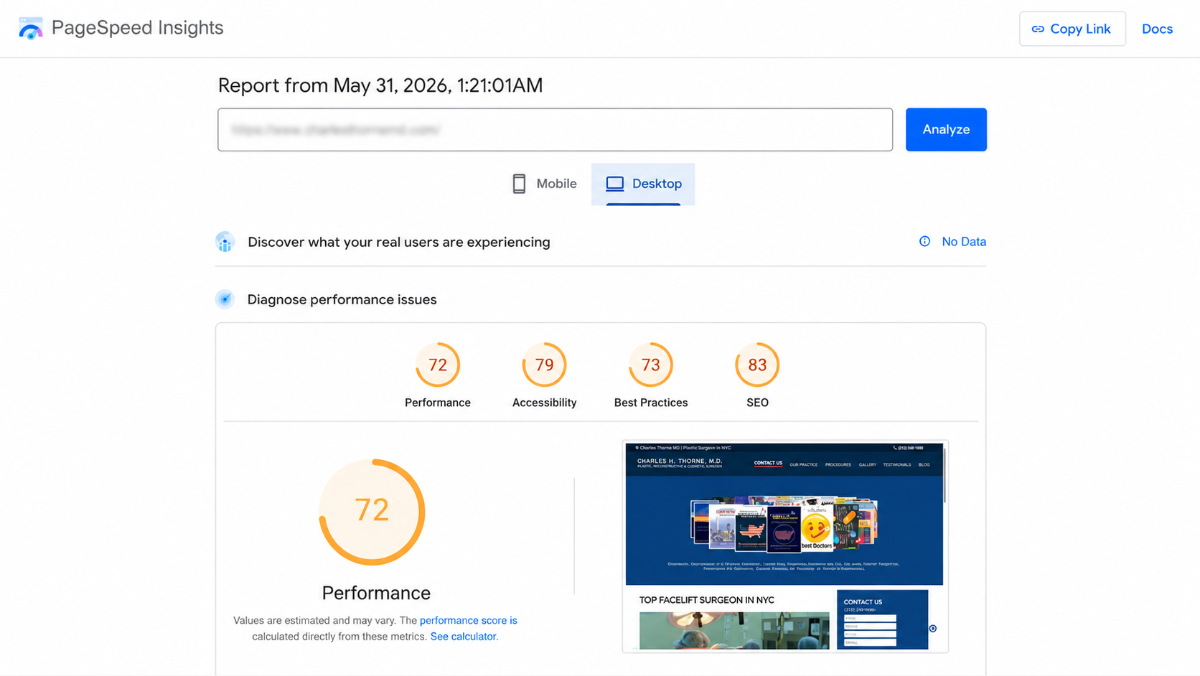
Page speed is a ranking factor. A score of 72 is decent, but in a market as competitive as plastic surgery, every point counts.
Google measures how fast pages load and how quickly visitors can interact with them. A slow site loses rankings and patients both. Use Google’s PageSpeed Insights to find and fix the issues.
2. HTTPS
Your site must be served over HTTPS. Patients entering contact information need to see the padlock. Google uses it as a trust signal too.
3. Schema markup
Schema is code that tells Google what your content means. For plastic surgery practices, three types matter:
- MedicalBusiness (your address, phone, and hours)
- Physician (connects each surgeon to their credentials and specialties)
- FAQ schema (gets your answers pulled directly into Google search results)
4. URL structure
The URL of a page should clearly describe its content. This helps both users and search engines understand what the page is about.
For example, /procedures/rhinoplasty-surgeon-new-york/ clearly indicates that the page is about rhinoplasty surgery in New York.
On the other hand, /page?id=482 provides no context about the page content.
Using clean, descriptive URLs makes it easier for search engines to understand your website structure and can improve the user experience.
They are the foundation on which everything else sits on. To learn more, you can check out our on-page SEO tactics guide, which covers the full checklist.
Mapping the Three Types of Patient Search Intent
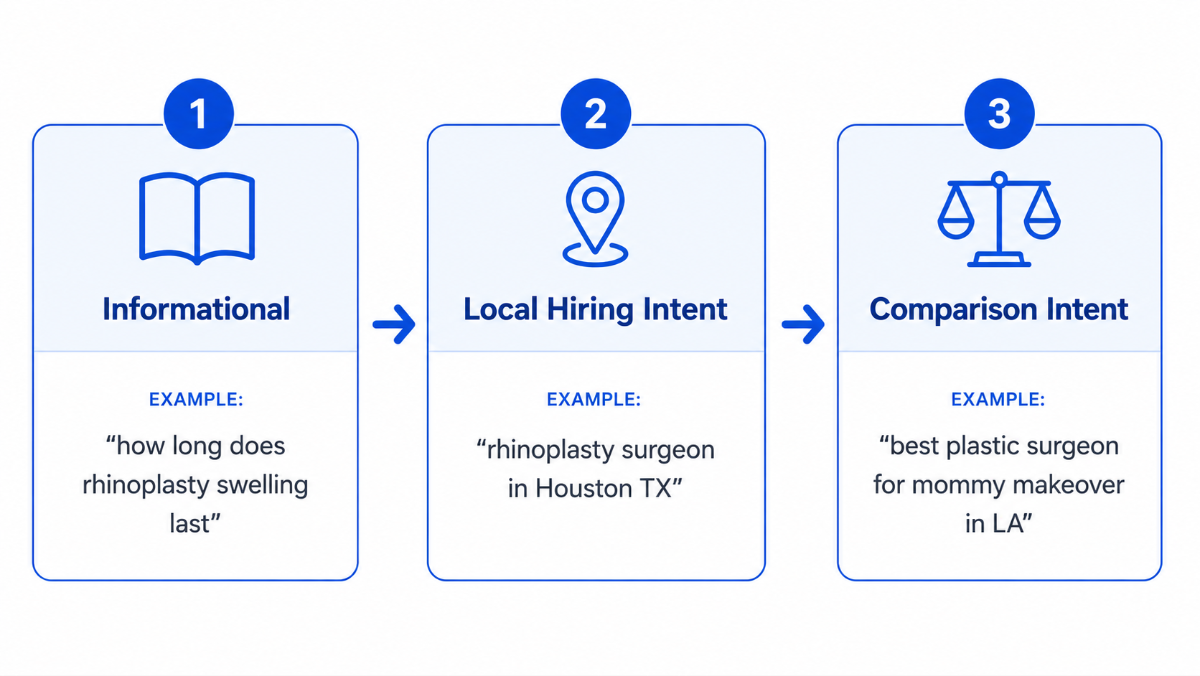
Each intent stage needs a different page type to capture the right patient at the right time.
Patients move through three distinct intent stages before booking. Each stage needs a different content type. Most plastic surgery websites cover one and ignore the other two.
1. Informational intent
The patient is researching. They’re searching “how long does rhinoplasty swelling last” or “facelift vs thread lift which lasts longer.” Educational blog content built around these queries captures patients early and builds trust before they’re ready to choose a surgeon.
2. Local hiring intent
The patient is ready to find a surgeon in their city. They’re searching “board certified rhinoplasty surgeon in Houston TX” or “breast augmentation surgeon Beverly Hills.”
These searches need dedicated local landing pages with:
- Surgeon credentials
- Procedure detail
- Before-and-after imagery (with consent)
- A clear consultation CTA
3. Comparison intent
The patient is evaluating options. They’re searching “best plastic surgeon for mommy makeover in Los Angeles.” Authority content that addresses qualifications, certifications, and what differentiates one surgeon from another captures this search type.
Most clinics only invest in local hiring intent pages. The practices generating consistent organic leads build all three and interlink them. A patient who reads your recovery guide comes back to book with the surgeon they’ve been reading about.
Our HIPAA-compliant SEO strategy covers how to structure this for a medical practice.
Local SEO for Plastic Surgeon: How Google Decides Which Surgeons Appear on the Map
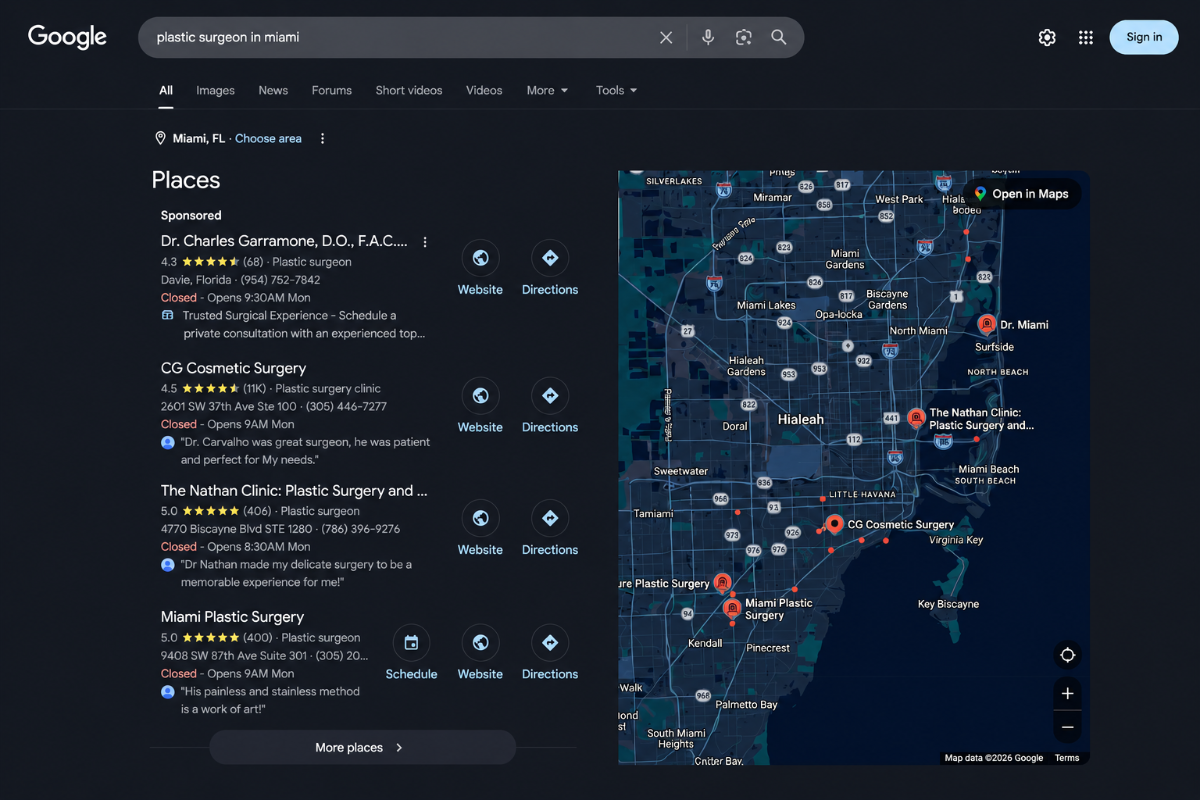
Google Local Pack for plastic surgeons in Miami.
When a patient searches “plastic surgeon near me,” Google shows a Local Pack:
a map with three listings at the top of the results.
Those three spots drive more clicks than almost anything else on the page.
1. Google Business Profile
Claim and fully complete it. Add procedure keywords to your description. Upload photos of the clinic and team. Answer patient questions in the Q&A section about recovery, cost, and booking.
2. Collect reviews that mention specific procedures
A review that says “my rhinoplasty recovery was smooth” carries more local SEO weight than a generic five-star review because it contains keywords patients are actually searching. Our Google Business Profile optimization guide covers the specifics.
3. NAP consistency
Your practice name, address, and phone number must be identical everywhere online:
- Your website
- Google Business Profile
- Healthgrades
- Zocdoc
- Every directory listing
Google cross-references these. Discrepancies reduce trust and hurt local rankings.
4. Location-specific pages
If you serve multiple cities, each location needs its own dedicated page. One generic “locations” page does not rank for city-specific searches. A page targeting “rhinoplasty surgeon in Scottsdale AZ” needs local office details, procedure options, and a consultation CTA.
Building Backlinks for a Plastic Surgery Practice
Google uses backlinks from other websites as trust votes.
A practice with credible links from medical associations and health publications ranks better than one without them, even when content quality is similar.
High-value backlink sources for plastic surgeons include:
- Directories from the American Society of Plastic Surgeons (ASPS) and the American Board of Plastic Surgery (ABPS)
- Patient platforms like RealSelf and Healthgrades
- Local media when surgeons comment as experts
- City-specific health directories
Ten links from credible healthcare sources do more than 200 from unrelated websites. Focus on the sources your patients trust. Those are the same sources Google trusts.
Recommended Reading:
To learn more about backlinks, check out our real estate backlinking strategy, which explains the link quality framework in full.
How to Measure Whether Your Plastic Surgery SEO Is Working
Most practices pay for SEO for months without knowing if it’s actually doing anything. That’s not acceptable. These are the metrics that tell you:
| Metric | What it tells you | Where to track it |
| Organic sessions | How many people find you through search | Google Analytics |
| Keyword rankings | Which procedure and city searches you appear for | Google Search Console |
| Local Pack appearances | How often you appear in map results | Google Business Profile Insights |
| Consultation form submissions from organic | Whether traffic converts to inquiries | Google Analytics (Goals) |
Rankings alone are not the goal. A practice can rank on page one for a hundred keywords and generate zero consultations if the landing pages don’t convert. Track traffic to leads, not traffic to traffic. That is the number that tells you whether the SEO is working for the business. See how to interpret these signals in our SEO metrics guide.
How CometRank Handles SEO for Plastic Surgery Practices
Executing plastic surgery SEO properly requires building hundreds of intent-matched pages, maintaining technical health, running a local citation strategy, and managing backlink acquisition simultaneously. Most practices don’t have the bandwidth to do this in-house, and most agencies move too slowly to make a meaningful dent.
We’re an AI SEO agency that runs this entire workflow for clients using CometRank, our proprietary SEO software. CometRank runs six AI agents across intent mapping, content creation at scale, on-page optimisation, local citation management, and authority building. A human SEO captain reviews everything before it goes live. If you’re looking for an AI SEO agency for healthcare services, this is what the execution actually looks like at scale.
To see how CometRank handles this for your practice, book a demo, and we’ll walk you through the full workflow in one call.
Conclusion
Plastic surgery is a high-trust decision. Patients spend weeks researching before they book. The practices that appear throughout that research process, in the informational content patients read early, in the local results when they’re ready to choose, and in the review platforms where they compare surgeons, win a disproportionate share of that demand.
Start with one piece: a technical audit, a fully optimized Google Business Profile, or a set of city-specific procedure pages. Each piece compounds.
SEO for Plastic Surgeons: Frequently Asked Questions
1. How long does it take for plastic surgery SEO to show results?
Local SEO improvements, such as a fully optimized Google Business Profile and consistent NAP data, can show results in four to eight weeks. Content-driven rankings for competitive procedure keywords typically take three to six months, depending on market saturation and how much content the practice publishes. Markets like Beverly Hills or Manhattan take longer than smaller cities. The timeline shortens significantly when content is published at volume rather than one article per month.
2. What keywords should a plastic surgery practice target?
Start with procedure-plus-location keywords: “rhinoplasty surgeon in [city],” “breast augmentation [city],” “facelift surgeon near me.” Then add informational keywords for patients still researching: “rhinoplasty recovery timeline,” “deep plane facelift vs SMAS,” “breast implant types comparison.” Finally, target comparison-intent searches: “best plastic surgeon for mommy makeover in [city].” Each keyword type needs a different content format to match what the patient is actually looking for.
3. How is local SEO different from regular SEO for plastic surgeons?
Regular SEO focuses on ranking in the main Google search results. Local SEO focuses on ranking in the Google Local Pack, the map results that appear for city-specific searches. Local SEO requires a fully optimized Google Business Profile, consistent NAP citations across directories, location-specific landing pages, and procedure-specific patient reviews. For most plastic surgery practices, local SEO produces the fastest and highest-quality results because the patients it captures are nearby and actively looking to book.
4. Do patient reviews help with plastic surgery SEO?
Yes, significantly. Reviews that mention specific procedures and locations carry strong local SEO signals. A review that says “my rhinoplasty with Dr. Smith in Denver was excellent” contains the exact keywords patients search and reinforces the geographic relevance Google uses for local rankings. More reviews also improve click-through rates from the Local Pack, which is itself a ranking signal. Send patients a direct link to your Google review page to make leaving a review easy.