
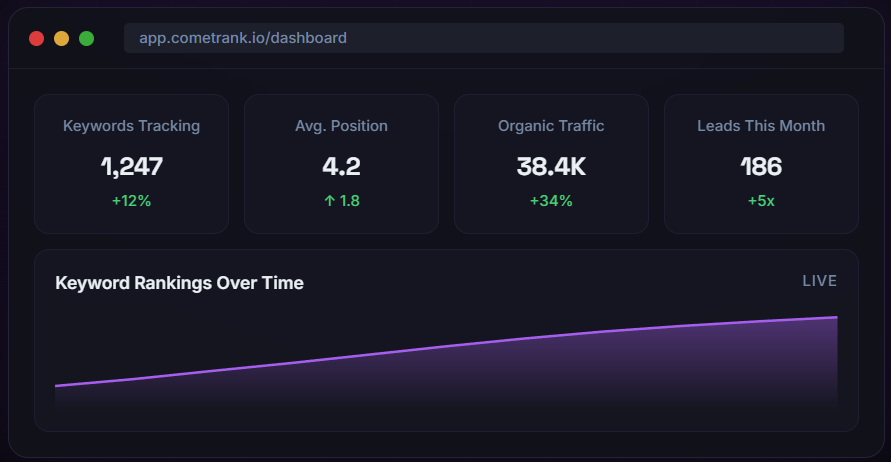
Every month, your orthopedic practice doesn’t rank on page one, 15 to 20 potential patients choose a surgeon they found on Google instead of you.
Not a better surgeon. A better-ranked one.
That gap compounds. The practices that invested in SEO 12 months ago are pulling further ahead. They have the pages, the reviews, and the local presence. Patients searching for orthopaedic care in your city find it first and stop looking.
SEO for orthopedic surgeons is how independent practices close that gap. This article covers what the top-ranking practices are doing right and what needs to change on your site.
Why Orthopedic Patients Are Already Searching for You
Patients don’t wait for a referral anymore.
A growing share of people search Google before their first GP appointment. They’re:
- comparing practices
- choosing between doctors
- and deciding before anyone refers them anywhere.
The practice that ranks gets the consultation. The one that doesn’t waits. 68% of all search clicks go to the top five positions. If you’re not on page one, you’re not in the room. This is what SEO for orthopedic surgeons solves.
The Keyword Strategy That Books Consultations for Orthopedic Surgeons
Stop Targeting “Orthopedic Surgeon Near Me”
“Orthopedic surgeon near me” is dominated by hospital networks. They have 500-page websites, decades of domain authority, and content teams publishing daily. Targeting that term as an independent practice is the wrong game.
Target Procedure-Specific and Condition-Specific Keywords
The right play is specific. Pair a procedure or condition with a city, and you enter a fight you can win.
| Keyword Type | Example | Patient Stage |
| Procedure-specific | “ACL reconstruction surgeon Dallas TX” | Decision-ready |
| Procedure-specific | “Total hip replacement surgeon Atlanta” | Comparing now |
| Condition-specific | “Knee pain specialist near me” | Early research |
| Condition-specific | “Spine surgeon for herniated disc Chicago” | Mid-funnel |
The more specific the keyword, the higher the intent and the easier it is to rank.
Condition-specific keywords capture patients earlier. Procedure-specific keywords capture them when they’re ready to book. Run both.
Other surgical specialties use this same logic. See how plastic surgeons build search pipelines for a comparable approach.
What an Orthopedic Service Page Needs to Rank
Most orthopedic sites have one “Services” page covering knee, hip, spine, and shoulder together.
Google reads that as shallow. It ranks for nothing specific.
Each procedure needs its own dedicated page. Not a paragraph inside a list but a full page.
What each procedure page must include:
- Surgeon’s fellowship training for that specific procedure
- Plain-language explanation of the technique used
- Expected recovery timeline (week-by-week is best)
- Patient outcomes or case examples without PHI
- FAQ schema targeting “People Also Ask” results
- A visible appointment booking CTA
This isn’t just content strategy. It’s conversion architecture. A patient researching “minimally invasive lumbar fusion” should land on a page that answers every question they have and ends with a clear path to book.
Poor page structure also kills conversions after the click. Healthcare landing page CRO covers what to fix on the page itself.
Local SEO for Orthopedic Surgeons: How to Rank Higher in Local Search
For most orthopedic practices, the Google Business Profile (GBP) is the first thing a patient sees before your website.
If it’s not optimised, you lose them before they click.
What most orthopedic GBPs get wrong:
- Wrong or missing specialty categories
- No procedure-specific posts or updates
- Reviews go unanswered, which signals neglect to new patients
What a competitive GBP looks like:
- Primary category: “Orthopedic Surgeon”
- Secondary categories: sports medicine, spine surgery (where relevant)
- Posts published weekly: procedure tips, recovery advice, practice updates
- Active responses to every review, positive and negative
- High-quality photos of the office, team, and facilities
Multi-location practices need a separate, fully optimised GBP per office. Don’t run one listing for three locations.
A surgeon with 60 reviews averaging 4.8 stars beats a hospital’s generic listing every time. Patients trust people, not systems.
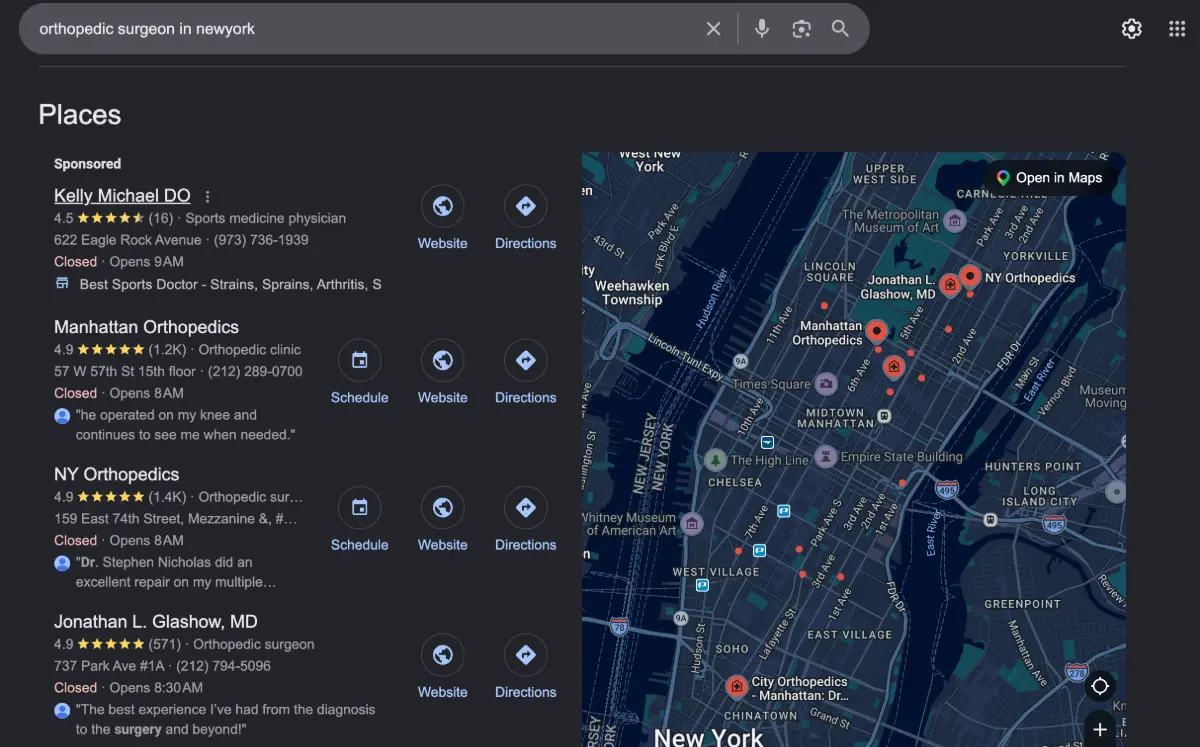
The Google Maps 3-pack for “orthopedic surgeon in New York,” three practices getting all the calls.
For a full breakdown of what moves the needle, read Google Business Profile for local SEO.
The E-E-A-T Signals That Google Requires for Medical Content
Orthopedic content falls under Google’s YMYL (Your Money or Your Life) category. That means Google scrutinises who wrote it, what their credentials are, and whether it can be trusted.
A blog post with no author name and no credentials won’t rank well against content written by named medical professionals.
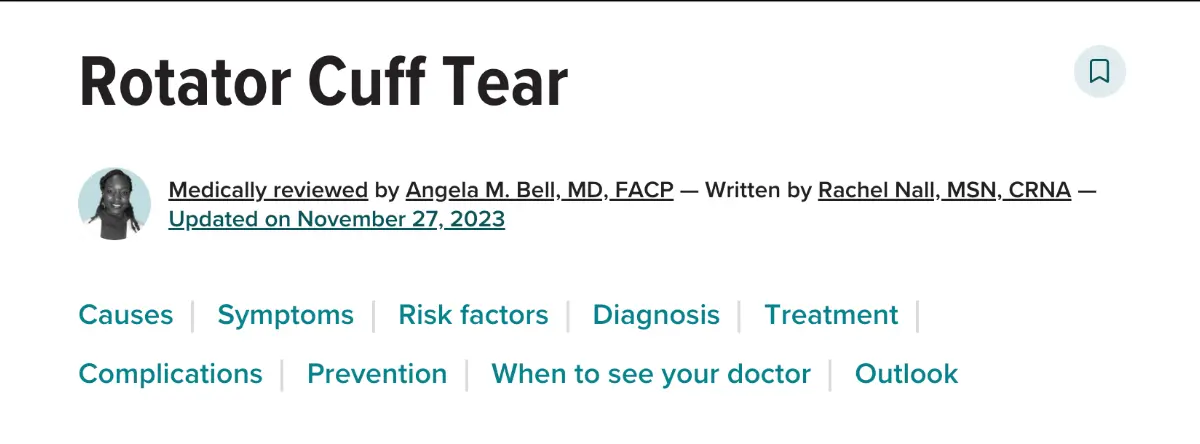
An example of E-E-A-T done right, credentials front and center before the reader even starts.
What Google looks for in orthopedic content:
- Named author with board certification or clinical credentials visible
- “Medically Reviewed By Dr. [Name], [Specialty]” byline on procedure pages
- Publish date and last-updated date on all content
- Links out to credible sources (AAOS, PubMed, clinical guidelines)
- Evidence of real patient outcomes: case examples without PHI
This isn’t optional for healthcare. It’s the baseline Google expects.
If your content is generic and anonymous, it won’t outrank content written by credentialed surgeons. The signal gap is too wide.
Local SEO for medical professionals covers how to build these authority signals across your full web presence.
On-Page and Technical SEO for Orthopedic Surgeons: What Your Site Structure Must Get Right
1/ On-Page Basics
Every page on your site needs:
- A keyword-specific title tag (not just “Services” but “ACL Reconstruction Surgeon | [City]”)
- A meta description with a clear reason to click
- An H1 that matches the page’s primary procedure or condition keyword
- Internal links connecting symptom pages to treatment pages to surgeon bios
Clean URL structure matters too. For example “ /knee-replacement-surgery” outperforms “/page123” for both Google and patients.
2/ Technical SEO That Affects Ranking
This is the layer most orthopedic practice sites ignore.
What to check and fix:
- Page speed: Slow pages lose rankings and patients. Compress all images. Remove unused scripts.
- Mobile performance: Patients search on phones. If your site is hard to navigate on mobile, it bounces.
- Core Web Vitals: Google measures loading speed, interactivity, and visual stability. Poor scores hurt rankings.
- HTTPS across all pages: Any page collecting patient information must be secure.
- Schema markup: Use MedicalOrganization, IndividualPhysician, MedicalCondition, MedicalProcedure, and LocalBusiness schema types. This helps Google understand your site and improves your eligibility for AI-generated search summaries.
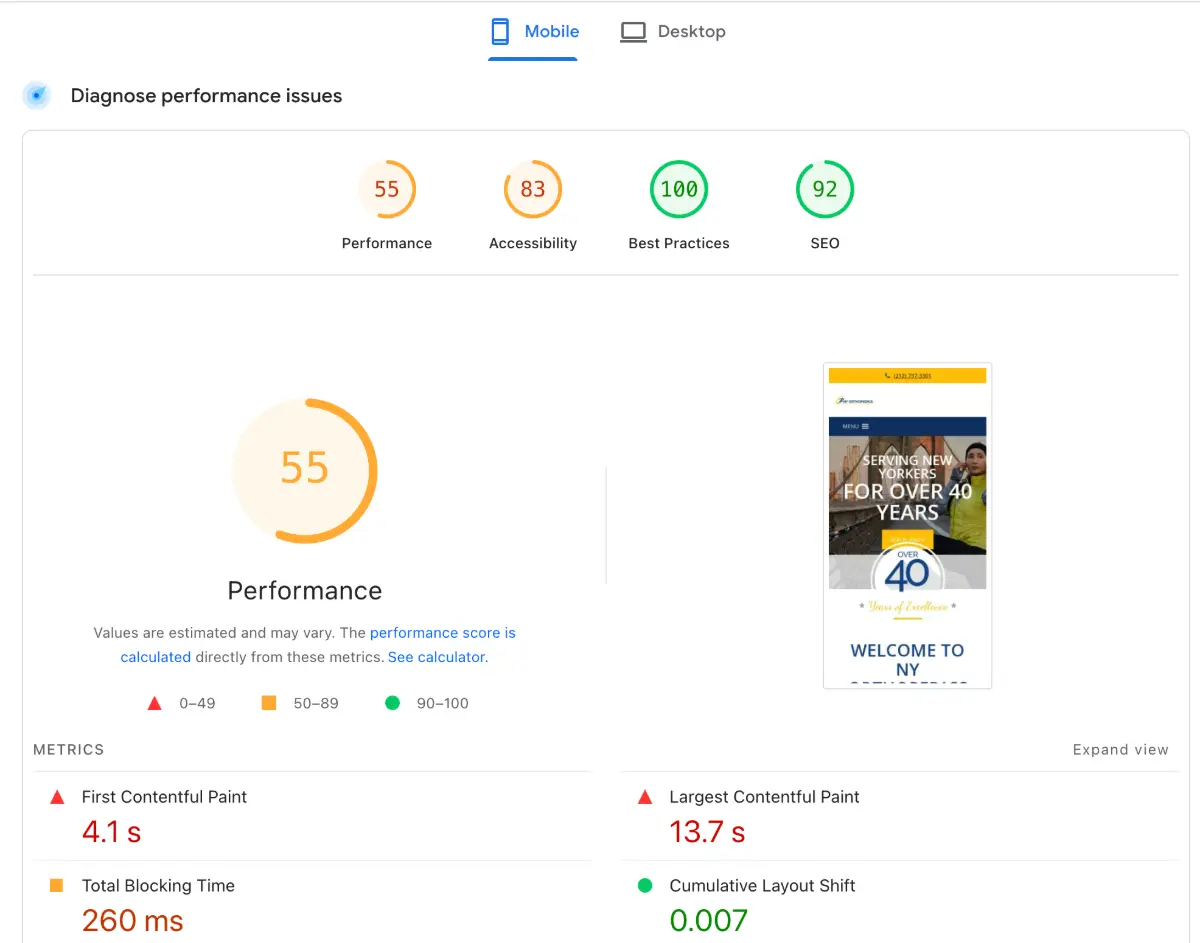
A 55 mobile performance score is costing this orthopedic practice rankings and patients.
HIPAA adds another compliance layer to how your site collects and handles patient data. HIPAA-compliant SEO strategy covers what that means in practice.
NAP Consistency, Directories, and Local Authority
Google uses your name, address, and phone number (NAP) across the web to confirm your practice is legitimate and localised.
If your NAP is inconsistent, “Suite 102” on your website but “Ste. 102” on Healthgrades, that dilutes your local authority. It’s a small thing that adds up across dozens of listings.
Healthcare directories where your NAP must match exactly:
- Healthgrades
- Vitals
- Zocdoc
- WebMD Physician Finder
- Doximity
Insurance directories where your listing must also be accurate:
- Blue Cross Blue Shield Provider Finder
- Aetna Provider Directory
- Cigna Healthcare Provider Directory
Getting listed and keeping NAP consistent across all of these tells Google you are a real, active, localised practice and not a dormant listing.
Off-Page SEO for Orthopedic Surgeons: Building Authority Outside Your Website
Rankings aren’t just about what’s on your site. Backlinks, meaning other sites linking to yours, tell Google your practice is trusted.
For orthopedic doctors, the best backlinks come from:
- Healthcare directories (Healthgrades, Zocdoc, AAOS member listings)
- Local community partnerships (sponsoring sports teams, co-hosting injury-prevention workshops with physios)
- Medical publications and journals citing your outcomes data
- Local news coverage of new procedures, research, or community events
- Podcast appearances, where being featured as a guest generates links from show notes
You don’t need 500 backlinks. You need authoritative ones from sources that make sense for a surgical practice.
If you’re weighing SEO against paid channels, Google Ads vs SEO for doctors breaks down the ROI comparison for medical practices.
How CometRank Handles SEO for Orthopedic Surgeons
Executing orthopedic SEO properly requires building dedicated procedure pages for every subspecialty, maintaining GBP profiles across multiple locations, running a local citation strategy, and publishing condition-specific content simultaneously. Most practices don’t have the bandwidth to do this in-house, and most agencies move too slowly to make a meaningful dent.
We’re an AI SEO agency that runs this entire workflow for clients using CometRank, our proprietary SEO software. CometRank runs six AI agents across intent mapping, content creation at scale, on-page optimization, local citation management, and authority building. A human SEO captain reviews everything before it goes live. If you’re looking for an AI SEO agency for healthcare services, this is what the execution actually looks like at scale.
To see how CometRank handles this for your practice, book a demo and we’ll map out your full search opportunity before the call ends.
Conclusion
The referral model still works. But it doesn’t explain why the practice across town is booking patients who never spoke to a GP in your network.
Those patients searched Google. They found a surgeon who had the right pages, the right reviews, and the right local presence.
SEO for orthopedic doctors isn’t about chasing traffic. It’s about being visible when that patient is already deciding between surgeons and making sure the answer is you.
Build the pages. Optimise the profile. Fix the technical foundation. The consultations follow.
SEO for Orthopedic Surgeons: Frequently Asked Questions
How long does SEO take to show results for an orthopedic practice?
Most practices see meaningful improvement in 3 to 6 months for procedure-specific and location-specific keywords. Broader terms take longer. Domain authority, existing content volume, and local competition all affect the timeline.
Should you target “orthopedic surgeon near me” or procedure-specific keywords?
Start with procedure-specific and location-specific keywords. “ACL reconstruction surgeon Dallas TX” has clearer intent and less competition than a broad near-me term. Once those pages build authority, broader terms become achievable.
Does every surgical procedure need its own page?
Yes. A single services page covering knee, hip, spine, and shoulder gives Google no signal about your depth in any one area. Each procedure needs dedicated content, credentials, outcomes data, and FAQ schema.
How do independent practices compete with hospital networks in search?
Not by matching their volume. You win by going specific where hospitals stay generic. A page targeting “minimally invasive lumbar fusion Charlotte NC” with fellowship credentials will outrank a hospital’s generic spine page for that exact search.
What schema markup does an orthopedic site need?
At minimum: MedicalOrganization for the homepage, IndividualPhysician for surgeon bios, MedicalCondition for condition pages, MedicalProcedure for treatment pages, and LocalBusiness for each office location.
What makes healthcare SEO different from general SEO?
Healthcare SEO operates under Google’s YMYL standards. Medical pages require credentialed authorship, factual accuracy, and strong E-E-A-T signals. HIPAA also constrains how patient data can be used in tracking and retargeting. A general SEO approach misses all three.