Most B2B teams have too many SEO tools.
They’re subscribed to platforms they barely open and pulling reports nobody reads. The problem isn’t access to data. It’s that most tools were built for traffic, not for leads.
B2B search is different:
- Lower search volumes per keyword
- Longer buying cycles with multiple decision-makers
- Higher revenue per converted lead
The right SEO tools for B2B find those high-intent searches, fix what’s hiding them, and connect rankings to revenue. Here are the 10 seo tools worth using in 2026.
The 10 Best SEO Tools for B2B Businesses in 2026
Here’s the full list at a glance before we break each one down.
| # | Tool | Primary Use | Pricing |
| 1 | Google Search Console | Performance tracking | Free |
| 2 | Google Analytics 4 | Revenue attribution | Free |
| 3 | Semrush | All-in-one SEO platform | From $139.95/mo |
| 4 | Screaming Frog | Technical site crawl | Free up to 500 URLs; £199/yr paid |
| 5 | Ahrefs | Backlinks + keyword research | From $99/mo |
| 6 | Surfer SEO | Content optimisation | From $79/mo (annual) |
| 7 | Moz Pro | Site audits + DA tracking | From $49/mo |
| 8 | SE Ranking | Affordable all-in-one | From $65/mo |
| 9 | SparkToro | Audience intelligence | Free tier; paid from $50/mo |
| 10 | CometRank | AI-powered B2B lead generation SEO | From $799/mo |
1. Google Search Console
The only tool that shows you exactly what Google sees on your site. Free, and it should be the first thing you set up before spending a dollar on anything else.
What GSC tells B2B teams:
- Which queries are generating impressions
- Which pages have indexing errors
- Where your site sits for high-intent keywords
No third-party estimates. Direct from Google.
Best for: Every B2B business, regardless of size or budget.
2. Google Analytics 4
Rankings mean nothing if you can’t connect them to the pipeline.
Set up properly, GA4 shows you which organic pages generate form fills, demo requests, and contact submissions. Most B2B teams underuse it because the default setup tracks pageviews, not conversions. Fix the setup first.
Best for: Connecting SEO activity to business outcomes.
Pricing: Free.
3. Semrush
The most complete seo tool for b2b teams that need one platform for keyword research, site audits, competitor tracking, and reporting.
Its Position Tracking monitors thousands of keywords at once. The Keyword Magic Tool surfaces long-tail B2B searches with buyer intent tags. That’s the difference between targeting “CRM software” (research intent) and “CRM software for manufacturing companies” (buying intent). The keyword research comparison breaks down how Semrush stacks up on that front.
Best for: B2B teams that need all-in-one research, auditing, and reporting.
Pricing: Pro at $139.95/mo; Guru at $249.95/mo.
4. Screaming Frog
Technical issues are silent lead killers.
Here are common B2B site issues Screaming Frog catches:
- Duplicate service pages and thin content
- Missing canonical tags on location pages
- Broken internal links across content hubs
- Crawl errors are blocking high-intent pages
For B2B sites with multiple service pages or a content hub, a quarterly crawl is non-negotiable. The paid licence covers unlimited URLs at approximately $250/year. That’s cheaper than one month of most SEO tools.
Best for: B2B sites with 100+ pages or a complex internal structure.
Pricing: Free up to 500 URLs; £199/year paid.
5. Ahrefs
If Semrush is the best all-in-one, Ahrefs wins on backlink depth and content gap analysis.
Its 35 trillion external backlinks index is the most trusted in the industry. The Content Gap tool is where the real B2B value sits: enter your domain and your top three competitors, and Ahrefs surfaces every keyword they rank for that you don’t. In B2B, those gaps are usually high-intent, low-volume searches no one on your team thought to target.
Best for: B2B teams focused on content gap analysis and building domain authority.
Pricing: Lite at $99/mo; Standard at $199/mo.
6. Surfer SEO
Publishing content that doesn’t rank isn’t a content problem. It’s usually a structural problem.
Surfer SEO scores your page in real time against the top-ranking pages for your target keyword. It uses NLP analysis to identify which terms, headings, and structural patterns correlate with first-page performance.
For B2B content teams writing case studies, comparison pages, and service landing pages, Surfer ensures every piece is built to rank before it goes live, not revised three months later.
Best for: B2B content teams who want a scoring system before publishing.
Pricing: Essential at $99/mo; $79/mo on annual billing.
7. Moz Pro
Moz invented Domain Authority. That matters because it’s the metric most B2B leadership teams recognise when you report on SEO progress.
Beyond DA, Moz Pro runs reliable site audits, tracks keyword rankings, and surfaces on-page optimisation recommendations. It’s not the most powerful tool on this list, but it communicates SEO value in a language non-technical stakeholders understand.
Best for: B2B teams that report to leadership using DA as a benchmark.
Pricing: Starter at $49/mo; Standard at $99/mo.
8. SE Ranking
SE Ranking gives you roughly 80% of Semrush’s functionality at about half the price.
The standout feature in 2026: the AI Overview Tracker, included in every plan at no extra cost. It monitors how your brand appears in Google’s generative search results. Semrush charges extra for this. SE Ranking doesn’t.
If you’re weighing white-label vs AI tools, SE Ranking sits in an interesting middle ground.
Best for: Lean B2B teams that need solid data without the enterprise price tag.
Pricing: From $65/mo; white-label reporting on all plans.
9. SparkToro
Most keyword tools tell you what B2B buyers search for. SparkToro tells you where they spend their time.
What SparkToro surfaces:
- Which newsletters do B2B buyers read
- Which podcasts do they listen to
- Which LinkedIn influencers do they follow
A keyword with 90 monthly searches but high commercial intent from a niche procurement audience can be worth more than one with 9,000 searches from general researchers. Pairing SparkToro with Semrush or Ahrefs is where the real value kicks in. Once your research workflow is set, the SEO tasks to automate guide is the natural next step.
Best for: B2B teams building content strategy around actual buyer behaviour.
Pricing: Free tier; paid from $50/mo.
10. CometRank
Every other tool on this list shows you data. CometRank does the work.
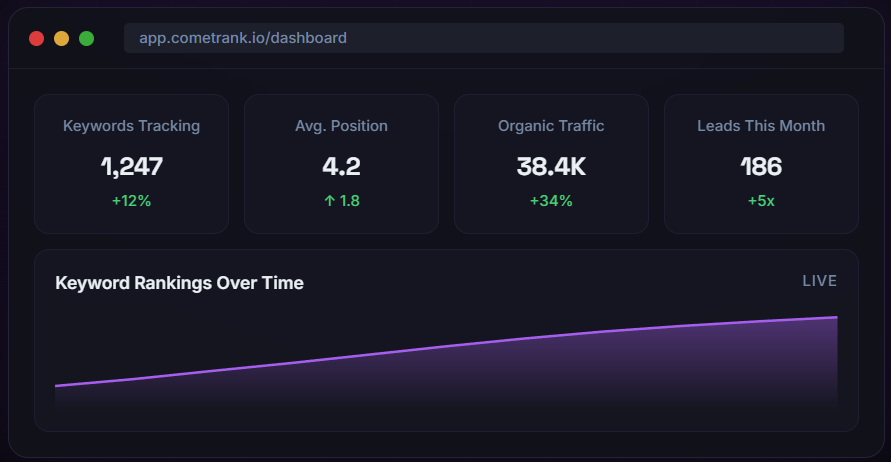
CometRank is an AI SEO lead generation platform built specifically for B2B businesses. It maps buyer intent and creates content at scale. It builds backlinks from sources that ChatGPT and Perplexity actually cite.
Where most B2B teams get stuck is execution. The research is done. The gaps are identified. But who builds the 150 pages those insights call for? That’s the gap CometRank fills, targeting in 3 months what a traditional SEO agency delivers in 12.
Best for: B2B businesses that want SEO to generate leads, not just rankings.
Pricing: From $799/mo. Traditional agencies charge $3,000 to $5,000/mo for fewer results.
Why Most B2B Teams Get SEO Tools Wrong
Most B2B teams own too many tools and use too few consistently. The typical mistake is buying overlapping platforms instead of covering distinct gaps. Three to four tools used well outperform ten used sporadically.
Here’s how to match the tool to the problem.
| Problem | Tool to use |
| Don’t know what’s ranking or indexing | Google Search Console |
| Can’t connect SEO to leads or revenue | Google Analytics 4 |
| Need keyword research and competitor data | Semrush or Ahrefs |
| Technical site issues are hurting rankings | Screaming Frog |
| Content not performing despite good topics | Surfer SEO |
| Need to show SEO ROI to leadership | Moz Pro |
| Budget is limited, but we need solid data | SE Ranking |
| Don’t know where B2B buyers actually look | SparkToro |
| Need execution at scale, not just insights | CometRank |
Most B2B teams need three to four of these tools working together. Not all ten. Not one.
How CometRank Handles the Execution Gap
Knowing which seo tools for b2b to use is the easy part. Executing consistently across keyword research, content creation, technical fixes, and link building is where most B2B teams fall short.
CometRank runs six AI agents covering every part of that workflow:
- Analyst maps competitor gaps
- Strategist builds the keyword roadmap
- Creator publishes landing pages and articles at scale
- Authority Builder targets backlinks from sources AI search engines actually trust
- Human SEO Captain reviews everything before it goes live
The result is a lead generation system, not just a rankings dashboard. If you want to see what that looks like for a B2B tech company, the breakdown is worth a look. Book a demo to see CometRank in action.
Conclusion
The right seo tools for b2b aren’t the ones that generate the most reports. They’re the ones that feed a system that generates leads.
Start with the free tools. Add technical and keyword research tools based on your biggest gap. Then ask yourself whether you have the bandwidth to execute what those tools are telling you.
If not, the answer isn’t more tools.
SEO Tools for B2B: Frequently Asked Questions
1. Do B2B companies need different SEO tools than B2C?
Yes. B2B targets lower-volume, higher-intent keywords with longer buying cycles. Tools like SparkToro and Ahrefs serve B2B better than high-volume traffic tools, though fundamentals like GSC and Semrush overlap.
2. How many SEO tools does a B2B team actually need?
Three to four, used consistently. A strong stack covers a free baseline (GSC + GA4), a research platform (Semrush or Ahrefs), a technical crawler (Screaming Frog), and a content optimiser (Surfer SEO).
3. Is Semrush or Ahrefs better for B2B?
Semrush wins for all-in-one reporting and content marketing. Ahrefs wins for backlink depth and content gap analysis. Most B2B teams use both eventually. Start with Semrush, then add Ahrefs.
4. What’s the most important free SEO tool for B2B?
Google Search Console. It shows what Google actually sees: indexing errors, query impressions, and page performance. No third-party tool replicates this because the data comes directly from Google.
5. Can an AI SEO platform like CometRank replace individual tools like Semrush?
Not entirely. Semrush and Ahrefs are research tools. CometRank is an execution platform. They solve different problems, though CometRank pulls data from multiple sources to run the full workflow.