
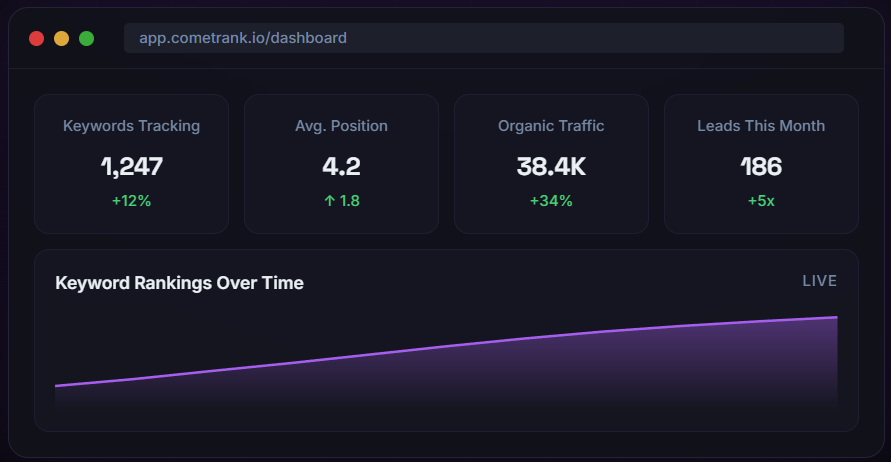
Most SEO teams spend too much time on repetitive tasks: keyword clustering, content briefs, internal linking, and rank monitoring.
These activities are essential—but they don’t require constant manual effort.
Modern SEO systems automate repeatable workflows so teams can focus on strategy, positioning, and revenue impact. Companies working with an AI SEO Company are increasingly shifting toward automation-first SEO operations, where discovery, planning, publishing, and optimization run continuously in the background.
Below are nine SEO tasks that should already be running on autopilot.
1. Continuous Keyword Opportunity Discovery
Search demand changes constantly. New queries appear, competitors launch pages, and ranking gaps emerge.
Manually discovering these opportunities every quarter is slow and reactive.
Instead, opportunity discovery should run continuously. Systems similar to how The Analyst works identify ranking gaps by analyzing search demand, competitor coverage, and topic clusters.
Example Implementation
If competitors rank for:
- “industrial water treatment equipment manufacturer in the USA”
Your SEO system should automatically surface related expansion queries such as:
- “industrial wastewater filtration system manufacturer”
- “chemical dosing equipment for water treatment plants”
- “industrial reverse osmosis systems supplier”
This allows you to build topic clusters instead of isolated pages.
2. Intent-Based Keyword Clustering
Keyword lists without intent mapping create scattered content.
Automation should group queries by search intent and buying stage, similar to how The Strategist structures search opportunities into actionable roadmaps.
Example
Cluster these queries together:
Commercial intent cluster:
- “precision CNC machining supplier for aerospace components”
- “CNC machining aerospace parts manufacturer”
- “aerospace aluminum machining services”
Recommended page:
Service landing page targeting:
“precision CNC machining supplier for aerospace components”
Page structure:
- Materials machined
- Tolerance capabilities
- Aerospace certifications
- Component examples
- Request a quote
3. Automated SEO Content Brief Creation
Content production slows down when writers wait for manual briefs.
Automated systems can generate structured briefs based on ranking data and competitor coverage.
This is similar to how The Creator prepares content structures before writing begins.
Example
Target keyword:
“Tesla charger installation electrician in Los Angeles CA”
Content brief sections:
- Tesla charger installation requirements
- Level 2 charger compatibility
- Electrical panel upgrade needs
- Installation timeline
- Cost breakdown
- Permits in Los Angeles
Writers should receive clear page structures automatically, reducing delays.
4. Programmatic Page Generation for Scalable SEO
Many industries require hundreds of pages to fully cover search demand.
Examples include:
- location pages
- industry pages
- service combinations
However, poor implementation leads to thin pages and ranking failures. Businesses often repeat the same issues outlined in Programmatic SEO Mistakes where pages are generated without unique value or intent alignment.
Example
Create scalable pages for:
“electric panel upgrade electrician in [city]”
Cities:
- Miami FL
- Tampa FL
- Orlando FL
Each page should include:
- Local electrical code requirements
- Permit information
- Panel capacity options
- Local service availability
- CTA for estimates
Automation should generate page frameworks, not duplicate content.
5. Internal Linking Optimization
Internal links influence crawl depth, topical authority, and ranking strength.
Yet many websites update links manually.
Automated optimization systems similar to The Optimizer continuously analyze:
- orphan pages
- anchor text gaps
- topical clusters
Example
If you publish an article targeting:
“industrial wastewater treatment equipment supplier”
The system should automatically create contextual links from related pages such as:
- “chemical dosing systems for industrial water treatment”
- “reverse osmosis filtration systems for manufacturing plants”
This strengthens topical authority.
6. Authority Building and Link Acquisition
Backlinks remain one of the strongest ranking signals.
But outreach campaigns often stall due to manual execution.
Automation-assisted systems like Authority Builder identify link opportunities through:
- industry directories
- partnership mentions
- supplier listings
- industry publications
Example
For a manufacturing company targeting:
“medical device injection molding company with ISO certification”
Authority signals could include:
- ISO certification directories
- medical device supplier databases
- manufacturing industry publications
Automating discovery speeds up authority growth.
7. SEO Quality Monitoring
Publishing content is only half the job. Maintaining quality across hundreds of pages is difficult without automation.
Systems similar to Quality Guardian continuously check:
- factual accuracy
- structural consistency
- outdated statistics
- missing schema or headings
This prevents content decay over time.
8. SEO Performance Monitoring and Ranking Alerts
Waiting for monthly reports hides ranking opportunities.
Instead, SEO monitoring should run daily.
Automation should detect:
- sudden ranking drops
- new competitors entering SERPs
- pages approaching page-one positions
Example
If a page ranks #11 for:
“industrial water treatment equipment manufacturer in the USA”
The system should trigger an optimization action:
- expand FAQ section
- improve internal links
- add case studies
Small improvements can push the page into top results.
9. SEO Checklists and Technical Hygiene
Many websites lose rankings due to simple technical oversights.
New pages launch without optimized titles, schema, or internal links.
Frameworks like those described in the SEO checklist for new website help standardize launch processes so every page meets SEO requirements from day one.
These checklists prevent common issues similar to the mistakes small business owners make when using seo such as missing metadata or weak page structure.
Why Automation Is Becoming the Default SEO Model
SEO is no longer just about publishing blog posts.
Winning search visibility requires:
- continuous opportunity discovery
- scalable content production
- automated internal linking
- ongoing optimization
That’s why many companies now operate with AI-driven SEO systems instead of manual workflows.
An experienced AI SEO Company combines automation with strategic oversight to run these processes continuously, allowing teams to focus on strategy, positioning, and conversion optimization instead of repetitive tasks.
The Strategic Takeaway
SEO growth comes from coverage, consistency, and compounding improvements.
Automation ensures that:
- opportunities are discovered faster
- pages are published at scale
- rankings are optimized continuously
The companies winning search today aren’t just doing SEO—they’re building automated SEO systems that operate every day.