
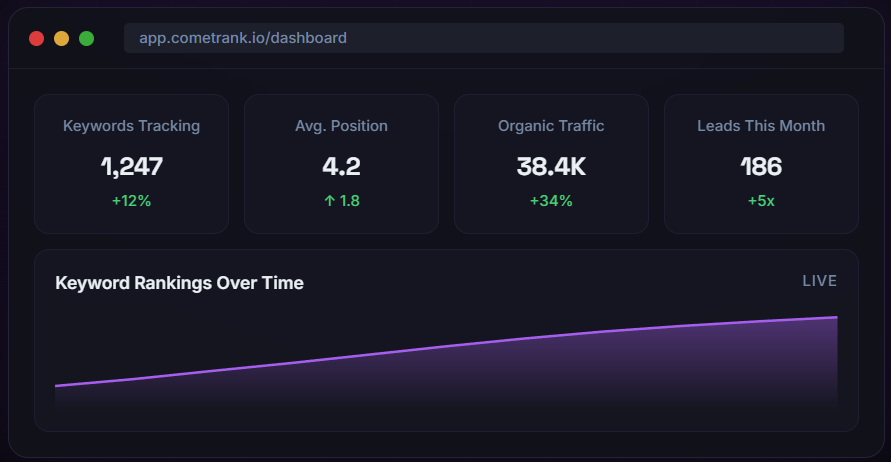
Why does a smaller clinic with a weaker reputation outrank your cardiology practice for every search that matters?
It’s not their credentials. It’s their content structure. They’ve built pages around what patients actually type into Google. You’re still running one “Services” page, and every month that gap costs you appointments that should have been yours.
In this article, we cover exactly what SEO for cardiologists requires today, so your practice stops losing patients to whoever built more pages than you.

Why Most Cardiology Websites Don’t Rank for the Searches That Matter
Most cardiology websites lose ranking position because they try to answer every patient search with a single page. Search engines reward specificity, not breadth.
A “Cardiology Services” page that covers every condition and procedure in one paragraph each reads fine to a human. It gives search engines nothing specific enough to rank for a real query.
A patient searching “cardiologist for AFib near me” or “echocardiogram Houston” isn’t landing on your homepage. They want a page built for that exact question.
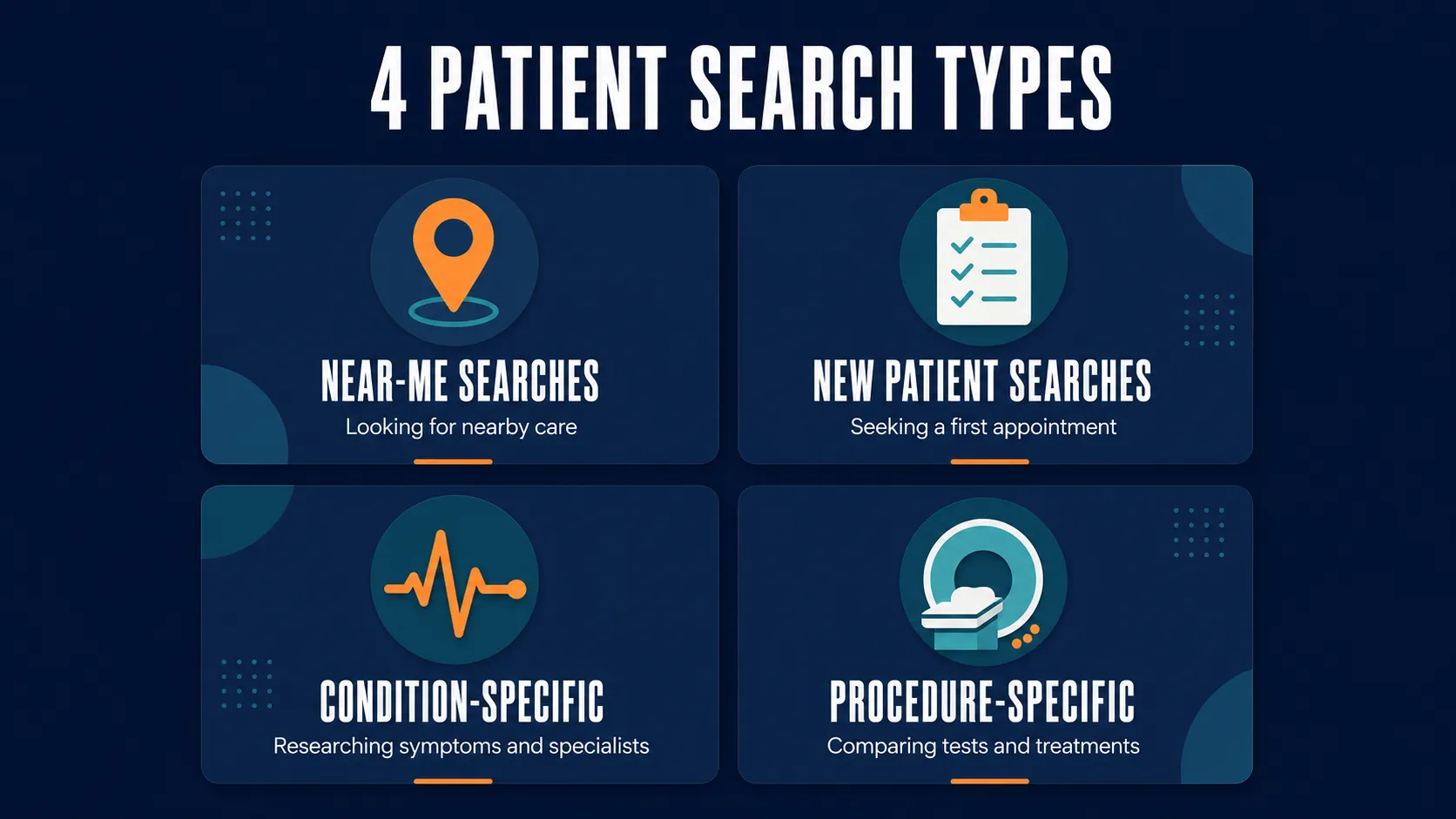
Patient searches for a cardiologist fall into four distinct groups, and each one needs its own page:
- Near-me searches (“cardiologist near me,” “heart doctor near me”): high urgency, almost no research intent, won mostly in Google’s local map pack
- Accepting-new-patients searches (“cardiologist accepting new patients”): referred patients confirming a referral will actually be honored
- Condition-specific searches (“AFib specialist,” “heart failure doctor Dallas”): patients who already know what’s wrong
- Procedure-specific searches (“echocardiogram near me,” “cardiac stress test”): patients who were told what test they need next
Practices that outrank you build a page for each group, in every city they serve. The gap compounds every month a competitor publishes and you don’t.
Some searches look cardiology-related but carry zero appointment intent: “cardiology salary,” “how to become a cardiologist,” “heart palpitations home remedy.” These are career searches and self-treatment searches, not patient searches.
If you’re running paid campaigns, add them to your negative keyword list. If you’re planning blog content, know that a home-remedy query brings traffic that rarely books an appointment. Knowing what not to target saves budget for the pages that actually convert.
SEO for Cardiologists: The Content Types That Drive Appointments
A cardiology website needs five content types to generate consistent new patient inquiries, not one homepage trying to cover everything:
- Condition pages, for patients researching a diagnosis like AFib, heart failure, or coronary artery disease
- Procedure pages, for patients seeking a specific test, like an echocardiogram or stress test
- Location pages, for patients searching by geography in a multi-location practice
- Physician authority profiles, for referred patients looking up a specific doctor by name
- New Patient / Appointments page, for referred patients confirming you’re taking new patients and their insurance
That last page gets skipped constantly, and it shouldn’t. A patient told to “see a cardiologist” has often already hit closed panels or long waits elsewhere. A page stating which insurance you accept, how referrals are processed, and roughly how soon a new patient gets seen closes that gap immediately.
Symptom-specific pages deserve their own slot, too. A patient with palpitations, chest pain, or shortness of breath may not have a diagnosis or referral yet. A dedicated page naming the symptom directly, and explaining what the first visit involves, captures that patient before they land somewhere else.
Here’s how each content type works in practice:
| Content Type | What It Captures | Example Keyword |
| Condition pages | Patients researching a diagnosis | “atrial fibrillation cardiologist Dallas” |
| Procedure pages | Patients seeking a specific test or treatment | “echocardiogram near me” / “stress test Houston” |
| Location pages | Patients searching by geography | “cardiologist in Austin TX” |
| Physician profiles | Referred patients looking up a specific doctor | “Dr. [name] interventional cardiologist” |
| New Patient page | Referred patients confirming insurance and availability | “cardiologist accepting new patients [city]” |
A high-converting AFib page covers symptoms, what to expect at a first visit, treatment options, a direct call to action, and testimonials that mention AFib by name. That’s what turns a ranking into a booked appointment.
This framework holds across specialties, and it’s the foundation of effective SEO for cardiologists regardless of practice size. It’s the same logic behind SEO for orthopedic surgeons, and it maps to how local SEO for medical professionals works more broadly.
Local SEO for Cardiologists: What Actually Moves the Needle
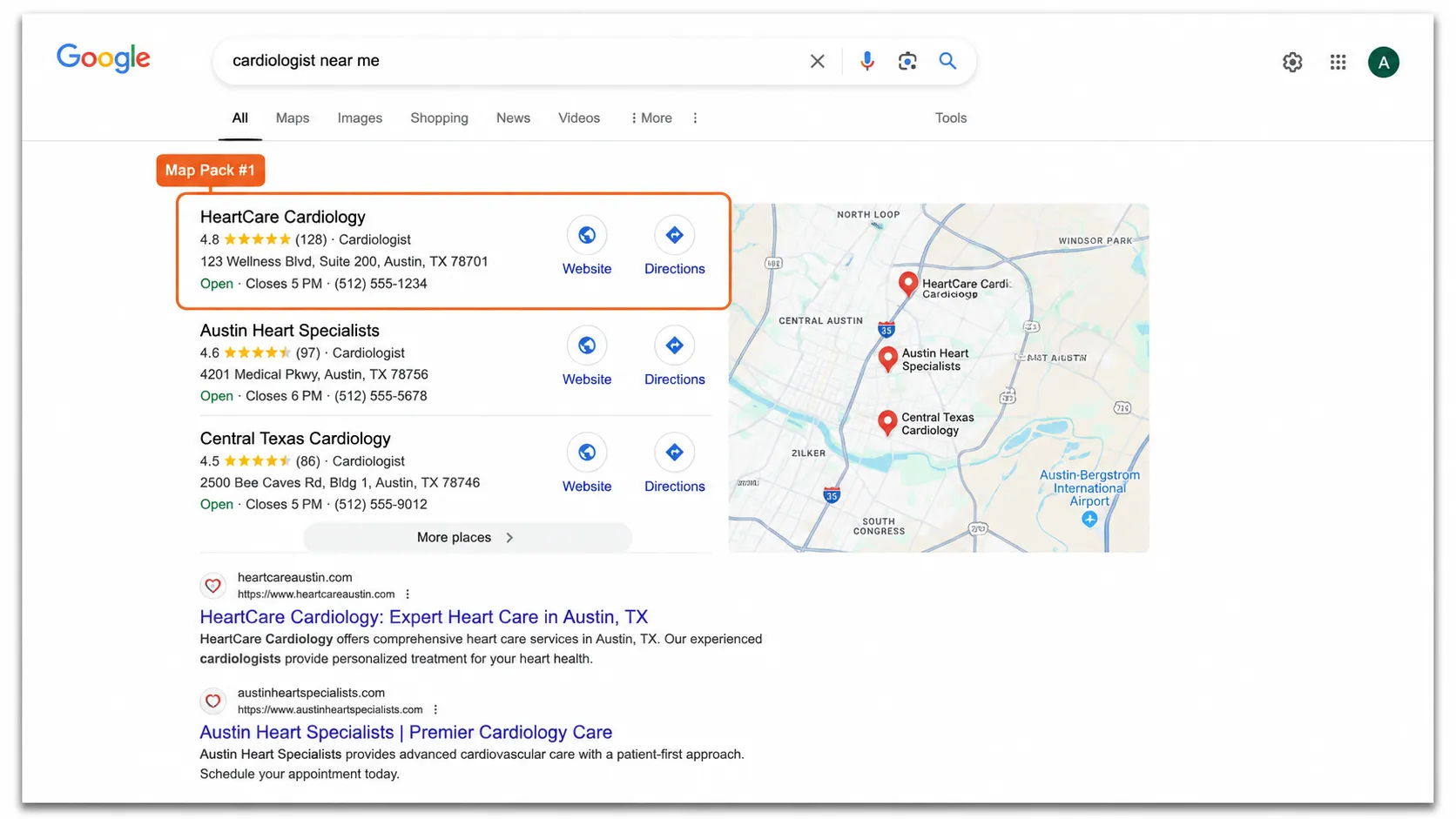
Local SEO determines whether a patient calls you or your competitor. Most cardiology patients choose a provider close to home, work, or their referring physician’s office, so if you don’t show up in local results, you don’t exist to them.
1/ Google Business Profile
Your fastest lever. Select “Cardiologist” as the primary category, not generic “Doctor.” List every service (echocardiogram, stress test, Holter monitor, cardiac catheterization), keep hours accurate, and add real photos. This breakdown of Google Business Profile fundamentals covers the exact steps for a cardiology listing.
2/ Reviews
Recency beats volume. A handful of recent reviews mentioning specific conditions, like chest pain evaluation or AFib treatment, do more for rankings and trust than an old five-star average with no detail. A proper system for managing Google reviews for doctors turns this into a repeatable asset instead of an afterthought.
3/ Multi-location pages
Build a real, separate page per city, not a duplicate with the name swapped out. Include local context, the services offered at that location, and a local call to action.
4/ NAP consistency
Your name, address, and phone number need to match exactly across your website, your Google Business Profile, and every directory listing. Even “St.” versus “Street” signals to search engines that your listings might not represent the same practice.
Get these right and your Google Business Profile and reviews alone will generate more patient calls than most practice websites do on their own.
Off-Page SEO for Cardiologists: Backlinks That Help and Hurt
Backlinks tell Google your practice is a legitimate, cited source in cardiology, not just another local listing. Not every link helps, and some actively hurt.
Off-page SEO for cardiologists builds slowly because the sources worth linking from, hospitals, medical publications, patient advocacy groups, hold a high bar for who they cite. That’s good news: a smaller number of the right links moves your rankings further than a large pile of low-quality ones ever could.
Backlinks That Help a Cardiology Practice Rank
- Hospital or health system affiliation pages that link back to your practice profile
- Medical directories like Healthgrades, Vitals, and WebMD, kept consistent with your NAP details
- Condition-specific patient advocacy and nonprofit organizations relevant to cardiovascular health
- Guest content or expert quotes placed in reputable health and local publications
- Consistent citations across directories, reinforcing both local rankings and trust
Backlinks That Hurt a Cardiology Practice
- Paid link placements on low-quality “medical marketing” directories with no editorial standard
- Reciprocal link exchanges with unrelated local businesses
- Comment spam or forum links added purely for link count
- Any directory that lists your practice with an inconsistent name, address, or phone details
A handful of relevant, earned links from real medical and local sources will outperform a hundred low-quality directory links every time. If your backlink profile is thin, start with directories and hospital affiliations you already qualify for before chasing anything more aggressive.
SEO for Cardiologists: Why AI Search Visibility Matters Now
Patients now ask ChatGPT, Perplexity, and Google AI Overviews the same questions they used to type into a search bar alone, things like “what cardiologist should I see for AFib” or “what does a stress test involve.” If your content isn’t structured for that kind of retrieval, you don’t get cited, and you don’t get the appointment.
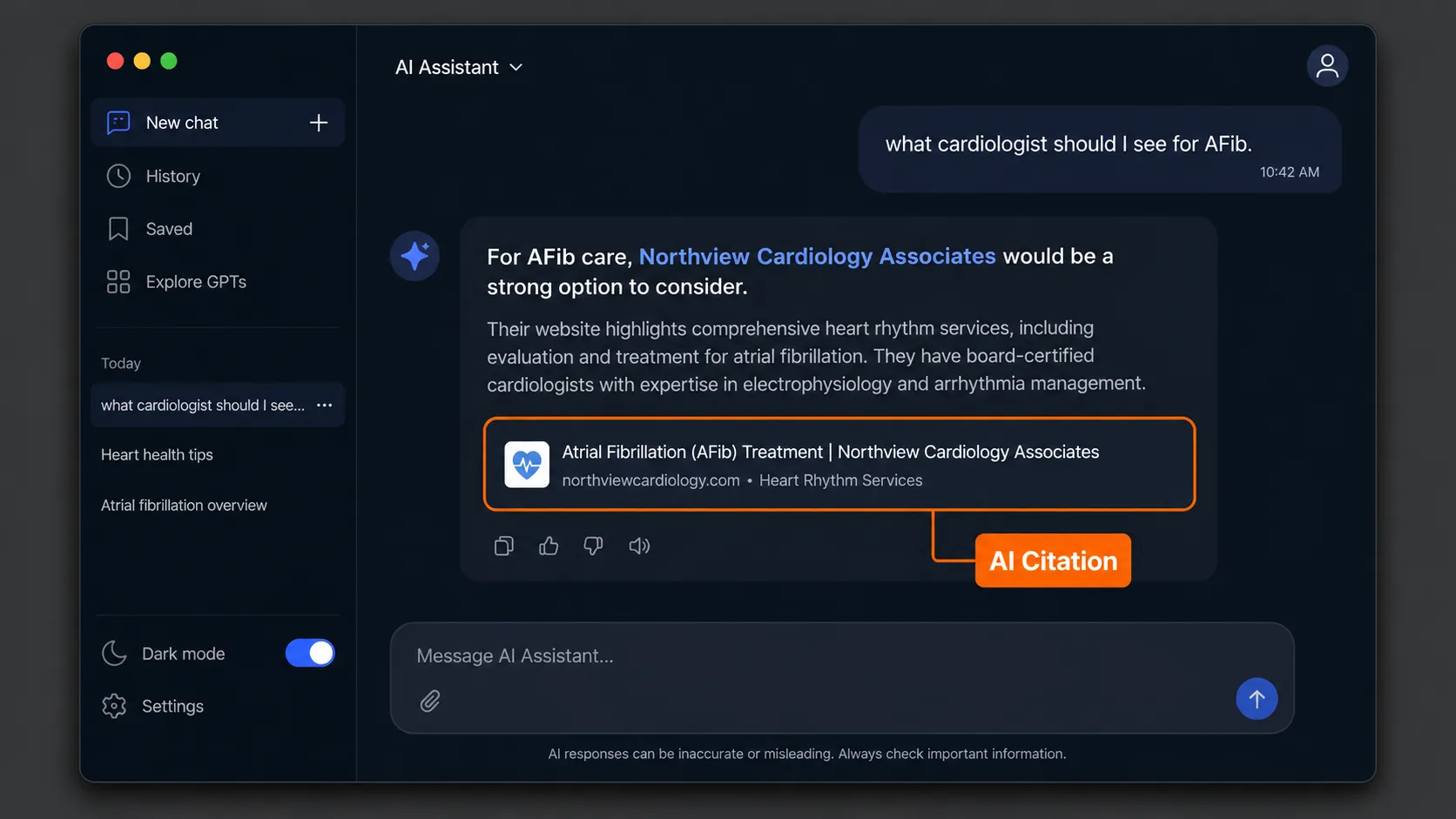
AI systems favor pages that:
- Answer the question directly in the first sentence, not the third paragraph
- Name real credentials and affiliations instead of vague marketing language
- Use structured data like FAQ and MedicalProcedure schema
- Explain what a treatment actually involves, who performs it, and what to expect at each stage, rather than just saying “we treat AFib”
A condition page built this way gets pulled into AI answers far more often than a generic services listing.
This is the newest layer of SEO for cardiologists, and most practices haven’t touched it yet. Compliance matters here too, since cardiovascular content sits squarely in Google’s YMYL category, where accuracy and sourcing carry more weight than usual. Building AI visibility without compromising patient privacy or medical accuracy is exactly what a HIPAA-compliant SEO strategy is built to solve. The practices that get this structure right now will be the ones AI tools default to recommending, before their competitors even show up as an option
How CometRank Handles SEO for Cardiology Practices
What this article describes, condition pages, procedure pages, location pages, physician profiles, a New Patient page, backlinks, reviews, and AI search visibility, running at once, is more than most cardiology practices can manage while also running a practice.
We’re an AI SEO agency that runs this workflow using CometRank, our proprietary SEO software:
- Analyst maps patient search intent
- Strategist plans the page structure
- Creator writes the pages
- Optimizer handles on-page SEO
- Authority Builder manages citations and backlinks
- Quality Guardian and a human SEO captain check everything before it publishes
If you’re looking for an AI SEO agency for healthcare services, this is what SEO for cardiologists looks like when it’s executed at scale. Book a demo, and we’ll walk you through the exact page plan for your market.
Conclusion
SEO for cardiologists is no longer about having a basic website or a single services page. Patients search for specific conditions, procedures, locations, and doctors, and your website should answer each of those searches with dedicated, helpful content. By combining strong local SEO, authoritative content, quality backlinks, and AI-ready pages, your practice can improve visibility, attract more qualified patients, and generate a steady flow of appointment requests over time.
SEO for Cardiologists: Frequently Asked Questions
1/ How long does it take for SEO to generate new patient appointments for a cardiology practice?
Most cardiology practices see meaningful search visibility improvements within three to four months of launching condition and procedure pages. Competitive local markets may take five to six months. Content volume and consistency determine the timeline more than anything else.
2/ Can a single-physician cardiology practice compete with hospital heart centers on Google?
Yes. Hospital systems have broad domain authority but rarely build specific condition and procedure pages at the level an independent practice can. A solo cardiologist with fifteen targeted pages will outrank a hospital system for specific queries like “AFib ablation cardiologist in [city].”
3/ What keywords should a cardiologist prioritize first?
Start with your highest-revenue procedures: catheterization, ablation, echocardiogram, and stress test. Then build condition pages for AFib, heart failure, coronary artery disease, and hypertension. These searches carry the highest patient conversion intent.
4/ Does SEO help with PCP referrals, not just direct patient searches?
Yes. Referring physicians research specialists before sending patients. A cardiologist with detailed physician profiles, hospital affiliation pages, and published condition authority content gets more referrals from PCPs who searched before picking up the phone.