
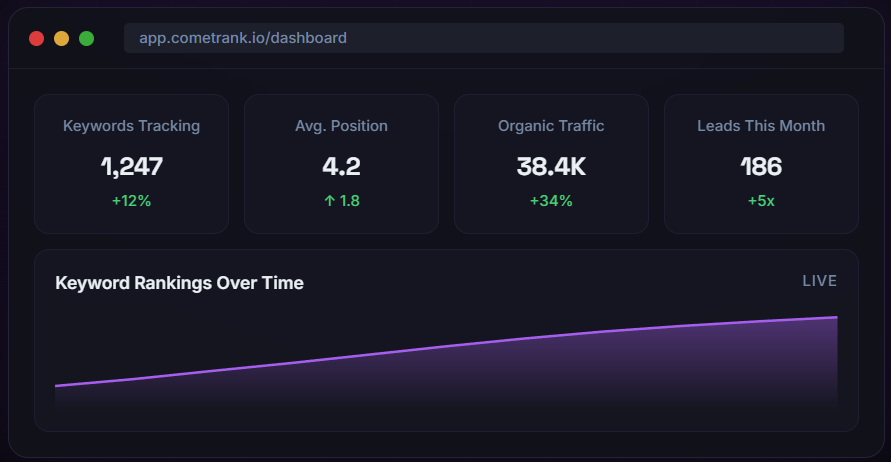

Decision-makers actively search for recruitment partners when hiring needs become urgent.
Why does a newer recruitment agency keep outranking you for your own speciality?
It is not their reputation. It is not how long they have been around. It is not even how good they are at placing candidates. It is that their website shows up when a hiring manager searches for exactly what you offer, and yours does not.
In this article, we break down the exact SEO strategy that turns your website into a client inquiry machine.
What Is SEO for Recruitment Agencies?
SEO for recruitment agencies is the practice of optimising your website, so it appears when hiring managers search for a recruiter in their:
- Location
- Specific industry
- Role type
Done right, it builds a steady pipeline of inbound client inquiries without paying for ads every month. Most recruitment agencies get this wrong from day one. They build a homepage targeting “recruitment agency,” a services page listing “staffing solutions,” and maybe a blog about industry news. None of that captures a serious client.
The problem is intent:
- “Recruitment agency” gets searched by students, job seekers, and researchers
- It is rarely typed by a CFO who needs to hire six engineers in 60 days
- That CFO searches for something specific: “software engineering recruitment agency for Series B startups”
Most job seekers start their search on Google. Hiring managers sourcing recruitment partners behave the same way. Your agency needs to appear for both audiences, but with different pages, different keywords, and different content structures.
5 Reasons Why Your Recruitment Agency Is Not Ranking on Google
1. Targeting broad keywords
“Recruitment agency” is dominated by job boards, Wikipedia, and national directories. A specialist firm cannot compete there.
2. Skipping local SEO
Recruitment is a local business. Most clients hire firms within their city or region. Agencies without location pages leave this traffic entirely on the table.
3. No niche content
Google rewards topical authority. A site with one generic services page and no industry-specific content signals nothing to search engines.
4. Ignoring technical setup
Slow page load times, missing schema markup on job postings, and poor mobile formatting all suppress rankings regardless of content quality.
5. No separation between the two audiences.
Employers and candidates need completely different pages. A site that mixes both on the same service page confuses search engines and converts neither.
The Keywords Worth Targeting & What Each One Does for Your Pipeline
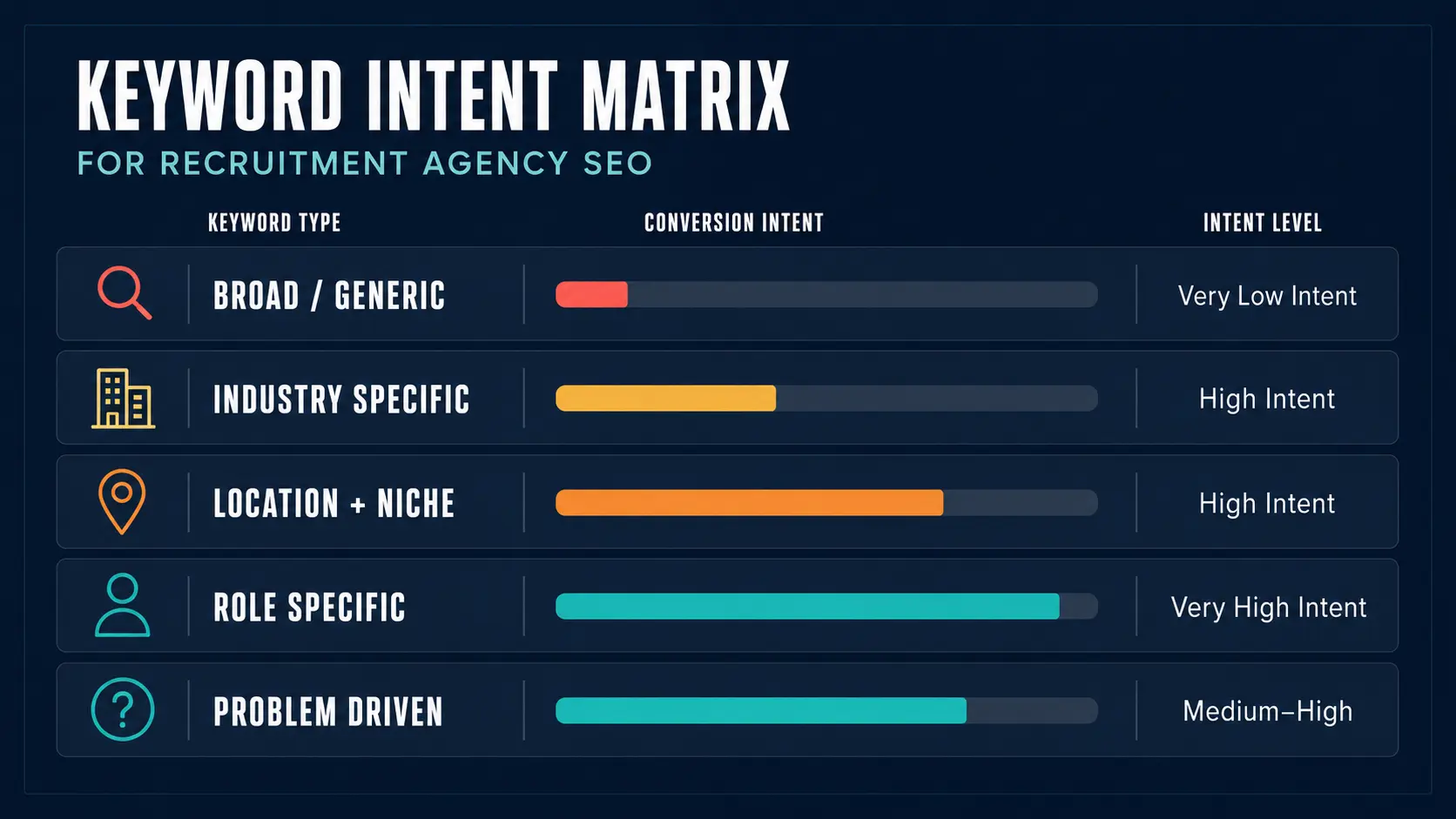
Not every keyword has the same buying intent. Recruitment SEO should prioritise terms that signal action.
| Keyword Type | Example | Who Is Searching | Conversion Intent |
| Broad / generic | “recruitment agency” | Students, researchers, job seekers | Very low |
| Industry-specific | “cybersecurity recruitment agency UK” | IT manager with an open role | High |
| Location + niche | “tech recruitment agency in Austin TX” | Local HR director | High |
| Role-specific | “executive search firm for SaaS CFO” | CEO or board member | Very high |
| Problem-driven | “how to hire machine learning engineers fast” | Founder scaling a team | Medium to high |
Your SEO strategy should target the bottom three rows. These keywords are less competitive and attract people already in the buying window.
Build Industry-Specific Pages That Signal Topical Authority
Create dedicated landing pages for every industry you serve. If you recruit for finance, healthcare, and SaaS, those are three separate content clusters, not one page with a list of industries.
Each industry page should answer the questions a hiring manager in that sector is asking:
- What roles do you typically place?
- What does your candidate pipeline look like?
- What is your placement timeline?
- Do you have case studies or placement outcomes to reference?
- What sector-specific knowledge or compliance experience does your team have?
Example: an agency serving the manufacturing sector should build pages targeting searches like:
- “CNC machining recruitment agency for production engineers”
- “manufacturing staffing agency for skilled tradespeople”
- “operations manager recruitment for factory floor roles”
Each page targets a different buyer, in a different part of the sector, with a different hire in mind. This is how you build search visibility without competing on impossible broad terms.
One thing worth mentioning:
For agencies doing this across several verticals, partnering with an AI SEO agency for staffing and recruiting companies makes the execution significantly faster.
Local SEO for Recruitment Agencies: How to Capture Regional Hiring Demand
Recruitment is a local business. A company in Denver rarely calls an agency based in Miami unless they have a compelling reason. They search “IT recruitment agency in Denver” and call whoever shows up first.
Location-based SEO pages are among the highest-converting assets a recruitment agency can build. The intent is clear, the competition is lower than national terms, and the buyer is ready to act.
Structure each location page around a specific market. Target keyword: “legal staffing agency in Chicago IL.” Recommended page sections:
- Chicago legal market overview (practice areas in demand, salary benchmarks)
- Roles you recruit for in Illinois
- Local firms and companies you have placed with
- Chicago-specific hiring challenges and how you solve them
- Contact form or intake CTA with Chicago office details
Do not cram multiple cities onto one page. Each city needs its own URL, its own content, and its own keyword targeting. A combined page with a location dropdown is invisible to search engines.
Recommended Reading:
If your agency operates across multiple markets, the multi-location SEO strategy guide walks through the exact architecture for scaling without cannibalising your own pages.
How to Get Your Job Postings Into Google Search Results
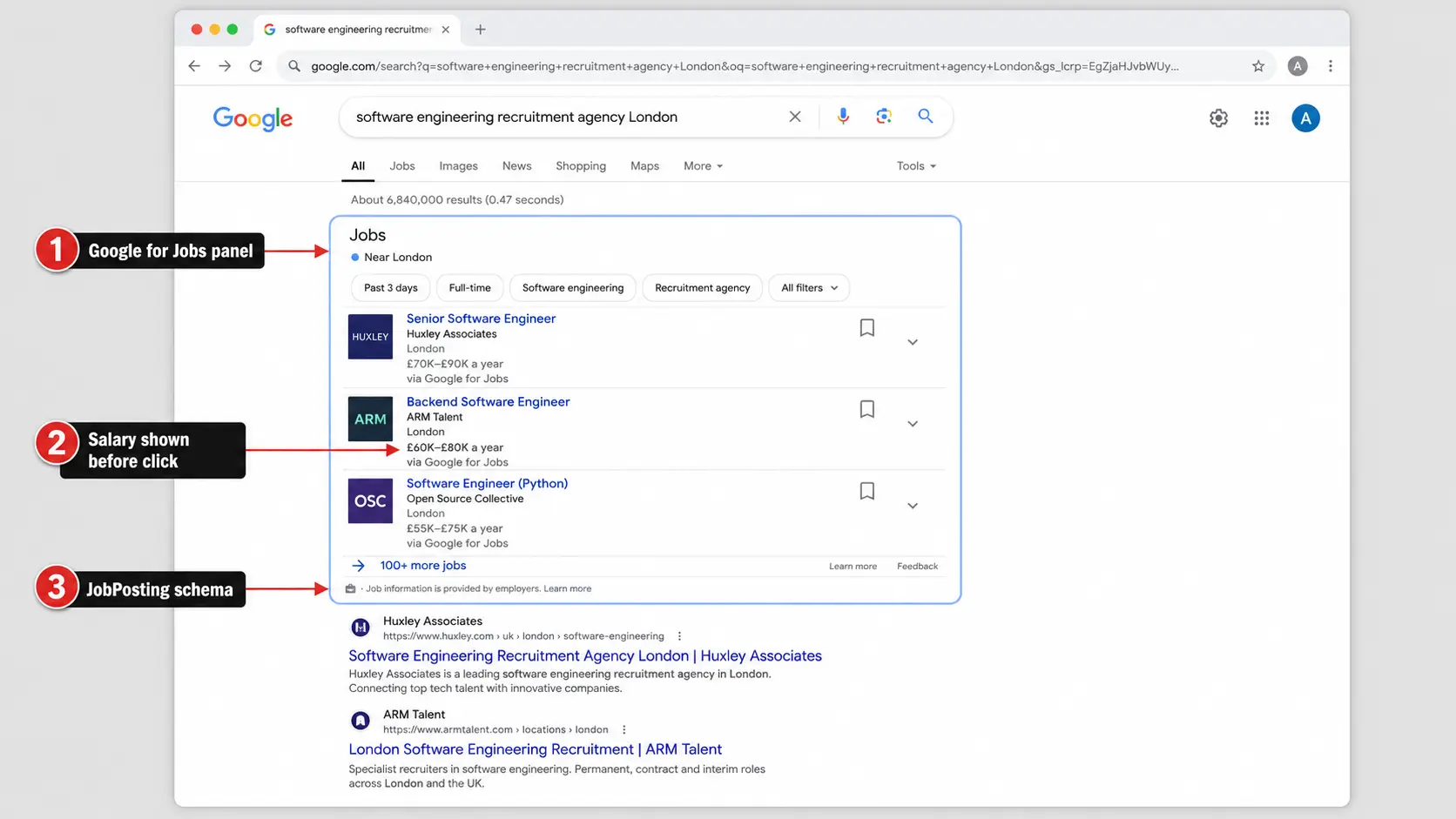
JobPosting schema can help recruitment content appear in richer search features.
Most recruitment agencies running SEO for recruitment agencies miss Google for Jobs entirely. Google does not only index your service pages. It surfaces individual job listings inside search results through a feature called Google for Jobs, a panel that appears when someone searches for a specific role.
To get your job postings into Google for Jobs, listings need structured data markup. Specifically, the JobPosting schema from Schema.org. This code tells Google:
- The job title
- Location
- Employment type
- Salary range
- Application deadline
When this markup is live, your listings can appear in a dedicated results box above regular organic results, with the salary, location, and employment type visible before the user even clicks. Click-through rates from this placement are consistently higher than standard organic results.
Beyond schema markup, job posting pages follow the same optimisation rules as any landing page:
- Use the job title as the page H1, with a location modifier included
- Write unique descriptions for every posting (never copy-paste across similar roles)
- Include salary range where possible, Google uses it as a ranking signal
- Add a clear, immediate application CTA above the fold
Run a technical check on your site to confirm your schema is being read correctly. The technical SEO site audit framework shows how to verify schema implementation step by step.
How to Build Content That Pulls Hiring Managers In Before They Pick a Recruiter
Not every hiring manager is ready to call a recruiter today. Some are six weeks from posting a role and doing research now. Others are solving a specific hiring problem and have not decided whether to use a recruiter at all. This is where content SEO for recruitment agencies earns its place.
Problem-solution content targets informational searches, people who are earlier in the buyer journey but will become clients if your content establishes credibility at the right moment. High-value content topics for a recruitment agency:
- “How to hire machine learning engineers in a tight market”
- “Average time-to-hire for software developers in 2026”
- “Signs it is time to use an executive search firm”
- “How to write a job description that attracts senior candidates”
For each article, structure the content so it:
- Opens by naming the hiring problem directly
- Explains why it is happening in the market
- Offers a practical framework for solving it
- Bridges naturally toward your agency’s services
These articles rank for informational queries, build your site’s topical authority, and prime readers to engage with your service pages later. They also attract backlinks from HR publications and industry sites, which strengthens your overall domain authority over time. Knowing what makes this content fail is just as important as knowing what makes it work.
Recommended Reading:
The mistakes small business owners make when using seo covers the patterns that kill content performance before it has a chance to rank.
Local SEO for Recruitment Agencies: Rank in Every City You Serve

Local search visibility helps recruitment agencies appear when clients are ready to act.
If your recruitment agency serves specific cities, your Google Business Profile (GBP) is one of the fastest wins available. A fully optimised GBP lets you appear in the local map pack when someone searches “recruitment agency near me” or “staffing firm in [city].” This placement sits above regular organic results and captures a high share of local click traffic.
To set it up correctly:
- Claim and verify your profile at each physical office location
- Fill in every field: description, services, categories, hours, and photos of your team and office
- Add your service areas explicitly, not just your registered address
- Collect reviews from placed candidates and satisfied clients
- Post job listings or hiring updates regularly to keep the profile active and signalling relevance
Name, address, and phone number (NAP) consistency matters too. Make sure your business details are identical across your website, GBP, LinkedIn, and any industry directories. Inconsistency reduces your local search authority. For a full breakdown of GBP optimisation steps, the google business profile for local seo covers each setting in detail.
Track the Right SEO Metrics So You Know What’s Working
Running SEO without measurement is guesswork. For a recruitment agency, you need to know which pages drive traffic, which convert visitors into leads, and where you are losing people.
Start with two free tools: Google Search Console and Google Analytics 4.
Google Search Console shows you:
- Which keywords trigger impressions for your pages
- Your click-through rate from search results
- Indexing errors affecting your pages
Google Analytics 4 shows you:
- Which pages visitors land on
- How long they stay
- Which pages lead to form submissions or contact requests
The core metric for SEO for recruitment agencies is not traffic, it is conversion. Set up goal tracking in GA4 for every form submission, demo request, or contact click.
Recommended Reading:
If your traffic is growing but inquiries are not, the SEO to leads guide covers the exact fixes.
How CometRank Does SEO for Recruitment Agencies Faster Than Any In-House Team
Building all of this manually is where most agencies stall. Creating industry pages, location pages, blog content, and job posting schema takes significant time. Most agencies publish three or four pages a month. At that rate, covering enough ground to compete takes years.
We’re an AI SEO agency that runs this entire workflow using CometRank, our proprietary software. Six AI agents handle every layer:
- The Analyst maps hiring intent and identifies what your ideal clients are actually searching
- The Strategist builds the keyword architecture across industries and locations
- The Creator produces landing pages, location pages, and blog content
- The Optimizer handles internal linking and conversion structure
- The Authority Builder runs an AI-driven backlink strategy
- The Quality Guardian reviews everything before it publishes
A human SEO captain oversees every step. This is not raw AI automation, it is a structured system with expert oversight built in. Agencies that get SEO for recruitment agencies right consistently generate inbound client inquiries without chasing them. If you want that system running for your agency, book a demo and we’ll map out exactly where your current search gaps are and what it takes to close them.
The Agencies Winning on Google Are Winning on Specificity
The firms ranking on page one for valuable hiring searches are not the biggest agencies. They are the ones with the most precise content, specific industry pages, specific location pages, specific job posting schema, specific content that answers what hiring managers are actually asking.
Build your SEO for recruitment agencies around how companies search for recruiters, not around how you describe your own services. That one shift is the difference between a website that generates client inquiries and one that sits invisible while competitors take the calls.
SEO for Recruitment Agencies: Frequently Asked Questions
1/ How long does SEO take to generate leads for a recruitment agency?
Initial traffic movement typically appears within three to four months. Meaningful lead generation from SEO usually starts between six and twelve months. The timeline depends on how competitive your target keywords are and how consistently you publish and optimise content.
2/ Should a recruitment agency target job seekers or hiring managers with SEO?
Both, but with separate pages and separate content. Job seeker content builds domain authority and topical trust. Client-facing content generates business leads. The two strategies work together. A site that only targets candidates will struggle to rank for commercial hiring searches.
3/ What is the most important SEO page a recruitment agency should build first?
An industry-specific or location-specific service landing page targeting a high-intent search your current clients would use. For example, “tech recruitment agency in San Francisco” or “finance recruitment firm for hedge fund analysts.” These convert better than any general homepage or blog post.
4/ Does a recruitment agency need a blog to rank on Google?
Not immediately, but yes over time. Blog content builds topical authority, attracts early-stage hiring managers, and creates internal linking opportunities that strengthen your service pages. Without it, service pages plateau in authority and become difficult to rank for anything competitive.
5/ How do job postings appear directly in Google search results?
Add JobPosting schema markup to every listing on your site. This tells Google the job title, location, employment type, salary range, and application deadline. When correctly implemented, your postings can appear in the Google for Jobs panel, which surfaces listings directly in search results with higher visibility than standard organic results.
6/ What keywords should a recruitment agency target first?
Start with location-plus-industry combinations where your agency already has placements and credibility. If you have placed healthcare workers in Chicago, build a “healthcare staffing agency in Chicago” page first. You have real evidence to support the content, and genuine placement history strengthens your E-E-A-T signals with search engines.