
97% of homeowners search online before hiring an HVAC contractor.
Most never scroll past the first three results. If your company isn’t in those results, you’re not losing to better contractors. You’re losing to better SEO.
In this article, we cover exactly what SEO for HVAC companies looks like so you can start capturing those searches instead of watching competitors take them.
What Is SEO for HVAC Companies?
HVAC SEO is the practice of optimizing your website and online presence so your company ranks higher in local search results for queries like “AC repair near me” or “furnace installation contractor in Denver CO.”
It’s different from general SEO. HVAC demand is:
- Intensely local
- Seasonal
- Intent-driven
A homeowner whose AC dies at midnight isn’t browsing. They’re calling the first company that appears. SEO for HVAC companies is about being that company, for the right search, in the right city, at the right time.
Tip 1: Optimize Your Google Business Profile First
Your Google Business Profile (GBP) is the single most important asset for local HVAC visibility. It populates the Google Map Pack, which drives more phone calls than any other search feature for service businesses.
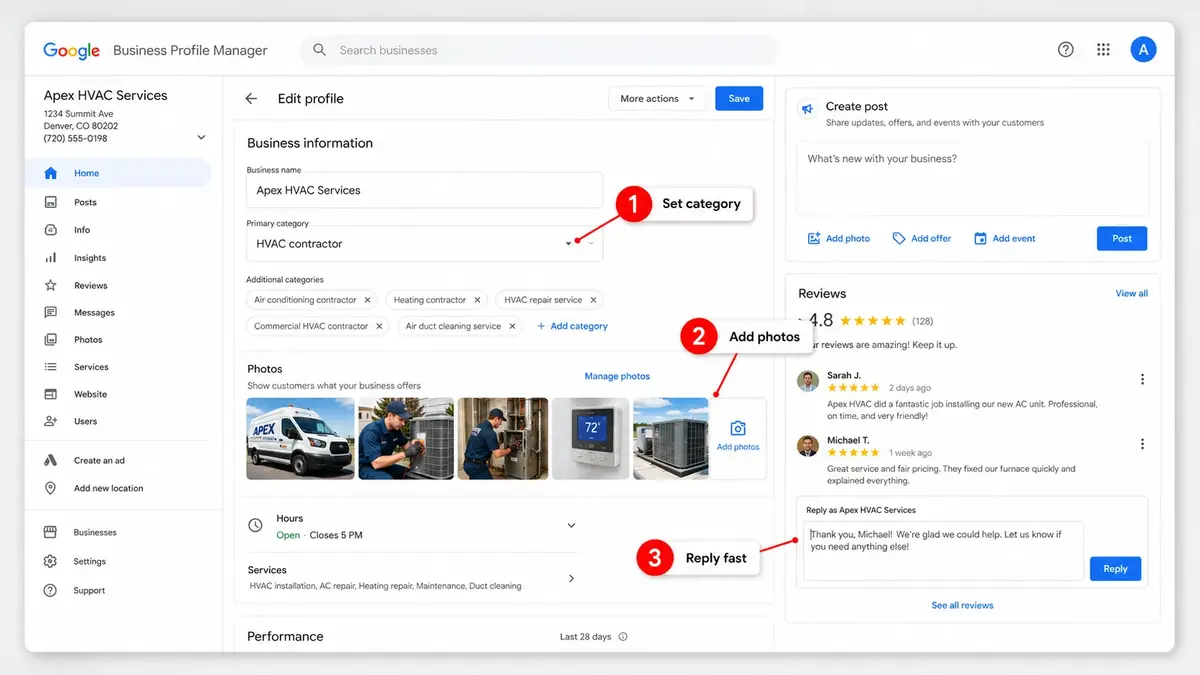
Here’s what to get right:
- Set your primary category to “HVAC contractor”
- Add secondary categories: “Air conditioning repair service,” “Heating contractor,” “Furnace repair service”
- List every service you offer with descriptions
- Use a local phone number, not a toll-free number
- Upload photos of your team, trucks, and completed jobs
- Post seasonal updates weekly
- Configure your service area by city and zip code
Businesses with fully optimized Google Business Profiles are 2.7x more likely to be considered reputable. Most HVAC contractors claim their profile and leave it half-complete. That’s a fast ranking win sitting unclaimed.
Respond to every review. Thank positive ones. Address negative ones professionally. Review responses are a local ranking signal Google weighs directly.
Tip 2: Do Keyword Research Before You Build Any Page
There are four SEO for HVAC companies keyword types that you should focus on:
| Keyword Type | Intent | Example | Page Type |
| Emergency / urgent | Ready to call now | “24 hour AC repair Dallas TX” | Emergency service landing page |
| Installation / replacement | Planning a purchase | “heat pump installation Phoenix AZ” | Service + location page |
| Comparison / evaluation | Researching options | “best HVAC company in Denver” | Blog or comparison guide |
| Informational | Diagnosing a problem | “why is my AC blowing warm air” | Blog post linked to service page |
Start with Google’s own tools. Study autocomplete suggestions, People Also Ask boxes, and Related Searches. These show exactly what homeowners are asking. SEO tools for keyword research like Ahrefs and SEMrush add volume data and difficulty scores.
Prioritize keywords with clear local intent. “HVAC services” is too vague to rank and too broad to convert. “Ductless mini split installation contractor in Mesa AZ” is specific, high-intent, and far easier to win.
Tip 3: Do Proper On-Page SEO for HVAC Companies For Every Service Page
On-page SEO tells Google what each page is about and why it deserves to rank. It’s the work you do directly on your website pages. Understanding 15 of the most important on-page SEO tactics gives you the full framework, but for HVAC every page needs:
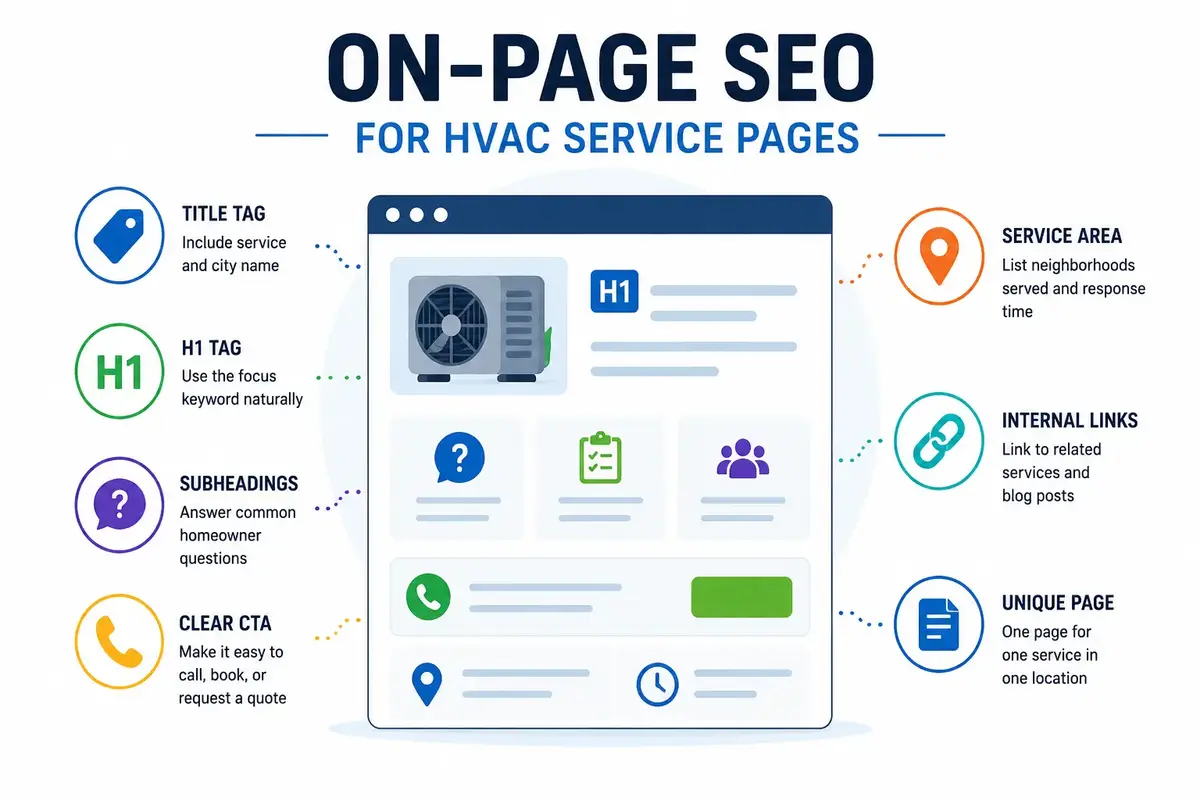
- A title tag with the service and city name (e.g. “AC Repair in Tampa FL | [Company Name]”)
- An H1 tag that includes the focus keyword naturally
- Subheadings covering questions homeowners ask
- A clear CTA: phone number, booking form, or quote request
- Service area, neighborhoods served, and response time on the page
- Internal links to related service pages and blog posts
One page cannot rank for multiple cities or multiple services. A weak HVAC page has a short service list, a “we’ve been around for 20 years” paragraph, and a contact form. A strong page covers what the service involves, signs a homeowner needs it, your process, and a direct CTA. That’s what ranks.
Tip 4: Create Dedicated Service Pages for Every Major Service
Do not list all your services on one page. Each service needs its own URL, its own keyword focus, and its own content depth.
Core service pages every HVAC contractor should have:
- AC repair and emergency AC repair
- AC installation and replacement
- Furnace repair and installation
- Heat pump installation
- Ductless mini split installation
- HVAC maintenance and tune-up plans
- Duct cleaning, sealing, and indoor air quality
Each of these should have location-specific versions. “Heat pump installation in Seattle WA” is a separate page from “heat pump installation in Bellevue WA.” This isn’t duplicate content. It’s how local SEO works.
Most HVAC websites have fewer than 20 pages. Competitive markets require 100+ pages covering service, problem, and location combinations. Digital marketing for HVAC companies at this scale requires a systematic build, not a one-page-at-a-time approach.
Tip 5: Use Blog Content to Capture Problem-Aware Searches
Many HVAC searches begin with a homeowner describing a symptom, not searching for a contractor. These are leads before they’ve called anyone.
Examples of problem-aware searches:
- “why is my AC blowing warm air” → leads to an AC repair page
- “furnace making banging noise” → leads to a furnace repair page
- “how often should I replace my air filter” → drives interest in a maintenance plan
- “heat pump vs central air cost comparison” → leads to an installation page
Each blog post should cover the most common causes, explain what homeowners can and can’t fix themselves, and link directly to the relevant service page. Blog content captures long-tail keywords your service pages can’t rank for and gives Google more signals that your site is an authoritative HVAC source. Google Business Profile for local SEO and a strong blog strategy together compound your local authority faster than either alone.
Tip 6: Build Location Pages That Capture Local HVAC Searches
Local SEO for HVAC companies depends on hyper-specific location targeting. A single “service area” page listing 20 cities doesn’t rank for any of them.
Build a dedicated landing page for each city or neighborhood you actively serve. Each page should cover:
- Neighborhoods and zip codes served
- Common HVAC issues specific to that climate
- Your typical response time to that area
- Local customer testimonials
- Phone number and CTA above the fold
Business citations reinforce every location page. Every mention of your name, address, and phone number across Yelp, Angi, HomeAdvisor, and local directories must be exactly consistent. Inconsistent NAP data confuses Google and suppresses rankings. What are citations in SEO explains how to build and maintain them at scale.
Tip 7: Technical SEO Keeps Your Site From Losing Rankings You Already Earned
Technical SEO for HVAC companies is the backend work that makes everything else function. Great content and strong local signals mean nothing if your site is slow or broken.
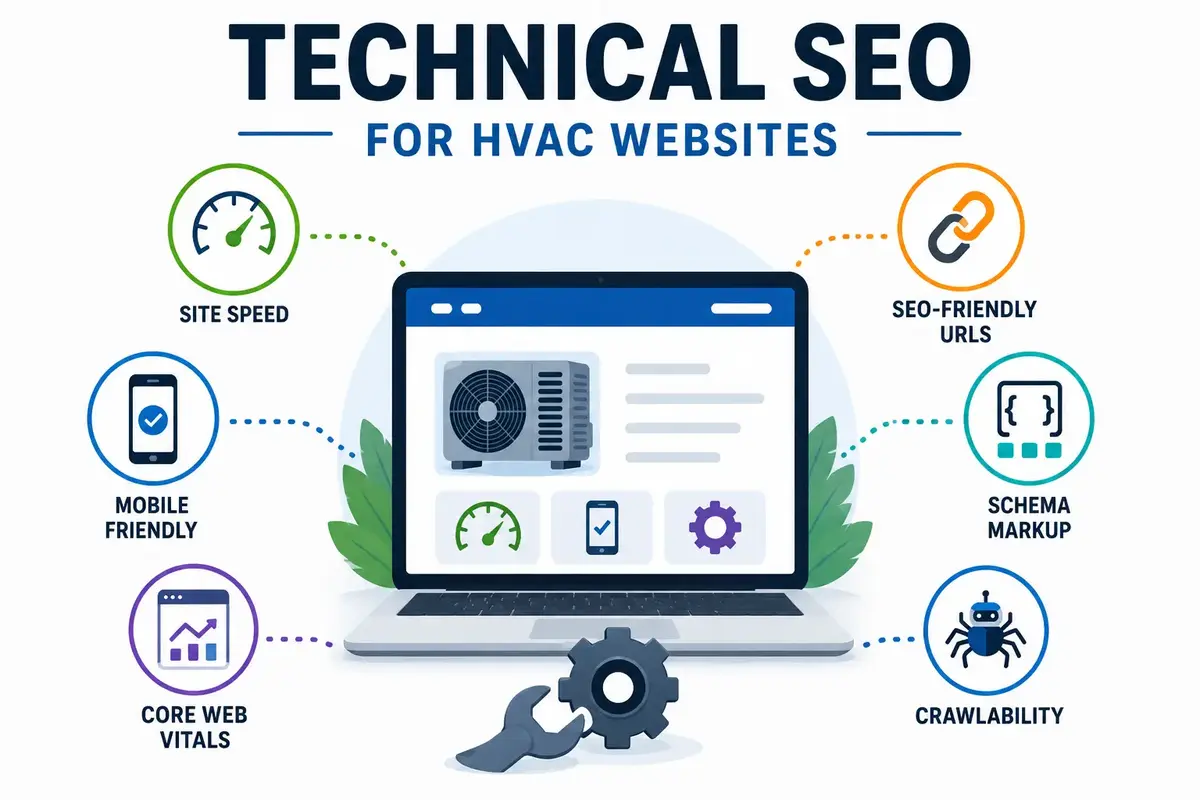
Key technical fixes for HVAC websites:
- Page speed: 53% of mobile users abandon a site that takes more than three seconds to load. Compress images, enable browser caching, use a fast host
- Mobile responsiveness: Over 60% of Google searches come from mobile. Emergency HVAC searches especially happen on phones
- Core Web Vitals: Google uses these as direct ranking signals
- URL structure: /ac-repair-dallas-tx/ outperforms /services/page-id-4827/
- Schema markup: Add LocalBusiness schema with NAP data, HVACBusiness type, and FAQ schema on pages that answer common questions
- Crawlability: Submit an XML sitemap. Check Google Search Console for crawl errors regularly
Recommended Reading:
Our blog on how to conduct a technical SEO site audit walks through this process step by step.
Tip 8: Get Reviews and Use Them as a Ranking Signal
Google Business Profile reviews are a direct local ranking factor. The more high-quality reviews you have, the better your Map Pack visibility.
87% of consumers read online reviews before choosing a local service business. Reviews don’t just influence rankings. They influence the decision to call.
How to collect reviews consistently:
- Ask every customer immediately after completing a job
- Send a follow-up text with a direct link to your Google review page
- Include review request language in invoices and completion emails
- Respond to every review within 24 hours
Display your best reviews on your service pages. If a customer mentions a specific city or service in their review, that language adds local keyword signals to your GBP. For most HVAC markets, 50 reviews at 4.8 stars outperforms 200 reviews at 4.2 stars.
Tip 9: Off-Page SEO for HVAC Companies
Off-page SEO is everything you do outside your website to build credibility. For HVAC contractors, this means earning backlinks that signal to Google your company is a trustworthy local business.
Quality beats quantity. One link from a local news site, the Better Business Bureau, or a homebuilder association is worth more than 50 links from generic directories.
Practical backlink tactics:
- Get listed on your local Chamber of Commerce website
- Get listed on HVAC-specific directories: ACCA, PHCC, SMACNA
- Earn mentions from local home improvement blogs or neighborhood sites
- Build relationships with general contractors and property managers who can refer and link to you
Avoid purchasing backlinks. Google penalizes paid link profiles and the penalty is severe. Seo for roofing contractors follows the same backlink playbook — the principles translate directly to HVAC.
Tip 10: Get Cited in AI Overviews and AI Search Results
Google’s AI Overview, ChatGPT, and Perplexity now answer HVAC questions directly in search results. If your content doesn’t appear in those answers, you’re losing visibility before homeowners even see your website.
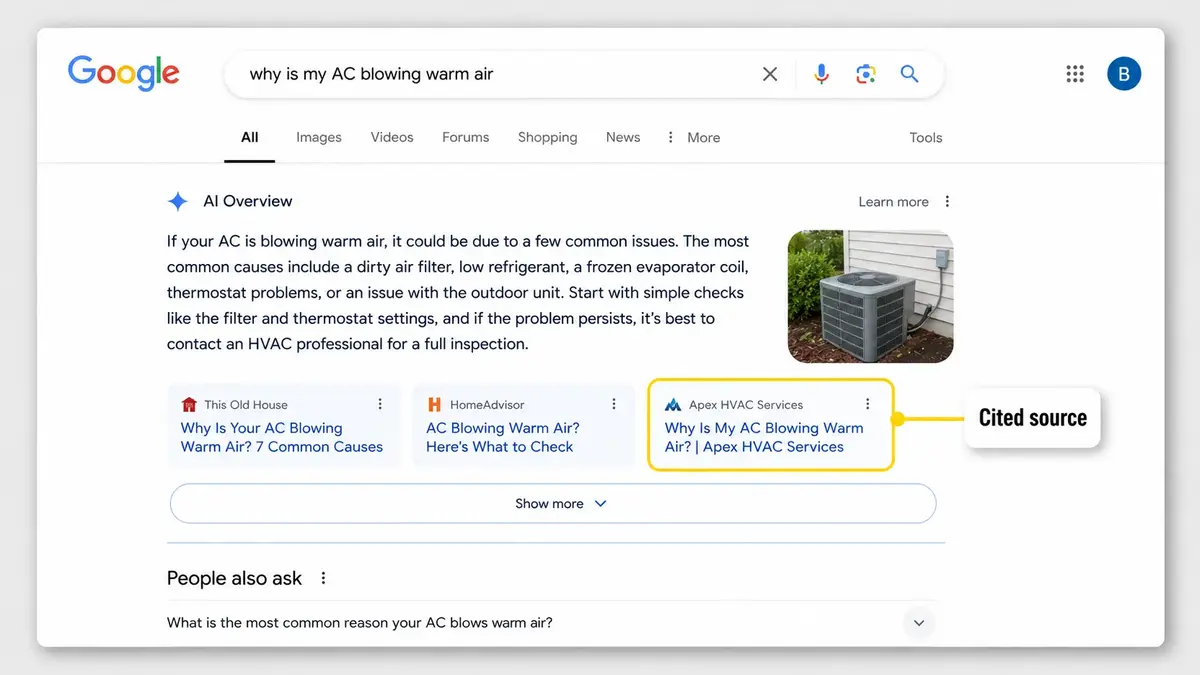
AI engines prioritise content that answers questions directly in the first sentence of each section. To get cited:
- Open every section with a direct, one-sentence answer
- Use FAQ sections with a question-and-answer format
- Add FAQ schema and HowTo schema to signal answer intent
- Cite statistics and attribute them to their source
- Update your content regularly with current data
AI search grader tools show you whether your HVAC business is appearing in AI results for your target keywords. Generative engine optimization is the strategy for improving that visibility systematically.
Tip 11: Track Results and Adjust for Seasonal Demand
HVAC search demand follows predictable seasonal cycles. Cooling queries spike April through August. Heating queries climb September through February. Your content calendar should follow these cycles, not fight them.
Track the right metrics:
- Keyword rankings: Monitor service pages weekly
- Organic traffic: Track visits from search by page in Google Analytics
- GBP views, calls, and direction requests: Real local intent signals
- Conversion rate: What percentage of organic visitors call or submit a form
- Bounce rate: High bounce rates on service pages signal content or UX problems
Use Google Search Console and Google Analytics together. Search Console shows which keywords you’re ranking for. Analytics shows what happens after the click. SEO metrics that tell you SEO is actually working explains what to track and what to ignore.
Run seasonal content 6 to 8 weeks before peak demand. A post titled “Signs Your AC Won’t Make It Through Summer” published in March captures traffic before competitors think to act.
What Mistakes Should You Avoid While Doing SEO for HVAC Companies
These tactics look like shortcuts, but they destroy long-term rankings:
- Keyword stuffing: Google detects unnatural keyword use and demotes pages that do it
- Duplicate location pages: Identical city pages with swapped names are penalized as thin content
- Buying backlinks: Paid link schemes trigger manual Google penalties
- Neglecting the GBP: A half-complete profile loses to any competitor who actively manages theirs
- Ignoring mobile: Slow mobile sites lose rankings and lose calls simultaneously
- Thin blog content: A 300-word post ranks for nothing. It dilutes your site’s overall quality signals.
How CometRank Handles SEO for HVAC Companies
Executing HVAC SEO properly requires building 100+ intent-matched pages, optimizing a GBP, managing citations, earning backlinks, writing seasonal blog content, and tracking performance simultaneously. Most HVAC contractors don’t have the bandwidth to run all of this in-house, and most agencies move too slowly to keep up with demand cycles.
We’re an AI SEO agency that runs this entire workflow for clients using CometRank, our proprietary SEO software.
CometRank runs six AI agents across:
- Intent mapping
- Page creation at scale
- On-page optimization
- Local citation management
- Authority building
- Quality control
A human SEO captain reviews everything before it goes live. To see how CometRank handles this for your HVAC company, book a demo and we’ll map out your local search opportunity before the call ends.
The HVAC Contractors Who Win on Google Do One Thing Differently
They treat their website as a lead engine, not a brochure. Every page targets a specific search. Every search maps to a specific homeowner problem. Every problem leads to a direct call to action.
HVAC companies that build this structure rank for hundreds of searches instead of a handful of generic ones. That’s how SEO turns search traffic into booked jobs year-round.
SEO for HVAC Companies: Frequently Asked Questions
1/ What is SEO for HVAC?
It is the process of optimizing your website and online presence to rank higher in Google search results when homeowners search for heating, cooling, and ventilation services in your area. It includes on-page optimization, local SEO, Google Business Profile management, and content creation targeted at high-intent service searches.
2/ How much does HVAC SEO cost?
HVAC SEO typically costs between $500 and $5,000 per month depending on market size, competition level, and scope of work. Most HVAC companies in competitive markets need to invest at least $1,000 per month to build meaningful visibility against established local competitors.
3/ How long does SEO for HVAC take to show results?
Most HVAC companies see measurable ranking improvements within 3 to 6 months. Highly competitive markets can take 6 to 12 months before significant lead volume arrives. Results compound over time, which is why consistency matters more than short-term bursts.
4/ Is SEO worth it for HVAC companies?
Yes. SEO builds long-term lead generation that doesn’t stop working when you pause a budget. Unlike paid ads, an optimized page continues attracting calls month after month. For HVAC companies with recurring seasonal demand, SEO is one of the highest ROI marketing investments available.
5/ Do HVAC companies need a separate page for every city they serve?
Yes, if you want to rank in those cities. A single “we serve the greater metro area” page won’t rank for individual city searches. Each city needs a dedicated, unique location page with specific information about that area.
6/ Can you do HVAC SEO myself?
You can handle basics like claiming your Google Business Profile, collecting reviews, and writing blog posts. Technical SEO, backlink building, and large-scale location page creation are harder to do well without expertise or dedicated time.
7/ What SEO mistakes should HVAC contractors avoid?
The biggest mistakes are keyword stuffing, buying backlinks, creating duplicate city pages, ignoring mobile performance, and publishing thin blog content. Any of these can actively suppress your rankings rather than improve them.