
Many fashion ecommerce brands deprioritize SEO.
Not because it doesn’t work – but because paid ads deliver results faster.
Launching campaigns on Meta or Google can generate sales within days, while SEO often takes months to show measurable growth. For brands focused on immediate revenue, the slower timeline makes SEO feel risky.
But the long-term reality is different.
Paid ads stop generating sales the moment budgets pause. SEO, on the other hand, compounds over time — turning search visibility into consistent organic revenue without ongoing ad spend.
This is why understanding why seo is important for ecommerce is critical for brands that want sustainable growth.
The challenge for fashion ecommerce isn’t whether to rank for keywords like “women’s dresses” or “streetwear hoodies.” Those keywords are extremely valuable.
The real issue is that many brands rely only on a few broad keywords, while ignoring the thousands of high-intent searches shoppers actually use when they are close to buying.
Effective fashion ecommerce SEO captures both broad discovery searches and high-intent purchase searches.
Why Fashion Ecommerce SEO Requires Intent Mapping
Fashion buyers rarely search using a single generic keyword.
Their searches evolve as they move closer to purchase.
Example Search Journey
A shopper looking for a hoodie might search:
- “streetwear hoodie trends 2026”
- “oversized hoodie outfits men”
- “black oversized hoodie men heavyweight cotton”
The final search reflects clear buying intent.
Brands that only target generic terms like “hoodies” miss these valuable conversion-focused queries.
Optimize Category Pages for High-Intent Fashion Searches
Category pages often drive the majority of ecommerce revenue.
Instead of simply listing products, category pages should target specific commercial search queries.
Example keyword:
“oversized streetwear hoodies for men”
A strong category page should include:
- intro text describing the style and fit
- hoodie fabric options (cotton, fleece, heavyweight)
- styling recommendations
- filters for size, color, and material
- customer reviews and social proof
Well-structured category pages improve both rankings and conversions.
For deeper implementation guidance, review this guide on
SEO for Ecommerce product pages.
Build Product Pages That Capture Long-Tail Purchase Searches
Many fashion ecommerce sites use product pages that only contain minimal descriptions and images.
Search engines need structured content to understand the product and rank the page.
Example product keyword:
“women’s oversized beige trench coat”
An optimized product page should include:
Product Overview
Explain the design, material, and intended style.
Size and Fit Guide
Provide measurements, model sizing, and fit recommendations.
Fabric Details
Describe material composition, durability, and care instructions.
Style Inspiration
Show how the item can be styled with other products.
Structured product pages help both rankings and conversions.
More detailed guidance can be found in these
seo best practices for ecommerce sites.
Use Image SEO to Capture Visual Fashion Searches
Fashion discovery frequently happens through Google Images and visual search.
This means product images must be optimized for search engines.
Example:
Instead of naming a file:
IMG_2043.jpg
Use:
black-oversized-streetwear-hoodie-men.jpg
Add descriptive alt text such as:
“Men’s black oversized streetwear hoodie with drop shoulders.”
These small optimizations help products rank in visual search results.
For a deeper breakdown, see these
image seo guidelines for ecommerce products.
Scaling Fashion Ecommerce SEO with AI
Fashion ecommerce SEO requires managing:
- hundreds of product pages
- dozens of category pages
- seasonal collections
- trend-based content
Doing this manually becomes slow and inconsistent.
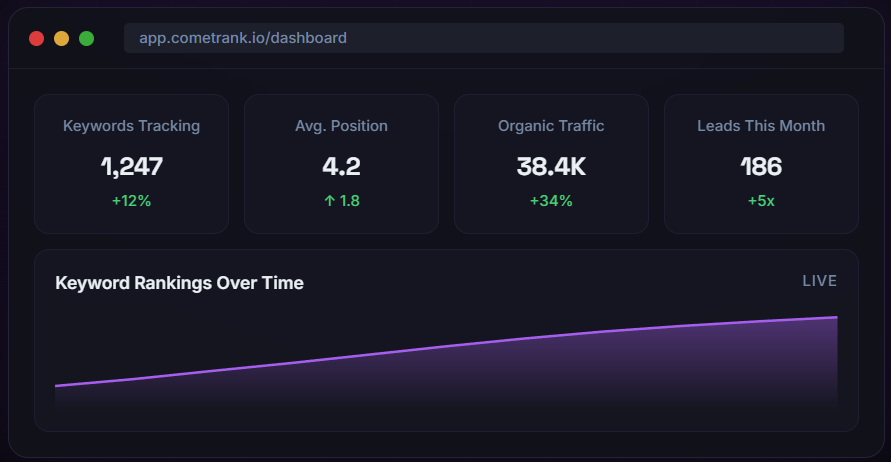
Platforms like Cometrank act as an AI SEO command center that helps ecommerce brands discover search opportunities, create optimized pages, and improve rankings continuously.
An advanced AI SEO platform typically uses multiple AI agents:
- AI SEO Analyst to discover keyword opportunities
- AI SEO Strategist to map intent to content
- AI SEO Content Creator to generate structured pages
- AI SEO Optimizer to improve rankings and internal linking
If you’re evaluating tools built specifically for ecommerce search visibility, this guide on the
best rated ai tools for ecommerce seo and ai visibility compares the leading options.
The Long-Term Advantage of SEO for Fashion Brands
Fashion ecommerce is highly competitive, and relying entirely on paid advertising makes growth expensive.
Brands that invest in SEO build a compounding acquisition channel where search visibility continuously drives new customers.
The winning strategy is clear:
- rank for both broad and high-intent searches
- structure category and product pages for conversion
- optimize images for visual discovery
- use AI systems to scale content and search visibility
When done correctly, SEO becomes one of the most reliable ways to turn search demand into consistent ecommerce revenue.
