Searches are owned by EnergySage, SolarReviews, and national installers with domain authority built over a decade.
A regional installer isn’t outranking them. Not with a 30-page website and a modest budget.
The root cause isn’t effort. It’s the wrong keyword strategy entirely. Broad terms attract researchers, not buyers. National brands and aggregators dominate high-volume searches, leaving local installers with no foothold in the results that actually matter.
Every month spent chasing broad terms is a month of content that ranks nowhere and generates nothing.
Running SEO Like a One-Time Project
A common pattern: hire an agency for a few months, do some keyword research, refresh the homepage, publish two blogs, then move on.
SEO doesn’t work that way.
Google rewards sites that publish consistently and build authority over time. Two blogs and a revised homepage is not a system. It’s a one-time effort in an industry that requires a sustained one.
The result is a site that never builds topical authority and never earns the rankings that compound into leads. It’s the same reason generic SEO fails most businesses that try it without a plan.
Ignoring How Long Solar Buyers Actually Research
Solar is not a plumbing emergency. It’s a $15,000 to $30,000 decision.
Research shows the average residential solar buyer contacts 3.2 companies before deciding, often over weeks or months.
Buyers start with questions:
- Is solar worth it in my state?
- What does installation cost?
- How do local incentives work?
Most solar company websites have no content for this stage. No answers means no trust. No trust means they find a competitor who did answer those questions and call them instead.
Serving 15 Cities With One Page
A typical solar company covers a metro area or a few counties. But the website has one service page targeting one city.
Google cannot rank that single page for “solar installer in Scottsdale,” “solar company in Tempe,” and “residential solar Mesa AZ” simultaneously.
Each city needs its own page with its own geo-specific content and intent signals.
Without location pages, you’re invisible in every city except your home address. That’s the majority of your service area with zero organic presence.
Does High Traffic Mean More Solar Leads?
No. Traffic and leads are not the same thing.
Generic content about “how solar energy works” or “benefits of going solar” drives informational traffic. People reading those articles are researching. They’re not ready to get a quote today.
60% of online traffic goes to the top three search results, but that stat only matters if the searches you’re ranking for carry buying intent.
| Search | Intent | Outcome |
| “how solar works” | Research | No quote request |
| “residential solar installer in Phoenix AZ” | Buying | Quote request |
“Residential solar installer in Phoenix AZ” gets less traffic than “how solar works.” It generates far more leads.
Most solar SEO agencies report impressions and rankings. Not booked consultations. That’s why solar companies pay for SEO, see traffic go up, and still wonder where the leads are. You can read more about this disconnect in when SEO traffic doesn’t convert.
How to Fix SEO for Solar Companies
The fixes map directly to the problems above. None require a complete rebuild. They require a smarter approach from the start.
Target buying-intent keywords, not research-intent ones:
- “Residential solar installer in [city]”
- “Commercial rooftop solar [city]”
- “Solar company near me”
Lower volume. Much higher conversion rate.
Build a location page for every city you serve.
Each page needs its own headline, content, and geo-specific signals. This is how SEO for multiple locations builds organic presence across an entire service area, not just a headquarters city.
Create content for the research phase.
Pages that answer “how much does solar cost in [state],” “best solar incentives in [state] 2026,” and “solar panel ROI calculator” capture buyers early and build trust before they’re ready to get quotes. This is what local SEO for home services actually looks like in practice.
Publish consistently.
Google builds trust in sites that show up regularly. One blog a month is enough to start. Zero blogs a month means no authority, ever.
Measure the right things:
- Quote requests
- Consultation bookings
- Not rankings alone
If your SEO report shows traffic going up but leads staying flat, something in the strategy is broken.
Solar SEO That Runs Without You Doing the Work
A solar company owner is already managing crews, site visits, vendor calls, quotes, follow-ups, and customer questions. Running a consistent SEO schedule on top of that is not realistic. Building 20 location pages, tracking keyword-level conversions, creating content for every buyer stage, and earning the right backlinks cannot sit on the owner’s plate forever.
That is where CometRank closes the gap.
Before a single page goes live, the Strategist Agent maps keyword opportunities by buyer intent. It separates homeowners who are ready to request a quote from those still comparing solar costs, incentives, installation timelines, and financing options.
The Creator Agent then turns that strategy into city-specific solar pages across your service area. Each page is built around local search intent, quote-focused keywords, and the questions homeowners ask before choosing a solar installer.
The Authority Builder Agent supports those pages by targeting backlinks from sources that matter for both search engines and AI discovery. This includes trusted industry, local, and niche sources that platforms like ChatGPT and Perplexity are more likely to reference, instead of relying on a generic backlink list.
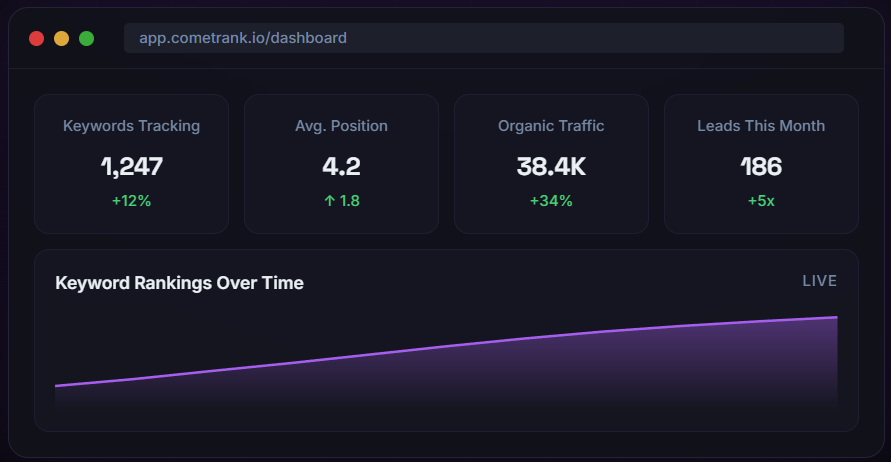
The outcome is not just more content. It is a solar SEO system built to attract quote-ready homeowners, expand visibility across service areas, and turn organic search into a repeatable lead pipeline.
To see how the full system works, explore the CometRank solar SEO platform
The Problem Was Never the Market
Demand for solar isn’t the issue.
Almost 70 gigawatts of new solar generating capacity are scheduled to come online in 2026 and 2027, representing a 49% increase in US solar operating capacity. Buyers are searching. The market is growing.
The companies winning that search traffic aren’t necessarily the best installers. They’re the ones with a content system, the right keywords, and a page for every city they serve.
That’s fixable. And it’s worth fixing before a competitor in your market figures it out first.
SEO For Solar Companies: Frequently Asked Questions
1. How long does SEO take to generate leads for a solar company?
Most solar companies start seeing meaningful ranking movement between 3 and 6 months, assuming they’re publishing consistently and targeting the right keywords. Location pages often rank faster than broad informational content because the competition is lower at the city level. Lead volume builds as more pages rank and authority compounds.
2. Should solar companies focus on local SEO or national SEO?
Local SEO, without question. Solar is a local service. Buyers want an installer in their city who can show up, pull permits, and handle warranties. National SEO targets broad audiences who can’t convert. Local SEO targets homeowners who are ready to get quotes in your service area right now.
3. What types of content actually convert solar leads from search?
The highest-converting content addresses specific buying-stage questions: solar cost in a given state, local incentive programs, ROI timelines, and installer comparison guides. Project case studies with real photos and costs also convert well because they reduce purchase hesitation. Informational blogs about how solar works drive traffic but rarely produce quote requests directly.
4. How many location pages does a solar company need for SEO?
One page per city or town you actively serve. If you cover a metro area of 15 cities, you need 15 location pages, each with unique content, not copies of the same page with the city name swapped. Thin or duplicate location pages can hurt rankings. Each page should include local signals: city name in the headline, references to local incentives or utility providers, and a clear CTA for that area.