
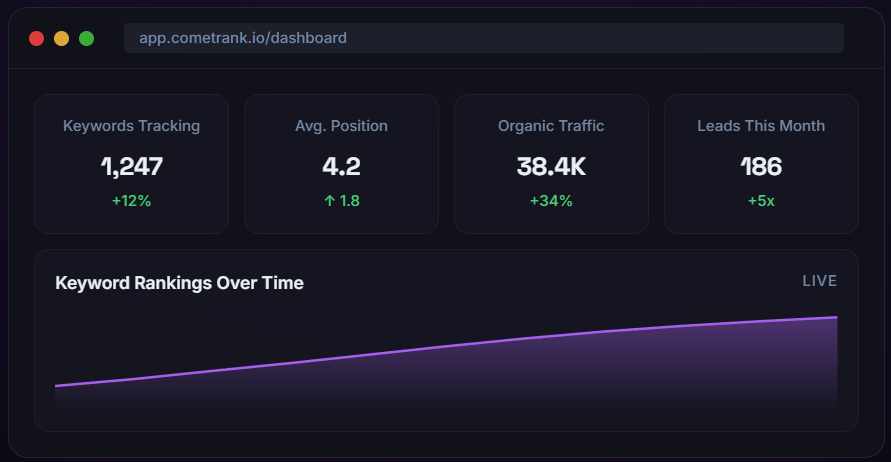
Why does the pediatric practice two miles away have a full schedule while yours has open slots every week?
Parents don’t browse casually when they’re choosing a pediatrician. They search with urgency, with trust concerns, and with a clear goal: book an appointment for their kid, today or this week. If your practice isn’t ranking for the exact searches those parents are typing, you’re handing patients to a competitor who happens to be easier to find online.
In this article, we cover how to do SEO for pediatricians the right way, from mapping parent search intent to page structure, to the backlinks and AI visibility that turn searches into booked appointments.

How to Map Parent Search Intent to High-Converting Pages
Most pediatric websites are built like brochures, not patient acquisition engines. They target one broad keyword, like “pediatrician near me,” skip service-specific pages, and omit the trust-building details parents actually want before they call.
Search engines and AI systems reward specificity. A generic homepage can’t compete with a page built for one exact need. Compare “pediatrician near me” to “same-day sick visit pediatrician Chicago IL” or “pediatric ADHD evaluation NYC.” Each phrase reflects a different parent, at a different moment, with a different level of urgency. Each one deserves its own page.
| Parent Search Intent | Example Search | Page to Build |
| Urgent care | “child fever doctor same day Houston” | Same-Day Pediatric Sick Visits in [City] |
| New patient / primary care | “pediatrician accepting new patients San Diego” | Pediatrician Accepting New Patients in [City] |
| Condition-specific | “pediatric eczema treatment Boston” | [Condition] Treatment for Kids in [City] |
Each page type needs its own proof points:
- Urgent care pages: same-day scheduling info and conditions treated
- New patient pages: age groups served, vaccination schedules, what to expect at a first visit
- Condition pages: symptoms parents recognize, treatment approach, when to come in versus wait it out
Getting this structure right does more for conversion rates than a redesigned homepage ever will.
Local SEO: The Core Growth Lever for Pediatric Practices
Local visibility decides whether you show up in the Google Map Pack, in “near me” searches, and increasingly in AI-driven results. A parent searching at 11 pm with a feverish toddler isn’t reading page two.
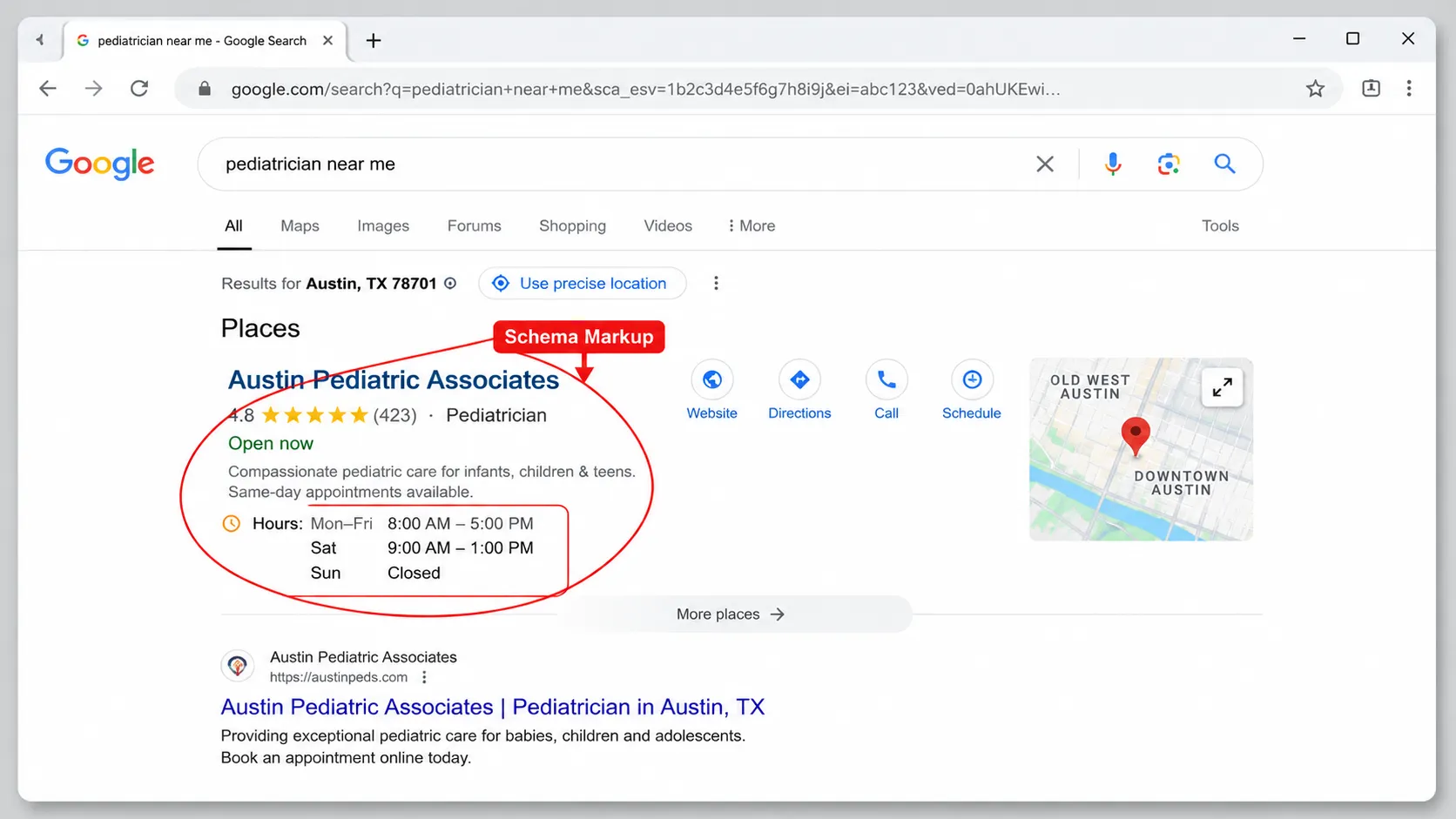
A strong local strategy has four parts: a fully optimized Google Business Profile, consistent name, address, and phone number everywhere your practice is listed, location-specific landing pages for each office, and backlinks from local and healthcare-relevant sources. Skip any one of these and you leave visibility on the table. Local SEO for medical professionals covers the multi-location version of this in more depth, which matters if your group runs more than one office.
Technical SEO and Schema Markup Parents (and AI) Actually Notice
A beautifully written page that loads slowly or looks broken on a phone loses the patient before they read a word. Most pediatric sites lose here quietly, and most owners never find out why.
Three things matter most:
- Site speed: a slideshow that looks impressive but drags load time costs you a worried parent who won’t wait
- Mobile experience: your appointment booking flow has to work with a thumb, one-handed, while someone’s holding a sick kid
- Schema markup: code that tells Google exactly what you are, a pediatric practice, what hours you keep, and what conditions you treat, so search results can show your rating and hours directly without a click
Practices that skip schema get outranked by practices that added ten lines of code and nothing else. An AI chatbot on the booking page can also catch a parent who’s unsure whether their kid needs same-day care or can wait, turning an uncertain visitor into a booked visit instead of a bounce
Backlinks That Actually Move Pediatric Rankings
Not every backlink helps your rankings. Some actively hurt them, and most practice owners can’t tell the difference until traffic drops.
1/ Backlinks From Schools, Pediatric Networks, and Local Partners
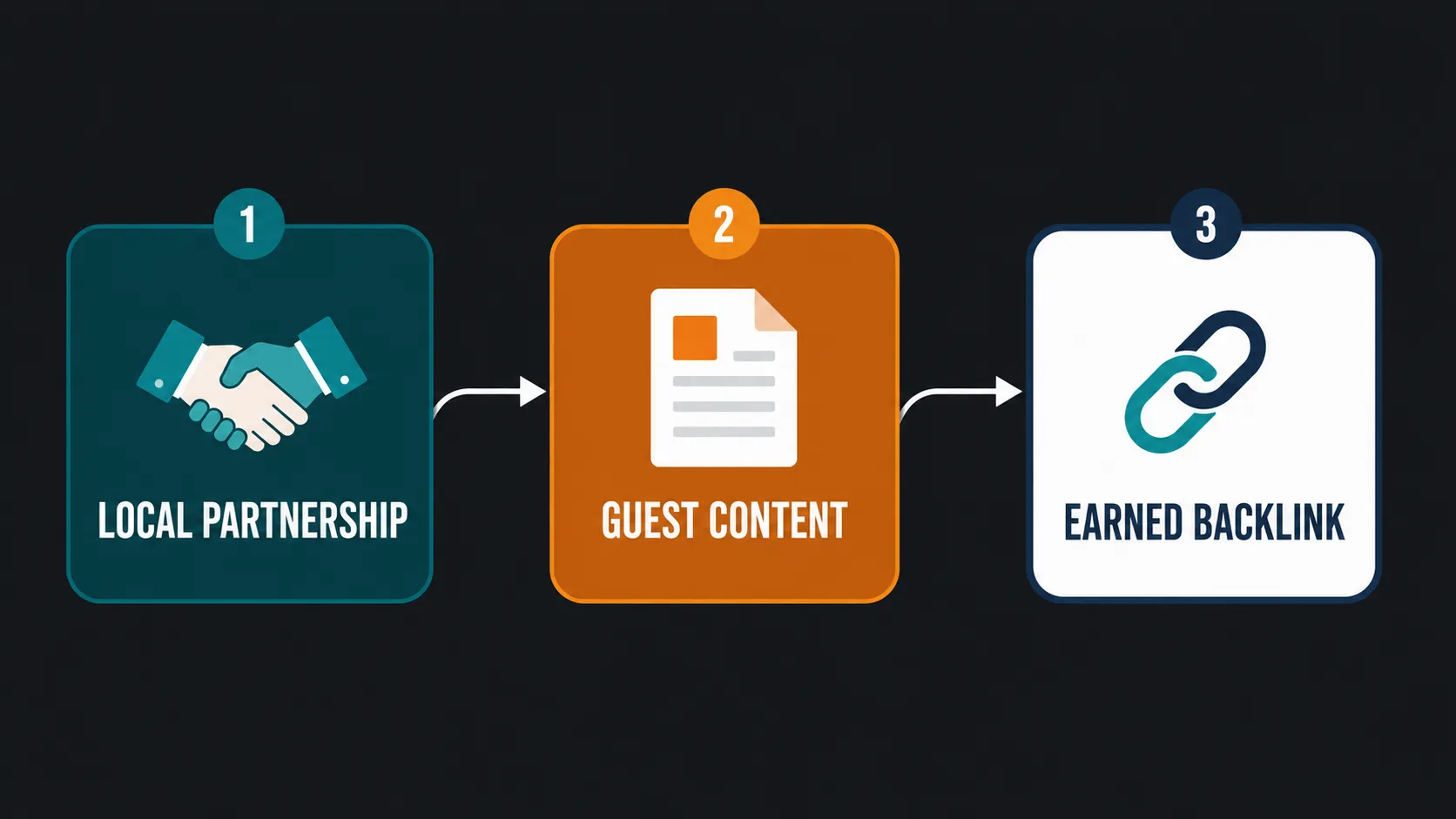
Links from sources like HealthyChildren.org, local school district health pages, pediatric associations, and parenting bloggers who cover real topics carry weight because they signal relevance. A link from the elementary school you partnered with for sports physicals tells Google and parents that real people trust you.
These links tend to come from genuine relationships:
- Guest posts in local parenting newsletters
- Health fair sponsorships
- Partnerships with children’s clothing stores and family businesses that refer patients back and forth
2/ Directory Spam and Bulk-Bought Links That Tank Rankings
Bulk-purchased links from unrelated directories, link farms, or “SEO packages” that promise hundreds of backlinks overnight do the opposite of what you want. Google can tell the difference between a link earned through a real local partnership and one bought in bulk from a site with no relevance to pediatric care.
Practices that chase volume over relevance often see rankings stall or drop after a Google update targets exactly this kind of link.
AI Search Visibility: Showing Up in ChatGPT, Perplexity, and Google AI Overviews
Parents are starting to ask ChatGPT and Perplexity questions like “which pediatrician near me takes same-day sick visits” instead of typing them into Google. If your practice isn’t structured for AI retrieval, you’re invisible in a channel that’s growing every month.
Google AI Overviews, ChatGPT, and Perplexity all pull from pages that answer a question directly in the first sentence or two, then back it up with specifics. A page that opens with three paragraphs of throat-clearing before it says anything useful gets skipped in favor of one that answers immediately.
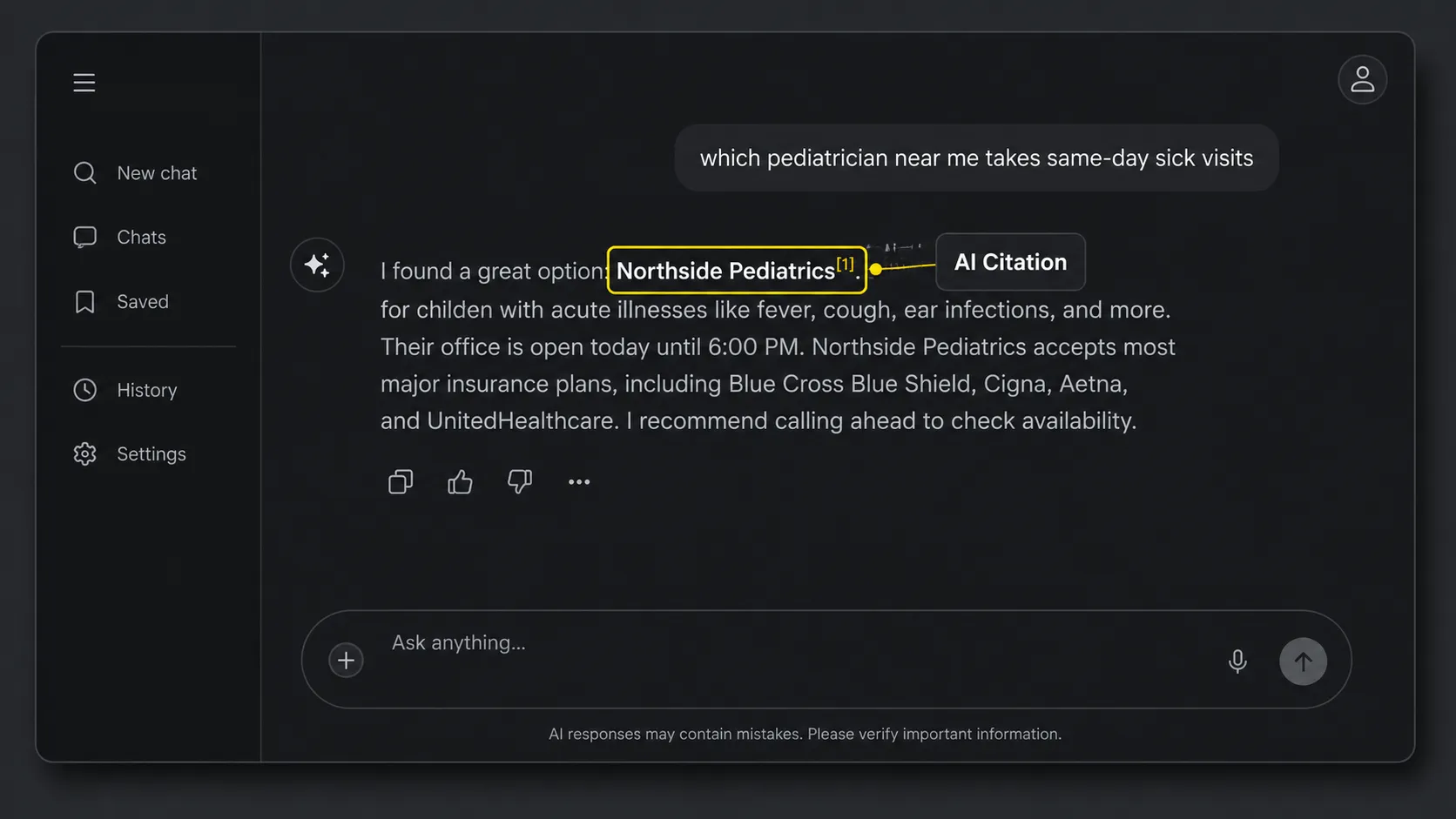
A few structural details make the difference between getting cited and getting skipped:
- FAQ sections that mirror how parents actually phrase questions
- Clear headings phrased as real questions, not vague labels
- Specific details like hours, insurance accepted, and conditions treated
Get these right and you increase the odds an AI engine cites your practice by name instead of a competitor’s.
Reputation Signals That Turn Reviews Into New Patient Bookings
Parents lean on reviews harder than almost any other trust signal when picking a pediatrician. Search engines notice too, factoring in review volume, recency, and how fast you respond.
Research from the University of Michigan found that nearly three-quarters of parents are aware of online physician rating sites, and more than a quarter have used those ratings to actually choose a paediatrician for their child. That’s not a small slice of your patient pipeline.
A consistent review process comes down to a few habits:
- Send a post-visit text asking for a review while the good experience is fresh
- Respond to every review, good or bad, within 48 hours
- Reply thoughtfully to negative reviews, since other parents read how you handle them and it often builds more trust than having no negative reviews at all
Practices with a consistent review process outperform practices that only think about reviews after a bad one shows up. Reputation management for doctors walks through the full system if you want to build this out properly
HIPAA-Compliant Content That Still Ranks
Healthcare SEO has real constraints, but compliance doesn’t have to limit how well your content performs. You just have to write it the right way from the start.
A few habits keep content compliant without losing helpfulness:
- Avoid patient-identifiable details entirely
- Use generalized examples instead of specific case stories
- Write symptom-based, educational content that helps any parent in that situation, not one specific patient’s file
Instead of “our 5-year-old patient with asthma improved after,” write “children with asthma often show symptoms such as.” Same helpfulness, zero risk. HIPAA-compliant SEO covers the full framework for balancing compliance with search performance if your team needs the detailed version.
Getting This Done Without Adding It to Your Own Plate
Everything above, intent-mapped pages, local SEO, schema, backlinks, AI visibility, reviews, works. But building and maintaining all of it by hand is a full-time job most pediatric practices don’t have room for.
We’re an AI SEO agency that runs this entire workflow for clients using CometRank, our proprietary SEO software. Six AI agents handle it:
- Analyst: studies your practice and market
- Strategist: maps parent search intent
- Creator: builds the pages
- Optimizer: keeps everything internally linked and formatted right
- Authority Builder: runs backlink outreach to healthcare-relevant sources
- Quality Guardian: checks every output against your standards before it goes live
A human SEO Captain reviews the work at every stage, so nothing publishes without a person checking it first. If you run more than one location, our AI SEO agency for pediatricians page shows how this applies specifically to pediatric groups, and you can book a demo to see it working on your own market
Strategic Takeaway
SEO for pediatricians works when you stop chasing broad visibility and start building for the exact moment a parent is ready to choose. That means pages built around real search intent, a local and technical foundation that doesn’t quietly leak patients, backlinks that come from genuine trust, and content structured so AI engines cite you by name. Practices that treat this as a system instead of a one-time project are the ones with full schedules next year.
Frequently Asked Questions on SEO for Pediatricians
1. How long does it take to see results from pediatric SEO?
Most pediatric practices start seeing movement in local rankings within three to four months, with meaningful patient inquiries following by month six. Highly competitive metro markets can take longer, especially for condition-specific keywords.
2. Do single-location and multi-location pediatric practices need different SEO strategies?
Yes. A single-location practice focuses on one strong local presence and a handful of intent-mapped pages. A multi-location group needs separate location pages, consistent NAP data across every office, and a content structure that avoids duplicate content between locations.
3. Can a pediatric practice do SEO without breaking HIPAA rules?
Yes. Content stays compliant by avoiding patient-identifiable details and using generalized, symptom-based examples instead of real case stories. Compliant content can still rank well when it’s specific and genuinely useful.
4. What is the difference between local SEO and general SEO for a pediatric practice?
Local SEO focuses on ranking for searches tied to a specific city or neighborhood, like the Google Map Pack and “near me” searches. General SEO covers broader informational content, like symptom guides, that can rank nationally and build topical authority.
5. How do AI search tools like ChatGPT choose which pediatric practices to recommend?
AI tools favor pages that answer a question directly and specifically, usually in the first sentence or two, and that include concrete details like hours, insurance accepted, and services offered. Vague or promotional content gets skipped in favor of pages that read like a direct answer.