
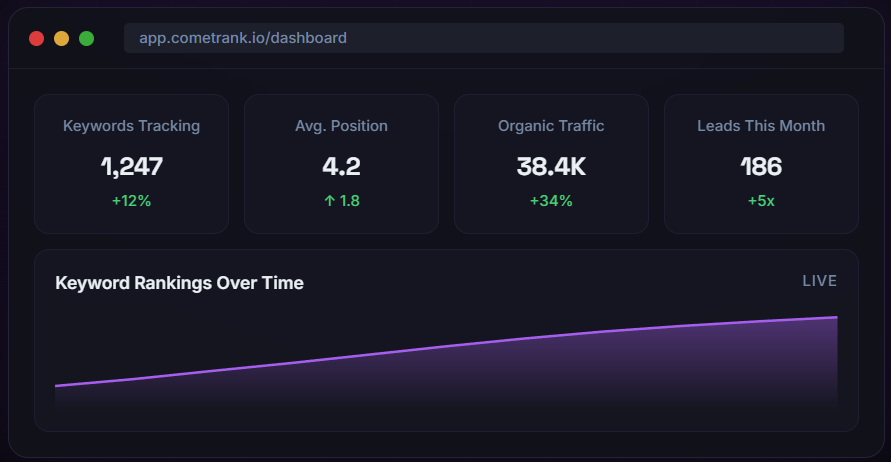
How many divorce cases did your website book last month?
If the answer is “not enough” or “I’m not sure,” your firm has an SEO problem.
Family law is one of the highest-intent legal niches on Google. People searching for a divorce lawyer or a custody attorney aren’t doing research. They’re ready to hire. The only question is which firm shows up first.
This article gives you the exact eight-step strategy to get your firm in front of those clients before your competitors do.
What Is SEO for Family Lawyers?
SEO for family lawyers is the process of making your firm appear in Google search results when potential clients search for divorce, custody, or family law services in your area. Done right, your site generates consultation requests around the clock, without continuous ad spend.
For family law, SEO works across three areas:
- Local search visibility: showing up in Google Maps when someone searches “divorce lawyer near me” in your city
- Organic rankings: appearing on page one for queries like “child custody attorney in Phoenix AZ”
- AI search presence: getting cited by ChatGPT and Google’s AI Overviews when people ask legal questions
Miss any one of these, and you’re leaving cases on the table.
Why Family Law SEO Is Harder Than Other Legal Niches
Family law SEO isn’t just competitive. It’s a specific kind of competitive that most agencies aren’t built to handle.
1/ High local competition
In cities like LA, Dallas, and Chicago, dozens of firms target the same geo-modified keywords. Breaking through without a structured approach is genuinely difficult.
2/ Privacy limits your review acquisition
Family law clients often prefer confidentiality. That creates a gap in one of Google’s most important local ranking signals.
3/ Google holds this content to higher E-E-A-T standards
Family law is YMYL (Your Money or Your Life). Google’s quality raters assess whether content is expert, authoritative, and trustworthy. Thin content doesn’t just underperform. It gets actively deprioritized.
4/ Advertising restrictions limit paid fallbacks
Some states restrict what claims family law firms can make in ads. That means paid search isn’t always a reliable fallback. Organic SEO becomes the only lead channel that compounds over time without the risk of an ad rejection or a cost spike.
Recommended Reading:
If you’re weighing how much to invest in SEO versus paid ads, the best legal SEO services breakdown lays out the ROI difference clearly.
Step 1: Do Keyword Research Around Real Client Problems
Most family law websites target keywords that sound right but don’t convert. “Family law attorney” gets searched. “Emergency child custody lawyer in Tampa FL” books consultations. The difference is intent, and finding the right keywords means looking at how clients actually search, not how the industry talks about itself.
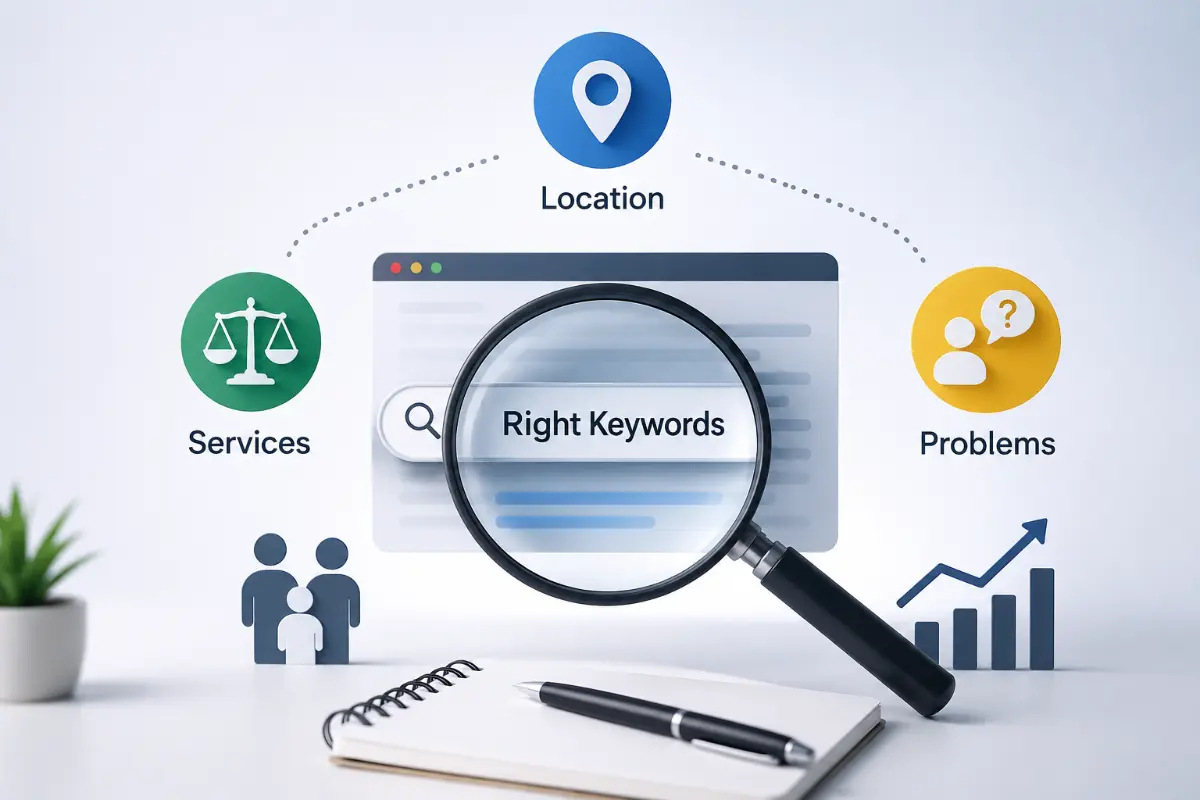
The foundation of effective keyword research starts with client intent
Service-specific, location-modified queries:
- “uncontested divorce lawyer in Houston TX”
- “spousal support lawyer in Los Angeles CA”
- “child custody attorney in Phoenix AZ”
Problem-based searches (earlier stage, still valuable):
- “how long does divorce take in California”
- “can child support be reduced after job loss”
- “what happens to the house in a divorce in Texas”
People searching these are two to four weeks away from hiring. Getting in front of them at this stage means your firm is already in mind when they’re ready to book.
Recommended Reading:
Not sure which keyword types actually drive case inquiries for law firms? The law firm keyword strategy guide breaks down all six keyword types with examples built specifically for legal practices.
Pro-Tip: Target Local Search Volume, Not National Numbers
National keyword volume misleads you into chasing targets you can’t realistically win.
Here’s a real example:
- “Divorce lawyer” nationally: 84,800 monthly searches, keyword difficulty 43
- “Divorce lawyer” in Chicago: 850 monthly searches, keyword difficulty 23
That Chicago version is far easier to rank for, and every person searching it is ready to hire. Filter Google Keyword Planner by city before finalizing any keyword target.
Step 2: Optimize Your Google Business Profile
Your Google Business Profile (GBP) is the first thing most clients see in a local search. According to Google’s own research, customers are 70% more likely to visit businesses with a complete Business Profile. An incomplete or inactive profile hands that traffic directly to the firm next door.
A properly optimized GBP includes:
1/ Primary category
“Family Law Attorney” with secondary categories like “Divorce Lawyer” and “Child Custody Attorney.”
2/ Complete NAP
Name, address, and phone number must be identical across your GBP, website, Avvo, FindLaw, and Justia. Inconsistencies hurt local rankings.
3/ Services listed
Divorce, child custody, spousal support, prenuptial agreements, every practice area you handle.
4/ Regular posts and Q&A
Post weekly. Add answers like “How is child custody determined in Texas?” directly on your profile. It builds trust before a client visits your website.
5/ Review strategy
Ask satisfied clients for reviews. Respond to every one, including negative. Reviews are a direct local ranking factor and the first thing prospective clients read before calling.
Step 3: Fix Your On-Page SEO Elements
On-page SEO means optimizing what’s on each page so Google understands what it’s about and ranks it for the right queries. For family law firms, this is where most sites have the biggest fixable gaps.
1/ Title tag
Include your primary keyword and location. “Divorce Lawyer in Austin TX | Smith Family Law” works. Keep it under 60 characters.
2/ Meta description
150 to 160 characters, includes the focus keyword, gives a reason to click. A vague firm tagline doesn’t cut it.
3/ H1 heading
One per page, includes the primary keyword. Your H1 should be what the client is searching for, not your firm’s slogan.
4/ URL structure
- Keep URLs short, lowercase, and built around the main keyword for that page.
A URL like /divorce-lawyer-austin-tx/ is clean, readable, and keyword-rich. Compare that to something like /services/page2/, which tells Google nothing.
5/ Internal linking
Link related pages to each other. Your divorce page should link to your custody page, your spousal support page, and relevant blog content. This passes authority between pages and helps Google understand your site structure.
Recommended Reading:
Want to go deeper on what actually moves rankings on-page? Our on-page SEO guide covers the 15 most important tactics with implementation steps for each.
6/ Image alt text
Descriptive alt text on every image. It helps accessibility and gives Google more context about your page.
Step 4: Handle the Technical SEO Foundation
Technical SEO determines whether Google can find, crawl, and rank your pages at all. For family law firms, these issues are common and invisible until they show up as ranking problems.
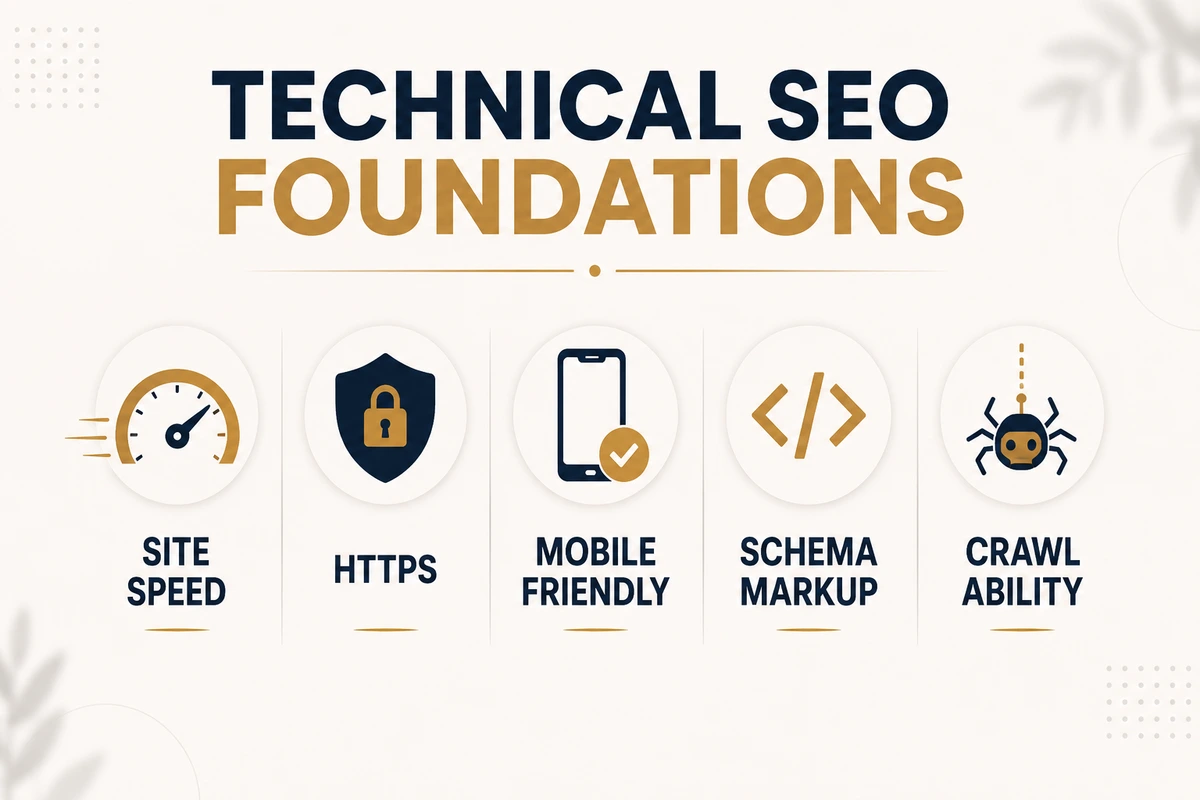
Five strong pillars of technical SEO foundations
Slow sites get penalized. Family law clients searching from their phones during a stressful moment will leave immediately. Run Google PageSpeed Insights and fix what it flags.
2/ Mobile responsiveness
Most family law searches happen on mobile. Text readable without zooming, buttons large enough to tap, forms that submit without errors.
3/ HTTPS
A “Not Secure” warning tells a distressed client your site can’t be trusted. Fix it.
4/ Crawlability
If your pages are accidentally blocked in robots.txt or marked noindex, they won’t rank regardless of content quality. Google Search Console’s coverage report shows exactly what Google can and can’t access.
5/ Schema markup
Attorney schema on bio pages, LegalService schema on practice area pages, FAQ schema on any page with FAQs. Schema-marked content appears richer in search results and gets extracted more reliably by AI Overviews.
Recommended Reading:
For a full walkthrough on how to do technical seo, check out our technical site audit guide.
Step 5: Build High-Intent Service and Location Pages
Location pages are how family law firms capture clients who already know what they need and where they need it. A dedicated page for each practice area in each city you serve is the fastest path to first-page rankings for high-converting queries.
Your site needs dedicated pages targeting:
- “divorce lawyer in Miami FL”
- “child custody attorney in Phoenix AZ”
- “prenuptial agreement lawyer in Chicago IL”
Each page should include state-specific legal procedures, local court information, jurisdiction-specific FAQs, and a direct consultation CTA. Cover the full scope clients ask about: contested vs uncontested divorce, when emergency custody orders are granted, how alimony is calculated in your state.
Family law is YMYL content. Google holds it to a higher standard than a blog about productivity tips. Your pages need to be:
- Detailed
- Accurate
- Backed by credible legal sources.
A thin 300-word page that skims the surface won’t rank and won’t convert. If you want to understand exactly what Google’s quality raters look for on legal pages, the guide on YMYL-compliant legal content writing is worth reading before you start building these pages.
Step 6: Publish Problem-Solving Blog Content
Not every future client searches for a lawyer first.
Many start with the problem, and your blog captures them before they know which firm they’ll hire.
The firms that generate the most organic traffic don’t just publish content. They answer the exact questions potential clients are already searching for. By showing up early in the research process, they build trust before a prospect ever starts comparing law firms.
Blog topics that convert for family law:
- “How is child custody decided in Texas?”
- “How long does divorce take in California?”
- “Can child support be reduced after job loss?”
- “What happens if my spouse hides assets during divorce?”
Open every article with a direct answer in the first two sentences. Google extracts these for featured snippets. End with a clear path to booking a consultation. Solo practitioners especially benefit from this approach since it levels the playing field against larger firms.
Recommended Reading:
Running a solo practice and not sure where to start? The SEO strategy for solo lawyers reveals how smaller firms can outrank larger practices in local search.
Step 7: Build Backlinks From Legal Directories and Local Sources
Backlinks are trust signals. A link from Avvo, Justia, or your local bar association tells Google your firm is a credible result worth ranking. Without them, even well-optimized pages struggle to break onto the first page in competitive markets.
1/ Legal directories
Get fully listed on Avvo, FindLaw, and Justia. They’re where clients check your credentials before calling. A complete profile builds both backlinks and client trust.
2/ Local bar associations
Contribute an article, get mentioned in their newsletter, or participate in publicized events. A link from your state bar carries significant authority.
3/ Community involvement
Sponsor a local family law clinic, a domestic violence shelter, or a children’s advocacy group. Many nonprofits link to sponsors. These links are natural, relevant, and exactly what Google values in YMYL niches.
4/ Guest posts
Write for local legal blogs or regional publications on family law topics. You get a backlink and position yourself as the market expert.
Pro-Tip: Avoid buying links. In a YMYL category, a manual Google penalty can remove your site from the first page entirely.
Step 8: Optimize for Google AI Overviews and AI Search
Google now answers a meaningful share of legal queries through AI-generated summaries at the top of the page. A firm cited in one of these gets visibility without needing a click, and that visibility drives brand recognition with clients who are actively deciding.
To get your content extracted and cited:
1/ Answer capsule format
Every section should open with a direct, standalone answer in the first two sentences. Not a preamble. An actual answer. AI systems pull these because they’re self-contained and extractable.
2/ Question-based headings
“How is child custody decided in Texas?” extracts better than “Child Custody Determinations.”
3/ Schema markup
FAQ schema on FAQ sections, LegalService schema on service pages, Attorney schema on bio pages.
4/ Source credibility
AI Overviews cite pages that cite authoritative sources themselves. Link out to state statutes and court websites. This signals your content is credible enough to be cited.
Recommended Reading:
Full breakdown in law firms in Google AI Overviews blog.
How to Track Whether Your Family Law SEO Is Working
1/ Keyword rankings
Google Search Console shows where you appear for target queries. Watch location-specific service pages specifically. Those rankings correlate directly with consultations.
2/ Consultation requests
Track form submissions and phone calls from organic search via Google Analytics with goal tracking. Without it, you’re running blind.
3/ Local visibility
Monitor GBP appearances in Maps results, clicks, direction requests, and direct calls from the profile.
4/ Backlink growth
Monthly tracking via Google Search Console’s links report. Steady growth signals a healthy authority-building campaign.
Recommended Reading:
The seven metrics that tell you whether SEO is actually converting to revenue are in this SEO metrics guide.
How CometRank Runs SEO for Family Law Firms
Executing all eight steps consistently requires more content, research, and technical work than most law firms can handle internally. That’s exactly the gap we built CometRank to close.
We’re an AI SEO agency that runs this entire workflow for family law clients using CometRank, our proprietary SEO software. Six AI agents handle every part of the process:
- The Analyst maps your ideal client’s search intent and identifies where your firm is losing visibility
- The Strategist builds the keyword plan around family law queries worth targeting in your specific markets
- The Creator produces location pages and blog content optimized for both Google and AI search
- The Optimizer handles internal linking, on-page structure, and conversion readiness on every page
- The Authority Builder runs backlink acquisition targeting legal directories, bar associations, and local sources
- The Quality Guardian reviews every piece of content before it goes live
Every agent runs under a human SEO captain who reviews the strategy, checks the content, and makes sure nothing goes live without expert sign-off.
If you’re looking for an AI SEO agency for law firms and attorneys that’s focused on one outcome, more consultation bookings from organic search, this is built for you.
Book a demo and see what this looks like for your family law practice.
Conclusion
The family law firms ranking at the top of Google right now aren’t there because they have bigger budgets. They built the right content in the right structure and kept at it.
The eight steps compound on each other:
- Keyword research feeds your location pages and blog content
- On-page SEO and technical fixes make those pages rankable
- Backlinks and GBP build the local authority that pushes them to page one
- AI search optimization makes sure you show up beyond Google, too
Build this system, and you stop chasing referrals. You start receiving a steady stream of inbound consultation requests from clients who already want to hire you.
Frequently Asked Questions About SEO for Family Lawyers
1/ How long does SEO take to work for a family law firm?
Most family law firms see meaningful ranking movement within 3 to 6 months of consistent SEO work. Competitive markets like LA or New York can take 6 to 12 months for first-page results on high-intent queries. Location-specific service pages tend to move faster than broad keyword targets.
2/ How much does SEO cost for a family law firm?
Traditional SEO agencies typically charge $3,000 to $5,000 per month for 4 to 10 pages of content. AI-powered options start lower and produce significantly more pages in the same timeframe. The right budget depends on your market size and how competitive your target keywords are.
3/ What keywords should a family lawyer use for SEO?
Start with location-modified service queries like “divorce lawyer in [city]” and “child custody attorney in [city].” Layer in problem-based terms like “how long does divorce take in [state].” Use Google Keyword Planner filtered by city, not national numbers.
4/ Is local SEO important for family law firms?
Yes. Family law is one of the most location-dependent legal niches. Clients won’t hire a firm outside their metro. Google Business Profile optimization and location-specific service pages are the single highest-ROI SEO investment for most family law practices.
5/ How do family lawyers get more clients through SEO?
Combine a fully optimized Google Business Profile with location-specific service pages and problem-solving blog content. Firms appearing in the local pack, organic results, and AI Overviews simultaneously generate consultation requests from multiple entry points without continuous ad spend.
6/ What makes a good family law website for SEO?
Fast mobile load speed, a dedicated page for every service and location, structured data markup (Attorney schema, FAQ schema, LegalService schema), state-specific legal detail, and a frictionless consultation booking path from every page.
7/ Do family lawyers need social media for SEO?
Social media is not a direct Google ranking factor, but it supports SEO indirectly. Sharing blog content on LinkedIn and Facebook drives traffic, increases engagement signals, and can generate natural backlinks. It also builds brand trust that converts first-time visitors into consultation bookings.
8/ What is the best way to get clients as a family lawyer?
Organic search through a structured SEO strategy is the highest-ROI long-term channel for most family law firms. It combines Google Business Profile visibility, first-page organic rankings, and AI Overview citations to generate consistent inbound consultation requests from clients actively searching for representation.