
Ecommerce SEO is no longer just about ranking product pages. Today, brands also need visibility in AI search engines, AI Overviews, and answer engines like ChatGPT and Perplexity.
That requires tools that can identify high-intent keywords, generate structured content, optimize product pages, and build topical authority at scale.
This guide compares the best rated AI tools for ecommerce SEO and AI visibility, what they do best, and when ecommerce teams should use them.
Why Ecommerce SEO Now Requires AI Tools
Traditional SEO tools focused mainly on keyword data and backlink tracking. Ecommerce SEO today involves a much larger system:
- product page optimization
- intent-based content clusters
- structured internal linking
- AI-readable content formats
- scalable page generation
Many ecommerce teams also struggle with the cost and speed of manual SEO, which is why AI automation is becoming essential. For example, the real cost of manual SEO per page can quickly scale into thousands of dollars when agencies or writers create pages one by one.
AI SEO platforms reduce that cost while increasing coverage across thousands of keywords.
1. CometRank — AI SEO Command Center for Ecommerce Growth
Best for: full-stack AI SEO automation and AI search visibility.
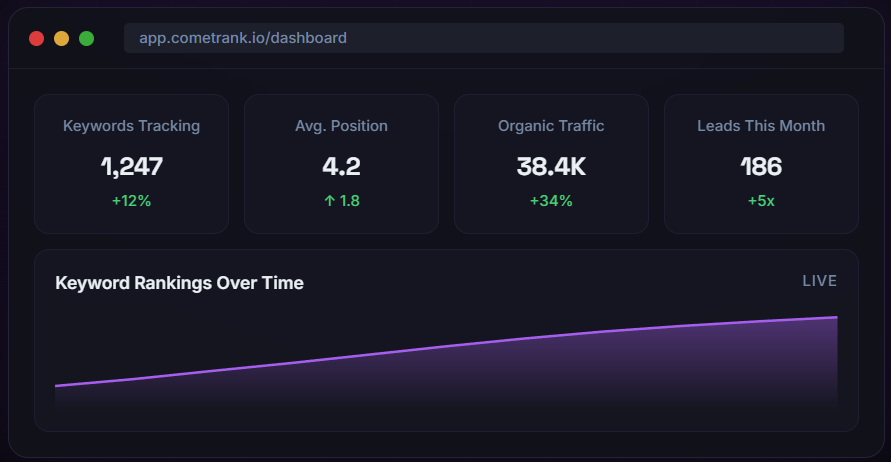
Cometrank is designed as an AI SEO command center rather than just a research tool. Instead of only showing keyword data, it helps ecommerce brands turn search demand into published pages and ranking content.
The system uses multiple AI agents to handle the entire SEO workflow:
- AI SEO Analyst identifies ranking gaps and keyword clusters.
- AI SEO Strategist maps search intent across product, category, and blog pages.
- AI SEO Creator generates structured SEO pages.
- AI SEO Optimizer improves internal linking and content depth.
- Authority Builder strengthens ranking signals.
Example: Ecommerce keyword coverage
A skincare brand targeting the keyword:
“vitamin C serum for hyperpigmentation”
Instead of creating a single product page, CometRank might generate:
Page structure
- Category page
Best vitamin C serums for hyperpigmentation - Product page optimization
Vitamin C serum 20% for dark spots - Educational guide
How vitamin C helps reduce hyperpigmentation - Comparison article
Vitamin C vs niacinamide for dark spots
This cluster approach helps brands capture multiple buying stages, which is one reason why SEO is important for ecommerce websites in the first place.
2. Surfer SEO — AI Content Optimization
Best for: optimizing blog posts and landing pages.
Surfer SEO analyzes the top ranking pages for a keyword and recommends:
- headings to include
- keyword usage
- content length
- topic coverage
For ecommerce brands, it is most useful when building educational content around products.
Example
Keyword:
“best running shoes for flat feet”
Recommended content structure:
- What causes flat feet while running
- Features to look for in running shoes
- Stability vs motion control shoes
- Recommended models
This helps content rank for product discovery searches.
However, Surfer does not manage content strategy or large-scale page creation, which ecommerce stores often need.
3. Ahrefs — Competitive SEO Intelligence
Best for: competitor research and backlink analysis.
Ahrefs remains one of the most powerful SEO data platforms for discovering:
- competitor keyword rankings
- backlink opportunities
- content gaps
Example: Competitor keyword gap
If a competitor ranks for:
- “wireless gaming headset for PS5”
- “best PS5 headset with noise cancellation”
Ahrefs can reveal those keywords, allowing ecommerce teams to build optimized product or blog pages.
However, Ahrefs mainly provides data, not automated content creation.
4. Jasper — AI Writing for Ecommerce Content
Best for: generating marketing content quickly.
Jasper is commonly used by ecommerce teams to produce:
- product descriptions
- marketing copy
- blog articles
Example use case:
Keyword:
“organic cotton baby clothes”
A Jasper-generated page might include:
- product benefits
- sustainability details
- washing instructions
- customer FAQs
However, Jasper does not manage SEO strategy, keyword clustering, or internal linking systems.
5. Semrush — All-in-One Marketing Suite
Best for: SEO + paid search analysis.
Semrush combines several capabilities:
- keyword research
- competitor analysis
- PPC data
- content optimization
It is particularly useful when comparing SEO vs paid acquisition strategies, such as the ROI differences explained in Meta ads vs SEO for Ecommerce websites.
However, like most legacy SEO tools, Semrush focuses more on analysis than execution.
What AI Search Visibility Means for Ecommerce
AI search visibility is becoming a critical growth channel. Platforms like Google AI Overviews increasingly pull information from structured, well-organized content clusters.
For ecommerce brands, this means optimizing not only product pages but also supporting content.
For example, strong SEO for Ecommerce product pages typically includes sections such as:
- product specifications
- FAQs about use cases
- comparison information
- buyer guidance
- structured internal links to related products
AI SEO platforms help automate this process across hundreds or thousands of SKUs.
How to Choose the Right AI SEO Tool
The best tool depends on what problem you need to solve.
Use research tools if you need:
- keyword data
- competitor analysis
- backlink insights
Use AI SEO platforms if you need:
- content creation at scale
- product page optimization
- internal linking automation
- AI search visibility
Many ecommerce brands combine research tools with an AI SEO platform to turn keyword opportunities into published ranking pages.
If you want a deeper look at research platforms, see this guide to SEO tools for keyword research.
The Future of Ecommerce SEO Is AI-Driven
Ecommerce SEO is shifting from manual page optimization to automated search visibility systems.
Brands that win in search are no longer just targeting a handful of keywords. They are building large intent-driven content ecosystems around products, problems, and buying decisions.
AI platforms like CometRank are designed to run this system continuously—finding opportunities, creating content, optimizing pages, and building authority.