
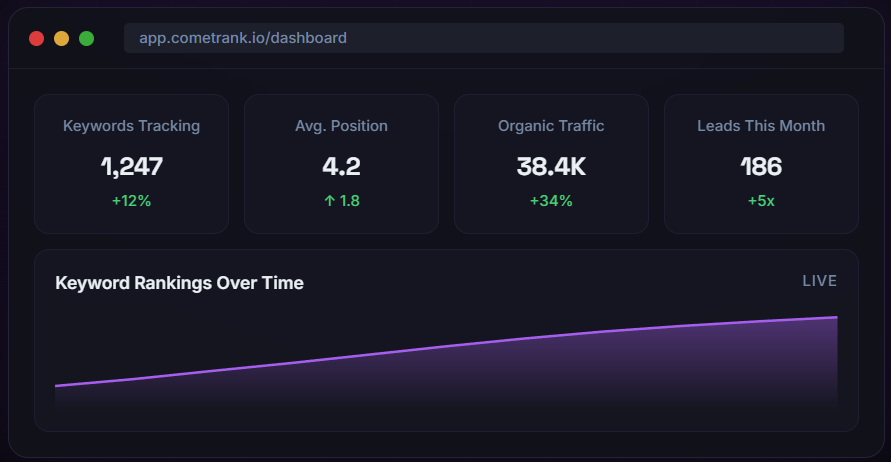
Why do small charities with limited budgets rank above well-funded nonprofits on Google?
It’s not the size of the organisation. It’s not how long it has existed. It’s structure. The charities that show up first have:
- matched their content to exactly what donors and volunteers type into Google
- backed it with the technical and trust signals search engines reward
In this article, we cover exactly what a working SEO strategy for charities and non-profits looks like, so your organisation stops losing donors and volunteers to whoever ranks above you.

Why an SEO Strategy for Charity & Non-Profits Matters More Than Ad Spend
Search is one of the few channels where nonprofits compete on equal footing with much larger organisations, and it doesn’t require an ad budget to win.
Unlike businesses, nonprofits often operate with limited marketing budgets, which makes organic search one of the most cost-effective ways to reach supporters. Charities like charity: water have built sustained backlink profiles through media coverage and partner campaigns alone, without paid promotion.
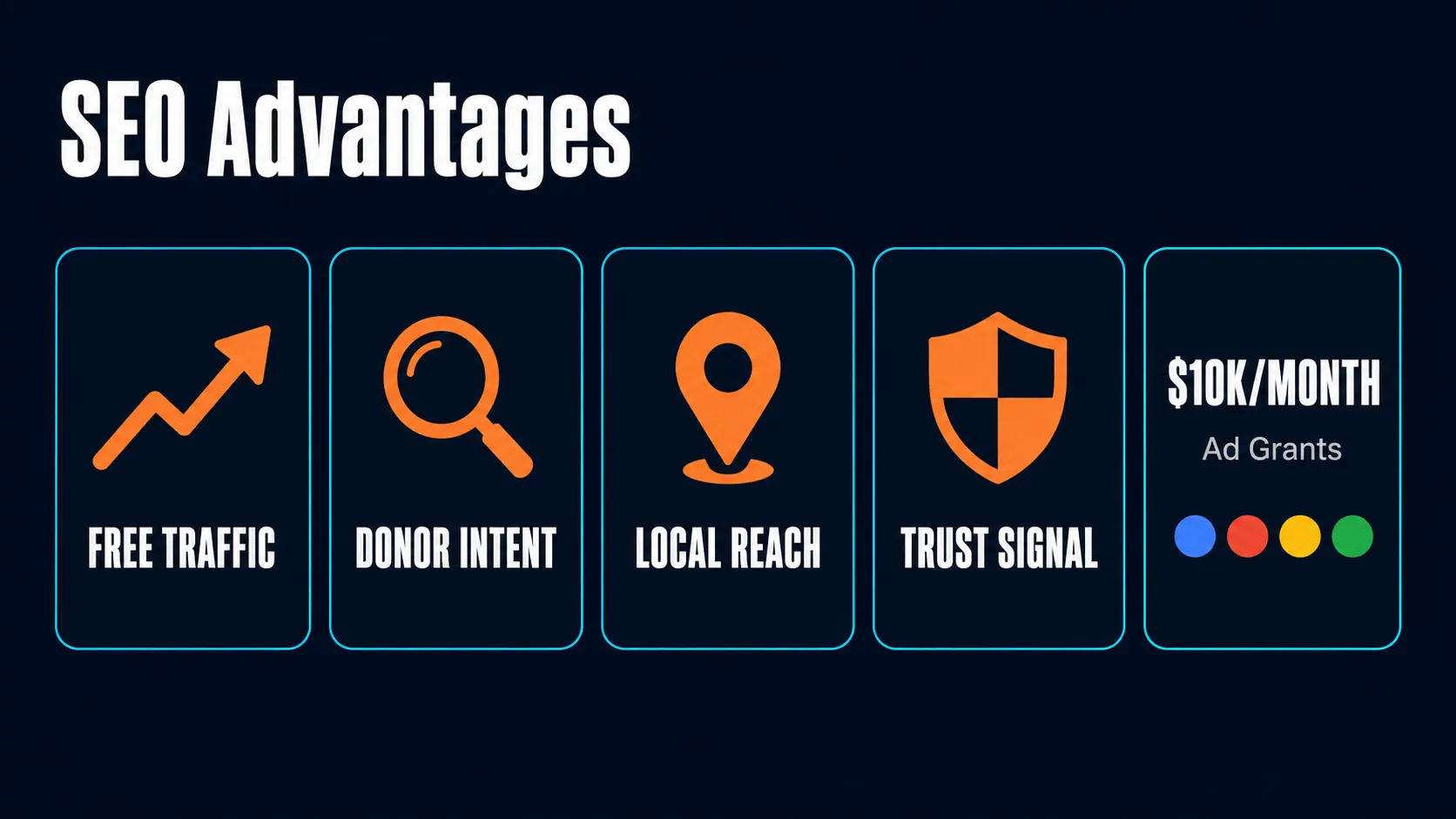
SEO allows nonprofits to:
- attract donors searching for causes to support
- recruit volunteers in specific locations
- raise awareness for social issues
- drive consistent long-term traffic
- qualify for free advertising through Google Ad Grants
Someone searching “donate to homeless shelter near me” is already motivated to help. Ranking for that search means your organisation captures the intent at the exact moment someone decides to act.
There’s also a funding angle most nonprofit SEO guides skip. Eligible 501(c)(3) organisations can apply for Google Ad Grants, which provides up to $10,000 per month in free Google Search advertising. The grant works best paired with organic SEO, since Google requires linking ads to content-rich, keyword-relevant landing pages, not thin donation forms.
Identify High-Intent Keywords for Donors and Volunteers
A nonprofit SEO strategy starts with keywords that reflect donation, volunteer, and cause-based intent, not just broad awareness terms.
Examples of high-intent nonprofit keywords include:
- donate to animal shelter near me
- sponsor a child education charity
- volunteer at food bank in Dallas
- climate change nonprofit donations
A nonprofit focused on wildlife conservation might target a keyword like “donate to wildlife conservation charity.” A well-structured landing page for that exact keyword should cover sections including:
- wildlife conservation challenges
- current projects and impact
- where donations go
- transparency reports
- donation options
Most charities make the same mistake here: they target broad, high-competition terms like “charity donations” or “nonprofit organization” because those have the highest search volume. Volume alone is misleading. A national children’s hospital and a five-person animal rescue are competing for the same broad term, and the smaller organization rarely wins that fight.
Specific, cause-and-location-based keywords have lower volume but far higher conversion, since the person searching has already decided what they want to support and is choosing who to give it to.
Finding these opportunities is much easier with specialized tools. Many organizations use SEO tools for keyword research to identify the exact phrases donors are searching for and build content around them.
How to Create Cause-Focused Content That Builds Authority and Trust
Search engines weigh experience, expertise, authority, and trust heavily for nonprofits, especially those working in health, education, or social justice. Organizations like Doctors Without Borders earn this trust by publishing transparent reports and showcasing staff expertise directly on their site.
A strong SEO strategy for charity and non-profits means publishing problem-solving content that answers real questions donors search for, not generic posts.
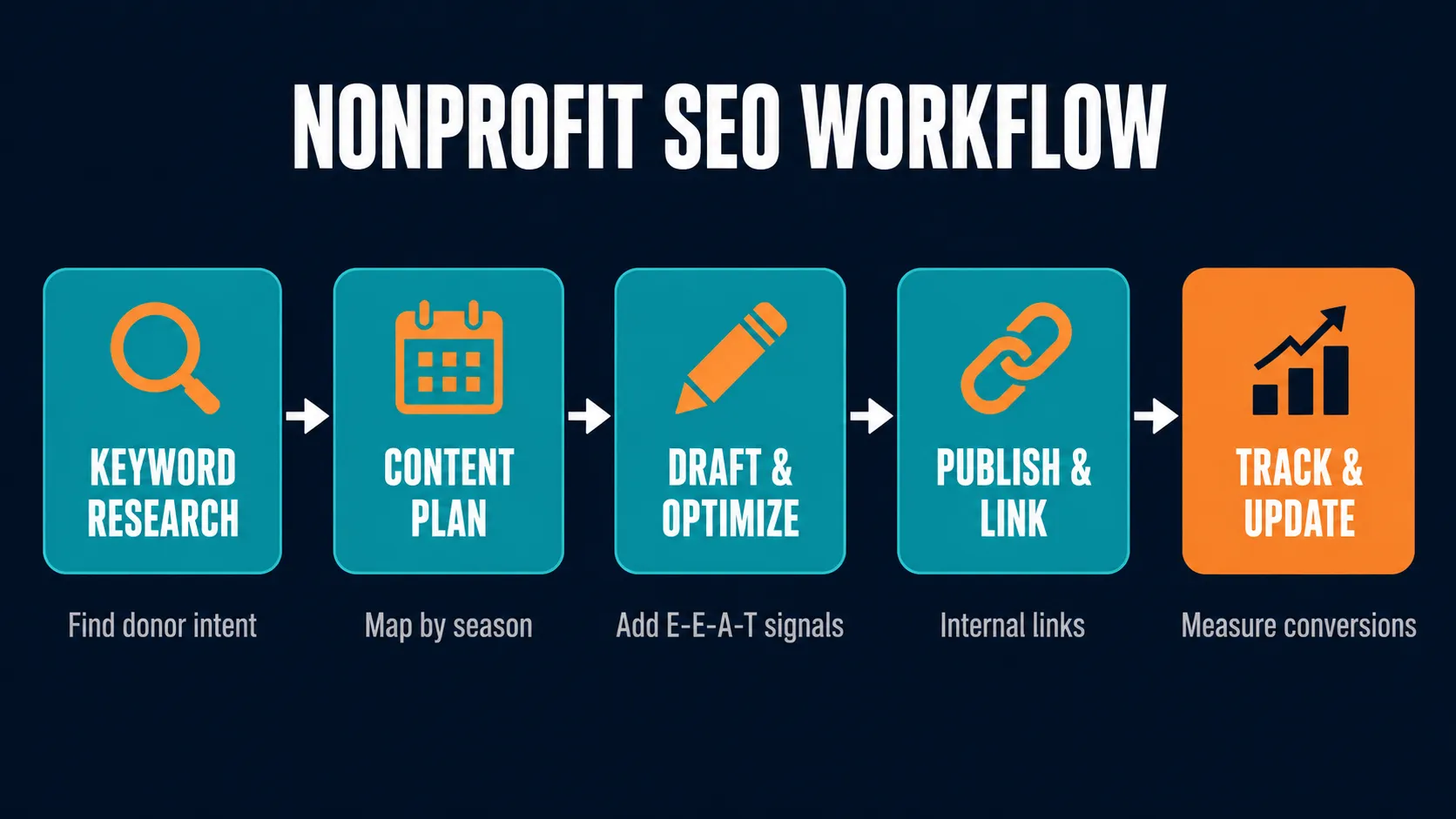
For example, an organization addressing homelessness might create an article targeting “how to help homeless people in Chicago.” A well-structured article on that keyword could include:
- statistics on homelessness in Chicago
- ways individuals can help locally
- donation opportunities and volunteer programs
- real impact stories
Publishing this consistently requires planning. Many nonprofits use a post calendar for SEO to organise blog topics, seasonal campaigns, and awareness initiatives.
Optimize Donation Pages for Search and Conversions
A donation page only drives giving if people can find it through search, not just through a navigation menu.
Most charities hide donation pages behind a generic button and leave them unoptimised. A page targeting a keyword like “donate to animal rescue organization” should include:
- the rescue mission and impact
- stories of animals placed in homes
- how donations are used
- transparency and accountability
- donation tiers and options
A form with a “Donate Now” button gives Google nothing to index and gives a hesitant donor no reason to trust the ask. Add one or two recent impact stories with specific numbers and the page earns both the depth search engines reward and the proof donors need before giving.
Use Local SEO to Attract Volunteers and Community Support
Many charities operate locally, making local SEO one of the highest-return tactics in any SEO strategy for charity and non-profits.
When someone searches “food bank near me,” “volunteer at animal shelter Houston,” or “charity organizations in Tampa FL,” Google prioritizes location-based organizations over national ones. Meals on Wheels does this well by optimizing local pages with city-specific keywords and service details.
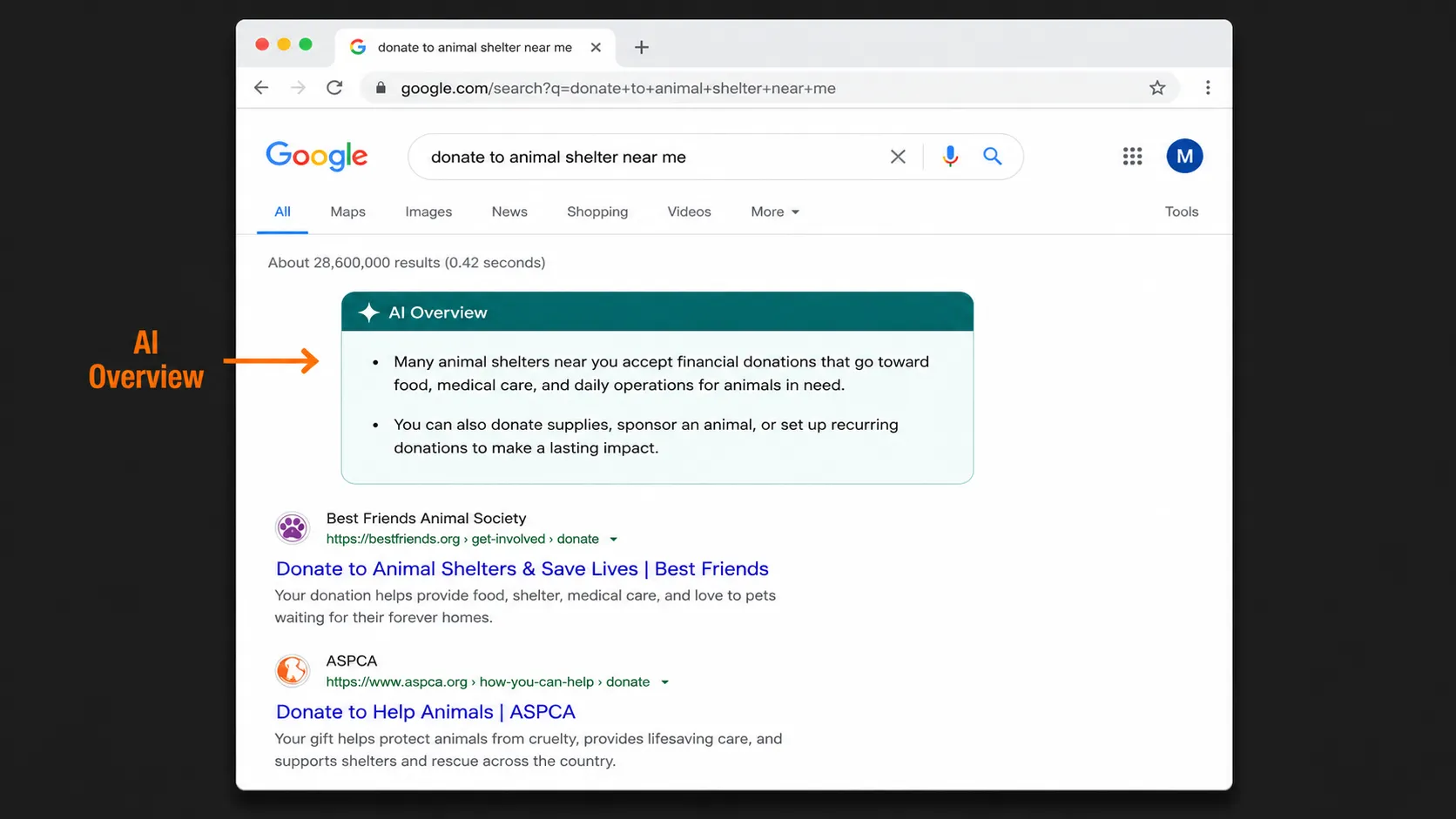
To improve local visibility, nonprofits should:
- optimize their Google Business Profile
- create city-specific landing pages
- list volunteer opportunities by location
- build local backlinks from community organizations
A page targeting “food bank donations in Dallas Texas” should cover who the food bank serves, how distribution works, donation methods, volunteer opportunities, and local impact. For a deeper walkthrough, see this guide on optimizing your Google Business Profile for local SEO.
Backlinks: The Trust Signal in Every SEO Strategy for Charity and Non-Profits
Backlinks remain one of the most important ranking factors in SEO, and a solid SEO strategy for charity and non-profits unlocks link-building opportunities most for-profit businesses never get.
Helpful Links That Build Authority
Nonprofits earn strong backlinks through:
- media coverage of campaigns and impact stories
● community partnerships and joint initiatives
● government and institutional initiatives
● original research reports
● fundraising pages that journalists and partners reference
A nonprofit launching a clean water campaign could create a dedicated page and promote it through press outreach, partners, and social media. This earns links from news sites and NGOs, improving search authority significantly. Directories like GuideStar and Charity Navigator are also reliable sources of credible backlinks, signalling trust to search engines without requiring outreach for every link.
Harmful Links to Avoid
Not every backlink helps. Purchased links, link farms, and irrelevant directory submissions can flag a site for manual review and suppress rankings. Reciprocal link exchanges with unrelated sites carry the same risk. A smaller number of links from relevant, reputable sources consistently outperforms a large volume of low-quality ones.
Organizations looking for external support often evaluate the best SEO companies for small businesses to help implement link building and content scaling without diverting staff time from programs.
AI Search Visibility: Showing Up in ChatGPT, Perplexity, and Google AI Overviews
Donors and volunteers increasingly ask AI tools direct questions instead of typing keywords into Google, and nonprofits that structure content clearly are the ones AI engines choose to cite.
ChatGPT, Perplexity, and Google AI Overviews pull from content that answers a question directly within the first few sentences, then backs it with specific, factual detail. A page that buries the answer under a long introduction rarely gets quoted, no matter how accurate the information is.
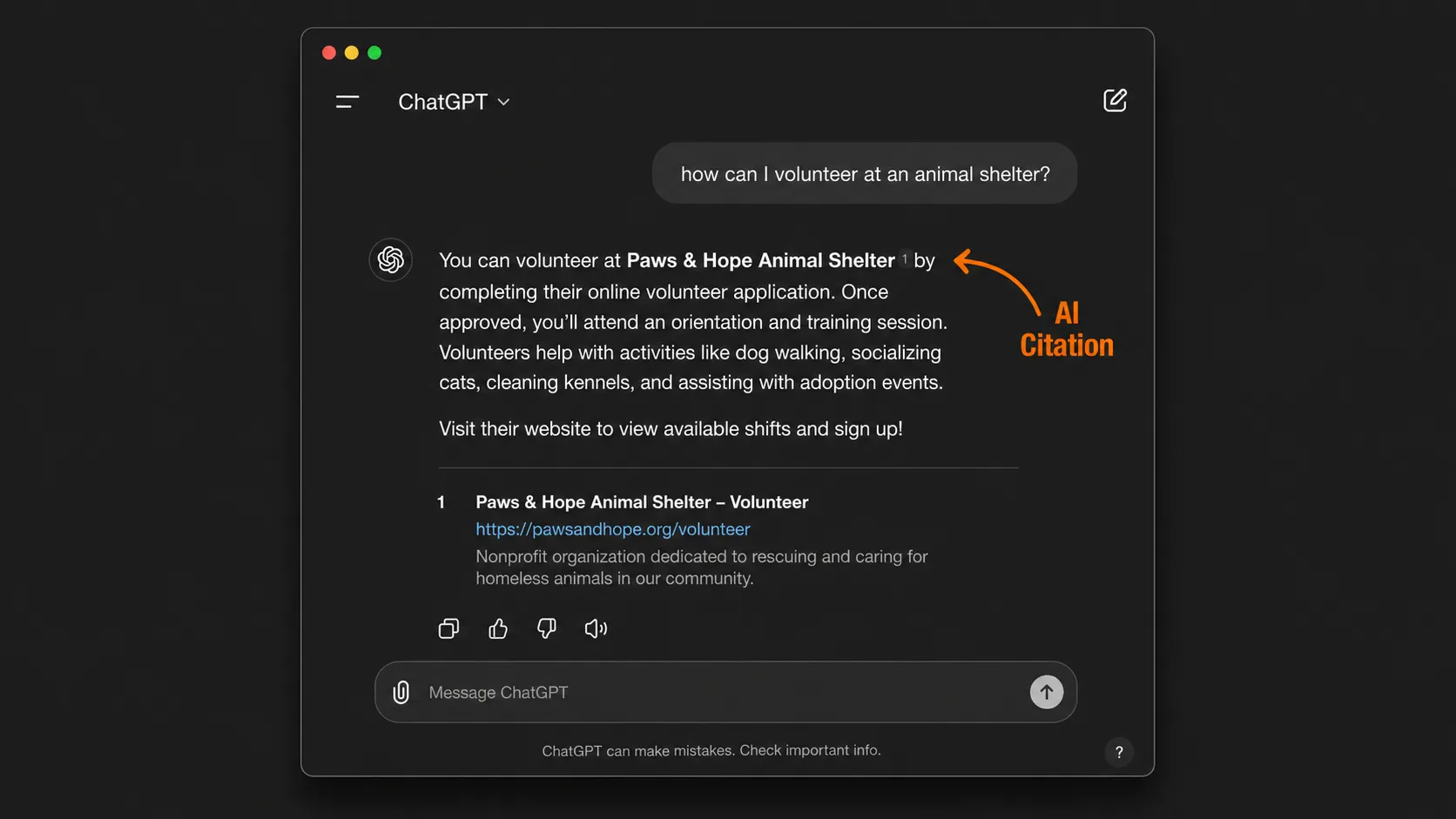
Any SEO strategy for charity and non-profits today must account for AI visibility. To improve it, nonprofits should:
- answer each section’s heading directly in the first sentence or two
- use clear, factual statements instead of vague mission language
- publish content under named, credentialed authors
- keep FAQ sections current, since AI tools frequently pull from them
When someone asks ChatGPT “how can I volunteer at an animal shelter in Houston,” the organizations cited are the ones whose volunteer pages state the time commitment, location, and sign-up process plainly in the opening lines, rather than burying that under a paragraph of mission statement.
You can check how your site currently performs with an AI search grader to see whether ChatGPT and Google AI already recognize your organization. For a broader look at how this discipline differs from traditional ranking work, this breakdown of generative engine optimization versus SEO is a useful next read.
How CometRank Handles SEO for Charities and Non-Profits
Running a full nonprofit SEO strategy means managing keyword research, local pages, backlink outreach, AI optimization, and content production simultaneously, usually with a marketing team of one or two people.
We’re an AI SEO agency that runs this entire workflow using CometRank, our proprietary software. CometRank deploys six AI agents across every layer:
- Analyst identifies keyword and intent opportunities
- Strategist builds the content and link roadmap
- Creator produces optimised, search-ready content
- Optimizer handles on-page signals and technical fixes
- Authority Builder manages citations and link building
- Quality Guardian reviews every output before it goes live
A human SEO captain checks everything before publishing. If you’re looking for an AI SEO agency built for mission-driven organizations, this is what execution at scale looks like. Book a demo and we’ll build your nonprofit’s search roadmap on the call.
The Long-Term Value of SEO for Charities
SEO is not a short-term campaign. It is a long-term visibility strategy that compounds with every piece of content published.
The right SEO strategy for charity and non-profits creates a sustainable channel that consistently brings donors, volunteers, community supporters, and media attention, without an ad budget powering it.
Track what actually matters: organic traffic to your donation and volunteer pages, conversion rate from that traffic, and which posts drive email sign-ups. Pageviews alone don’t fund programs.
Organizations that invest in this consistently develop authority in their cause area, making it easier for the people already searching to find and support their mission.
SEO Strategy for Charity and Non-Profits: Frequently Asked Questions
1/ What makes a good SEO strategy for charity and non-profits?
A strong nonprofit SEO strategy targets donor and volunteer intent separately, builds location-specific pages for local programs, and earns backlinks through media coverage and partnerships rather than purchased links. It also structures content so AI search tools can cite it directly.
2/ Can SEO help nonprofits raise awareness for a specific cause?
Yes. Publishing educational content that answers the questions people search before they know your organization’s name builds awareness earlier in the supporter journey, often before someone is ready to donate or volunteer.
3/ How is nonprofit SEO different from business SEO?
The mechanics are the same, but nonprofits typically optimize for four audiences at once: donors, volunteers, beneficiaries, and media or partners. Most for-profit SEO only optimizes for buyers.
4/ Do Google Ad Grants replace the need for SEO?
No. Google requires Ad Grant campaigns to link to relevant, keyword-rich landing pages, so the grant performs better when paired with organic SEO rather than used as a substitute for it.