
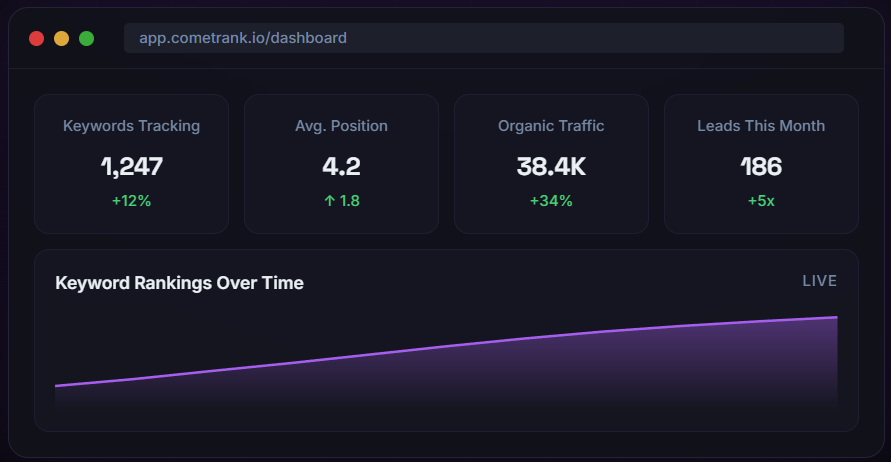
Why do newer OB-GYN practices outrank yours for local searches?

The practices showing up first didn’t get there through reviews or experience alone. They built a page for every condition they treat, kept their listings identical across every directory that matters, and wrote content the way patients actually search instead of the way a textbook would. Most practices still haven’t caught up.
In this article, we cover exactly what SEO for gynecologists requires to close that gap, from local search and backlinks to getting cited in ChatGPT and Google AI Overviews.
Why SEO for Gynecologists Starts With How Patients Search
Most gynecology patients now research a provider online before they ever pick up the phone. Research from Pew Research Center shows that most online health seekers begin at a search engine like Google, not a directory or a referral.
These aren’t vague searches. Patients search with intent, and that intent is exactly what SEO for gynecologists has to match.
High-intent gynecology searches look like this:
- “gynecologist near me accepting new patients”
- “best OBGYN for PCOS in [city]”
- “IUD insertion gynecologist [city]”
- “menopause specialist near me”
- “prenatal care OBGYN [neighborhood]”
Notice the pattern. Patients increasingly search in plain, personal language, “delayed periods” or “pelvic pain,” not “menstrual disorder.” Match that language and you show up. Match only the clinical term and you don’t.
Most of these searches happen quietly on a phone, often before the patient has told anyone else what’s going on. That’s part of why search has become the first consultation for many women’s health decisions, not a backup option after a referral falls through.
| Search Type | Example | What the Patient Wants |
| Informational | “what is PCOS” | Education, not a booking |
| Local intent | “gynecologist near me” | A practice to call now |
| Condition-specific | “PCOS specialist [city]” | A specialist for their problem |
| Transactional | “book gynecologist appointment online” | Immediate booking |
Ranking for the bottom two rows drives appointments. The top row drives traffic, not patients.
Where Does Google Show Gynecology Practices When Patients Search?
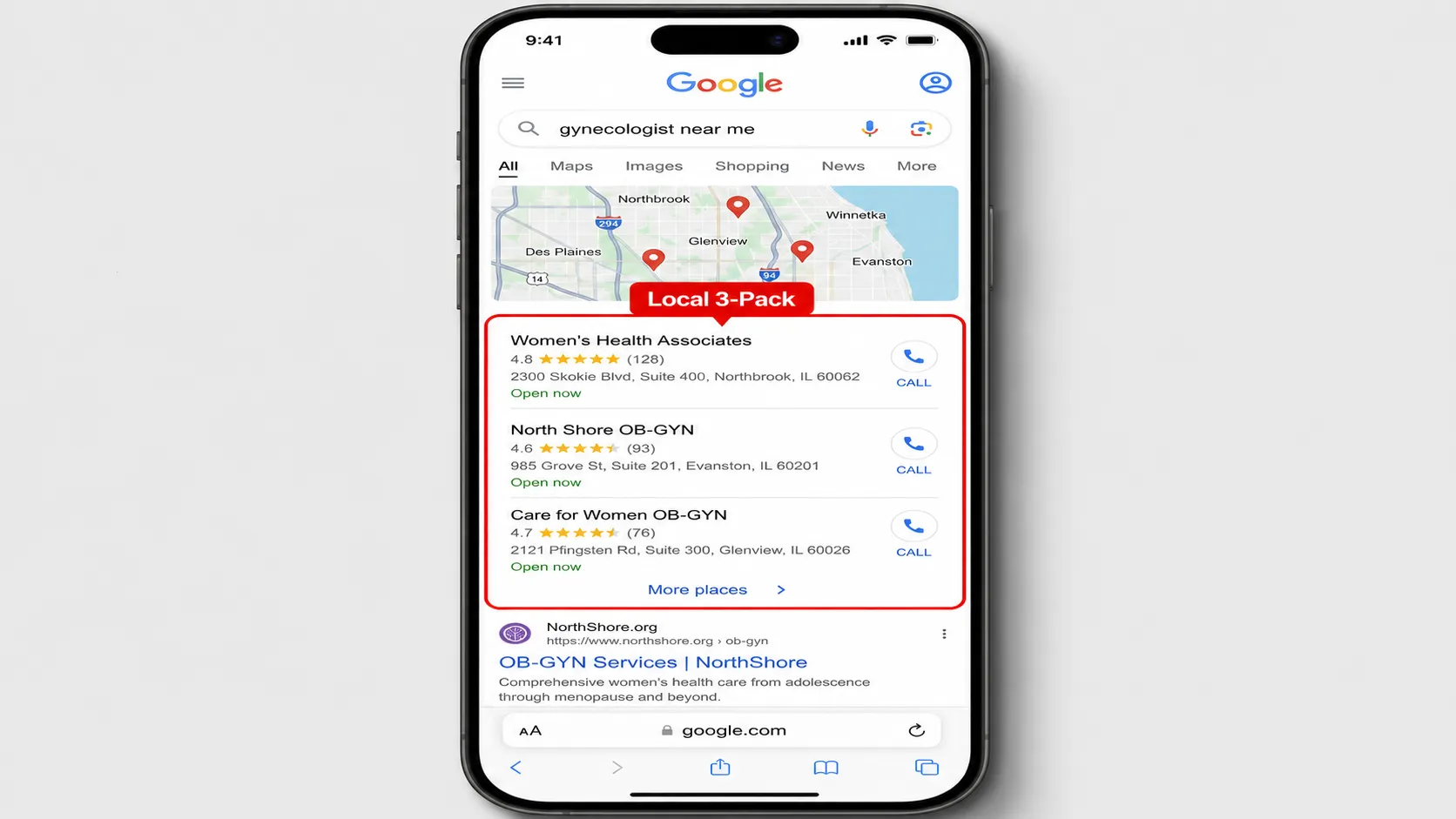
Google surfaces your practice in three places:
- The Local 3-Pack
- Organic results
- Google Business Profile.
The 3-Pack drives the most bookings for local practices and appears above organic results on mobile. If you’re not in it, most patients searching right now won’t find you.
| Ranking Surface | What It Requires | Booking Impact |
| Google Local 3-Pack | Optimised Google Business Profile, strong reviews, local citations | Highest, especially on mobile |
| Organic search results | Content targeting condition and service keywords | High for condition-specific searches |
| Google Business Profile | Complete profile, photos, Q&A, weekly posts | Drives direct calls and direction requests |
What it takes to rank in the 3-Pack:
- A fully completed Google Business Profile with your services listed
- A consistent NAP (name, address, phone) across every directory
- At least 20 to 30 recent reviews with responses
- Location-specific pages on your website
Two pieces practices skip most often are weekly Google Business Profile posts and the Q&A section, which Google treats as proof the listing is actively managed rather than abandoned, and our guide on local SEO for medical professionals walks through how to build that foundation properly. The 3-Pack is the first decision point in SEO for gynecologists. Win it before anything else.
Off-Page SEO for Gynecologists: Which Backlinks Actually Help a Gynecology Website Rank
Not every backlink helps. Google has gotten much better at telling the difference between a link that signals real clinical authority and a link bought purely to manipulate rankings.
Backlinks That Build Real Authority for Gynecology Practices
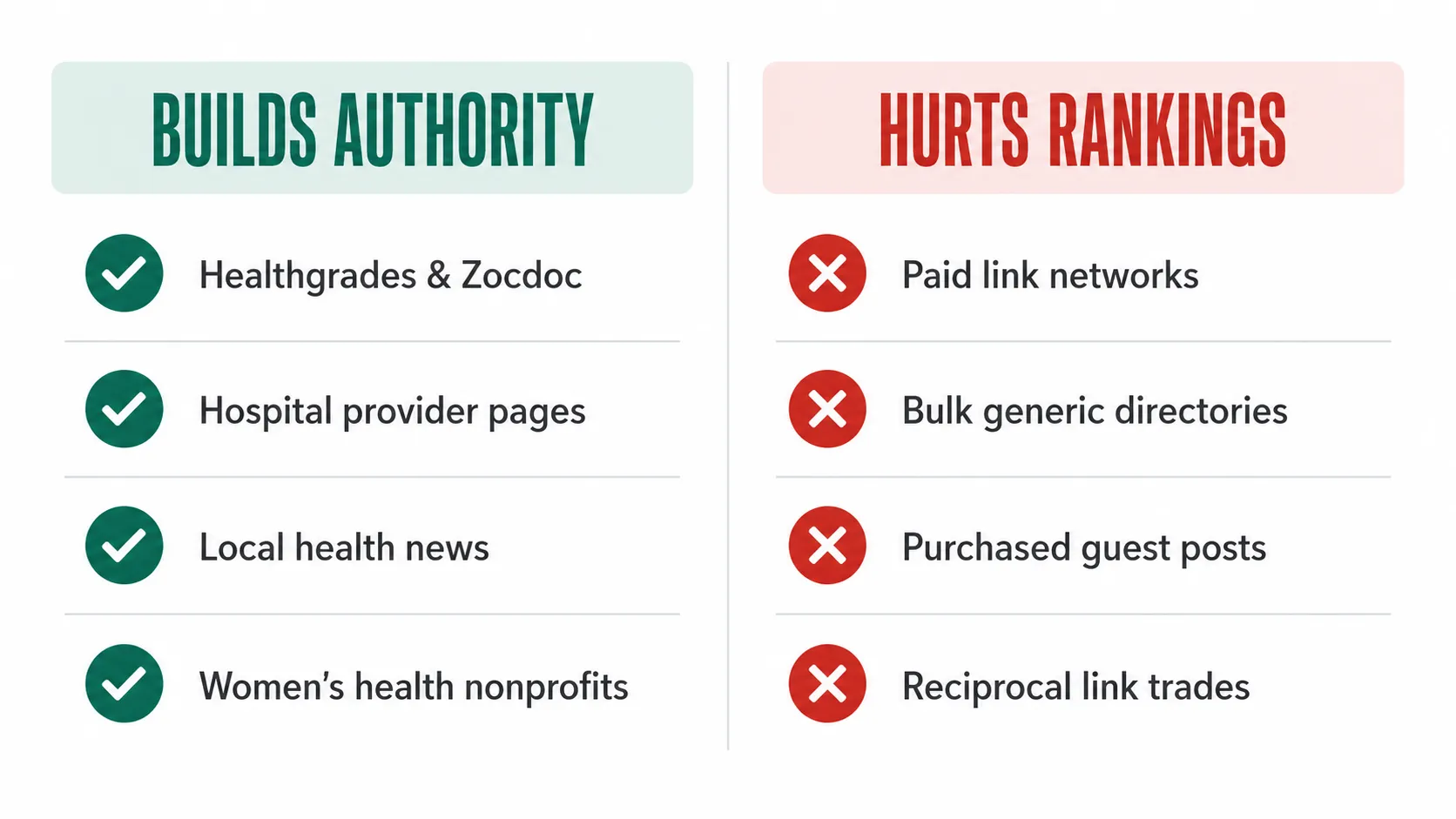
The links that actually move rankings come from sources Google already trusts in healthcare.
- Medical directories built specifically for healthcare, like Healthgrades and Zocdoc
- Affiliated hospital or health system pages that list you as a provider
- Local news coverage of a community health event, screening drive, or sponsorship
- Women’s health organizations and condition-specific nonprofits relevant to your specialty
These links work because they come from sites already trusted in the exact category your practice operates in.
Backlinks That Hurt More Than They Help
Some links actively damage rankings instead of just wasting budget.
- Paid link networks promising an “instant domain authority boost”
- Bulk-bought, generic directories with no healthcare relevance
- Guest posts on unrelated blogs purchased only to plant a backlink
- Reciprocal link trades with other local practices that exist purely to swap links
A handful of low-quality links rarely sinks a site alone, but they add up, and they signal to Google that the backlink profile was built rather than earned.
Website Fixes That Turn Gynecology Visitors Into Booked Patients
Getting a patient to click your listing is only half the job. The page they land on has to convert them, and most gynecology websites lose the booking right here because the patient can’t find what they need fast enough. This is the conversion side of SEO for gynecologists, and it’s where most practices fall short.
What a high-converting gynecology service page needs:
- Appointment booking button or phone number above the fold
- List of conditions treated (PCOS, endometriosis, prenatal care, menopause, IUD)
- Credentials and years of experience visible on the landing page
- Patient reviews or testimonials on the page itself
- Mobile load time under three seconds
A 2026 survey covered by Medical Economics found that 84% of patients check online reviews before booking care, which is exactly why your review count and recency affect both your ranking and your conversion rate, and why it’s worth learning the right process for managing Google reviews as a doctor.
The one thing most gynecology websites get wrong is the CTA. “Contact Us” should become “Book an Appointment” or “Request a Consultation,” a single change that reduces friction and increases conversions on its own.
Recommended Reading:
For a full breakdown of what clinic websites need to convert, read our guide on healthcare landing page conversion rate optimization.
Get Listed Where Gynecology Patients Already Look: The Directories That Matter
Google Business Profile gets most of the attention in SEO for gynecologists, but it’s not the only listing deciding whether patients find you. Gynecology patients also check medical-specific directories before they ever visit your website.
| Directory | What It Signals to Google | Priority for Gynecology Practices |
| Google Business Profile | Local relevance, NAP consistency, reviews | Highest, foundational |
| Healthgrades | Clinical credibility, board certification, patient ratings | High, healthcare specific |
| Zocdoc | Booking availability, insurance accepted, patient reviews | High, booking-intent traffic |
| WebMD Doctor Finder | Provider credentials, specialty match | Medium, broad reach |
| General directories (Yelp, Yellow Pages) | NAP consistency only | Low, supporting signal |
Most generic SEO advice stops at Yelp and Yellow Pages, but Healthgrades and Zocdoc carry more weight for a gynecology practice because they’re built around the exact decision patients are making: which provider to trust with their care.
A wrong phone number on Healthgrades or an outdated insurance list on Zocdoc reads as a red flag to an already-cautious patient, not a simple typo, which is why building these out properly follows the same logic behind building citations at scale, just applied to a niche where clinical credibility matters more than star count.
The Keywords Gynecology Patients Use Right Before They Book
Condition-specific keywords are the highest-converting searches in gynecology, because these patients already know their problem, want a specialist, and are ready to book.
Ranking for these terms requires individual service pages, not a single generic “Services” page. That’s the core of SEO for gynecologists: matching each condition to a page built around the words patients actually use.
| Condition | High-Intent Keyword | Search Intent |
| PCOS | “PCOS specialist near me” | Ready to book |
| Endometriosis | “endometriosis treatment gynecologist [city]” | Ready to book |
| Prenatal care | “OBGYN for first pregnancy [city]” | Ready to book |
| Menopause | “menopause doctor near me” | Ready to book |
| IUD | “IUD insertion gynecologist near me” | Ready to book |
| HPV / Pap smear | “gynecologist for Pap smear near me” | Ready to book |
Build one page per condition. Each page should target that keyword, answer the questions patients actually have, and end with a direct booking CTA.
Short, broad keywords like “gynecologist [city]” get more searches, but they’re mixed with people who aren’t ready to book yet, so they convert worse than condition keywords, where a patient typing “PCOS specialist near me” has already decided what kind of help they need.
Recommended Reading:
This is the same approach that works for SEO for fertility clinics, where condition-specific content drives the majority of patient inquiries.
AI SEO for Gynecologists: How To Get Cited in ChatGPT, Perplexity, and Google AI Overviews
Search isn’t only the traditional Google results page anymore. A growing share of patients now ask AI tools the same questions they used to type into a search bar, things like “find me a gynecologist who specializes in PCOS near me” or “what should I look for in an OBGYN.”
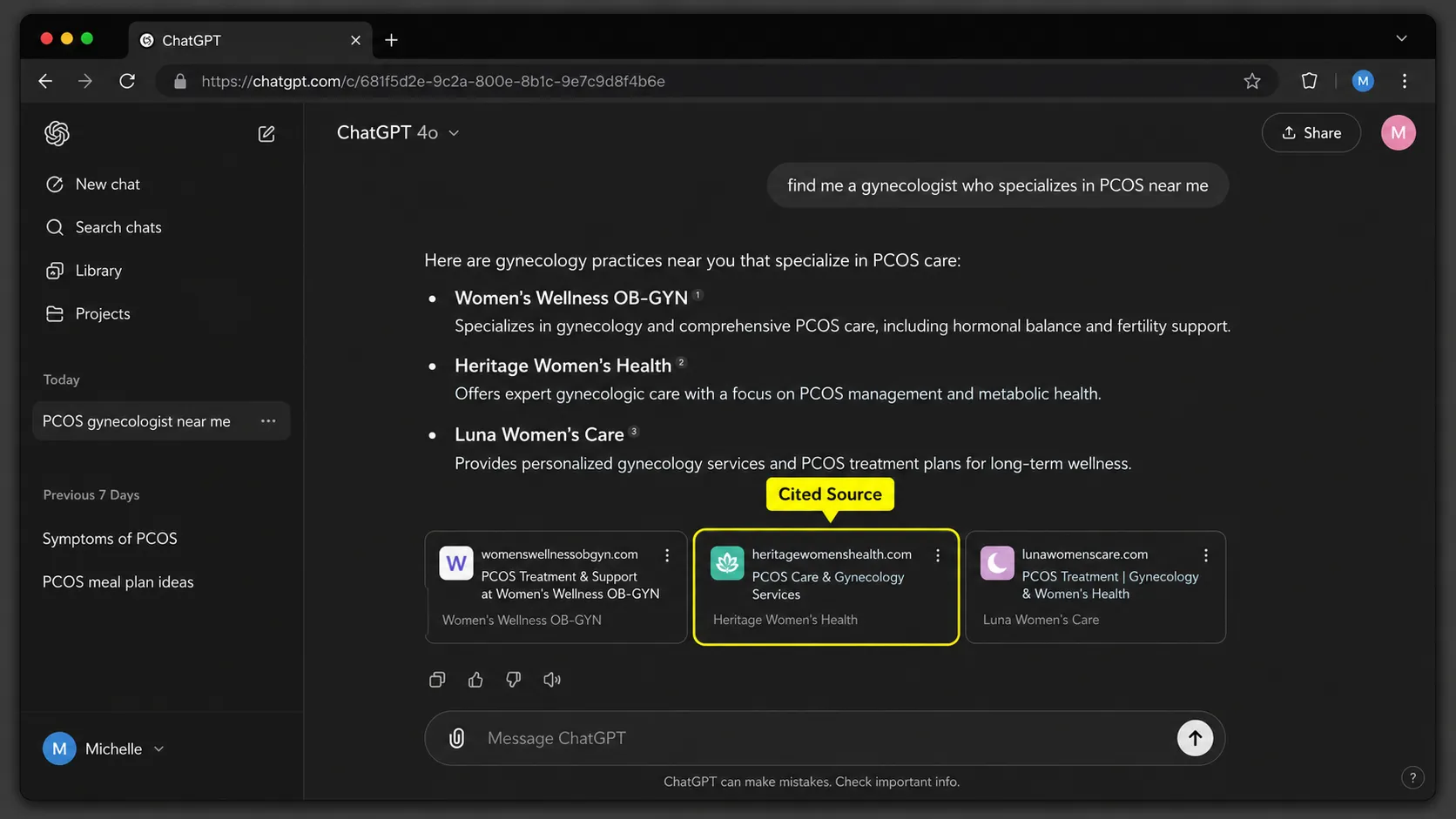
These tools don’t invent answers. They pull from sources they already trust:
- Well-structured pages
- Clear answer formats
- Listings that show up consistently across the web
Google’s own AI Overviews work the same way, often surfacing a generated answer directly above the traditional 3-Pack and organic results, before a patient even scrolls.
The same condition pages, reviews, and directory listings that win the Local 3-Pack also feed what AI Overviews, ChatGPT, and Perplexity surface, which is why AI SEO for healthcare services increasingly means optimising for both surfaces at once instead of choosing between them. If your practice isn’t showing up when a patient asks ChatGPT for a recommendation, the content gaps covered earlier in this article are usually why.
How CometRank Handles SEO for Gynecology Practices
Building condition-specific pages, claiming every medical directory, fixing your Google Business Profile, and proving trust signals to Google all at once is close to a full-time job. That’s the real execution cost of SEO for gynecologists. Most gynecology practices don’t have a marketing team built for that, and most agencies move too slowly to keep up.
We’re an AI SEO agency that runs this entire workflow for clients using CometRank, our proprietary SEO software. CometRank runs six AI agents across:
- Intent mapping
- Condition-page creation
- On-page optimisation
- Local citation management
- Authority building
A human SEO captain reviews everything before it goes live, which matters more in healthcare than in almost any other industry. If you’re looking for AI SEO for medical clinics, this is what that execution actually looks like at scale.
To see how CometRank handles this for your practice, book a demo and we’ll map out exactly which condition pages and directories would move your rankings fastest.
Conclusion
SEO for gynecologists isn’t about being the best practice in your city. It’s about being the practice Google decides to show first.
The practices winning right now aren’t doing anything mysterious. They built pages for the conditions patients actually search, claimed the directories patients actually check, and gave Google the trust signals medical content needs to rank.
Start with your Google Business Profile and one condition page, since everything else compounds from there. The practice that shows up first is usually the one that gets the call, not necessarily the one that deserved it most.
SEO for Gynecologists: Frequently Asked Questions
1/ How long does SEO take to work for a gynecology practice?
Most practices see meaningful movement in local rankings within 3 to 4 months. The Local 3-Pack often improves faster if your Google Business Profile was incomplete or your reviews were low. Full organic results for condition pages typically take 6 to 9 months to compound.
2/ What’s more important for a gynecologist, local SEO or content SEO?
Start with local SEO. The 3-Pack drives most appointment bookings for local practices. Condition-specific content compounds over time and brings in higher-intent patients, but only after the local foundation is solid.
3/ Should gynecology practices create separate pages for each condition treated?
Yes. A single “Services” page can’t rank for “PCOS specialist near me” and “IUD insertion gynecologist [city]” at the same time. Each condition needs its own page with its own keyword, patient questions, and booking CTA.
4/ Do patient reviews affect a practice’s Google ranking?
Yes. Google’s local algorithm factors in review quantity, recency, and response rate. A practice with 15 reviews from two years ago will usually lose the 3-Pack to a practice with 40 recent reviews, even with the same clinical quality.
5/ Which medical directories matter most for gynecologist SEO?
Google Business Profile matters most, followed by Healthgrades and Zocdoc. Both carry weight because they’re built around the exact decision a gynecology patient is making, not just a general business listing like Yelp.
6/ Is AI-generated content safe to use for medical SEO content like this?
Yes, as long as a qualified person reviews it before it publishes. Google doesn’t penalize AI assistance, it penalizes inaccurate or generic content. The risk isn’t the tool, it’s skipping the review step on YMYL topics like gynecology.
7/ How does CometRank handle healthcare SEO differently from a regular agency?
CometRank maps patient search intent before creating any content, then builds condition-specific pages and manages your local directory presence at the same time. A human SEO captain reviews everything for clinical and factual accuracy before it goes live.