
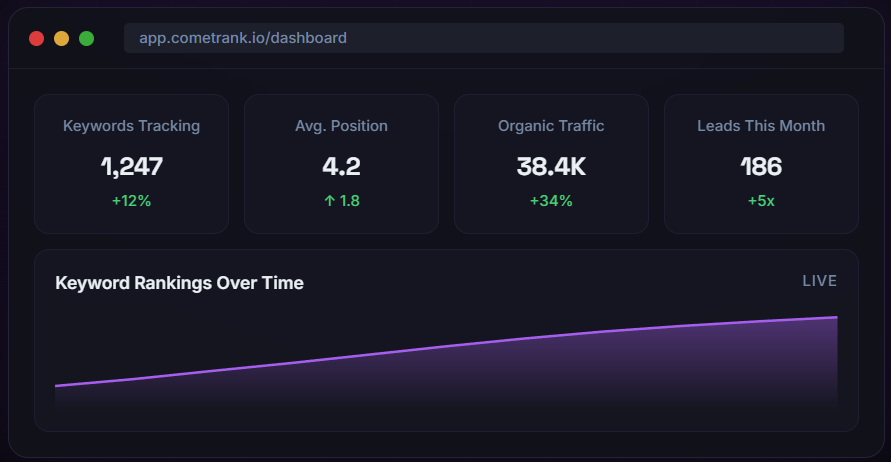
Why is your gym invisible on Google?
Every day, people in your area open Google and search for a gym. They pick one from the first few results, book a trial, and become a paying member. If your website isn’t ranking for those searches, that member was always going to someone else.
This guide breaks down exactly what SEO for gyms looks like, why most gym websites don’t rank, and what you need to fix to start showing up when it matters.
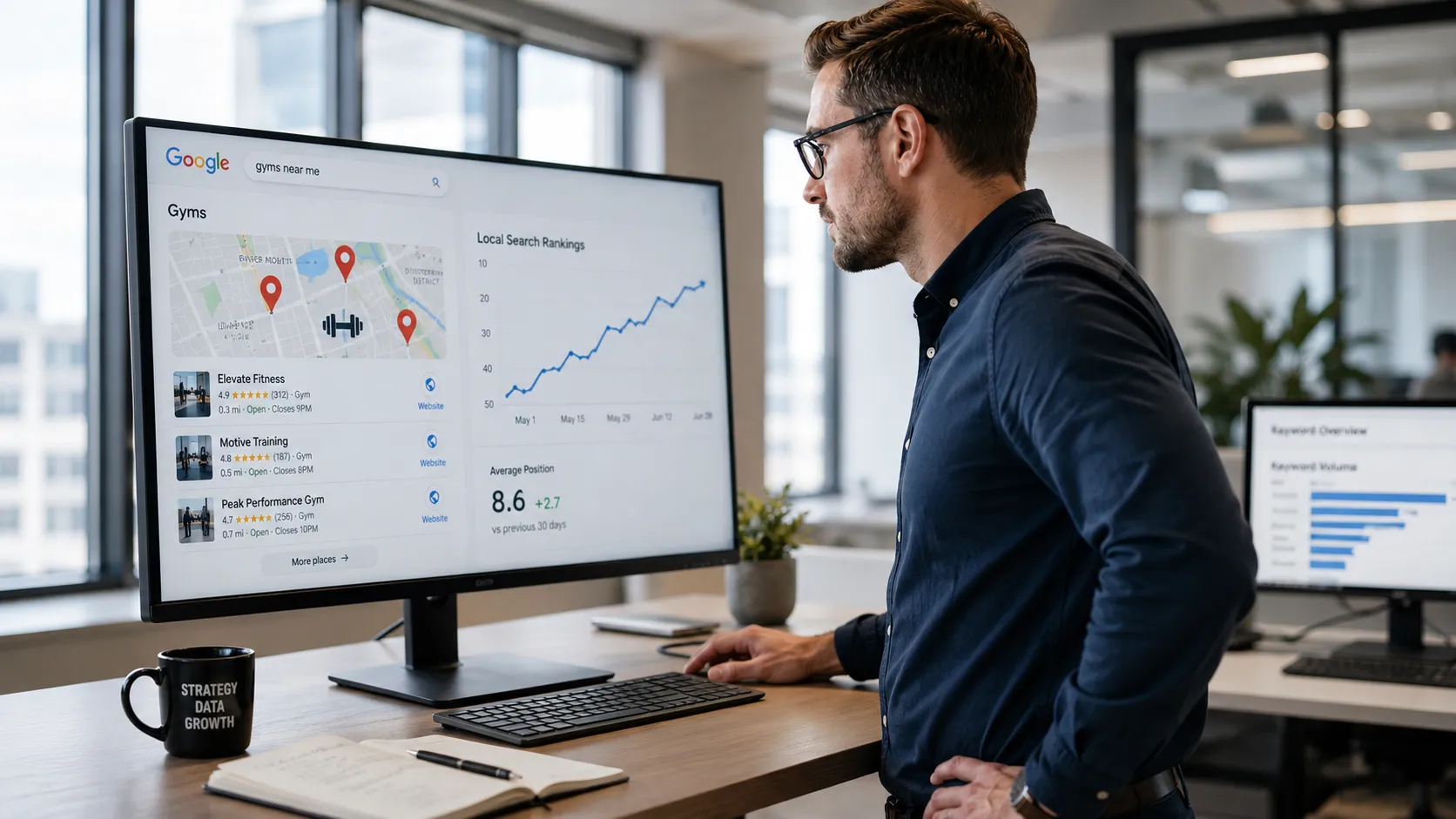
Why Most Gym Websites Don’t Rank (and It’s Not What You Think)
Most gym websites are built like brochures.
A homepage, a pricing page, maybe a trainer bio. That’s not enough to rank.
Search engines rank pages that match specific intent, which is why SEO for gyms requires more than a homepage and pricing page. A person searching “weight loss personal trainer in Miami FL” isn’t looking for your homepage. They’re looking for a page about weight loss training in Miami. If that page doesn’t exist on your site, you’re invisible for that search.
The bigger problem is that most gym websites make the same three mistakes:
- They target generic keywords like “fitness training” instead of high-intent local queries like “strength training gym in Denver.”
- They have no Google Business Profile, or one that’s half-filled and ignored.
- They’ve never built a single location page or service-specific page that actually maps to what people search.
Think with Google found that 76% of people who run a local search on their phone visit a business within a day. That’s not a small window. That’s your competition window, and the gym showing up in that moment gets the member.
Local SEO for Gyms: Start With Your Google Business Profile
Google Business Profile (GBP) is the listing that appears in Google Maps and the Local Pack at the top of search results. It’s often the first thing a potential member sees, before they ever reach your website.
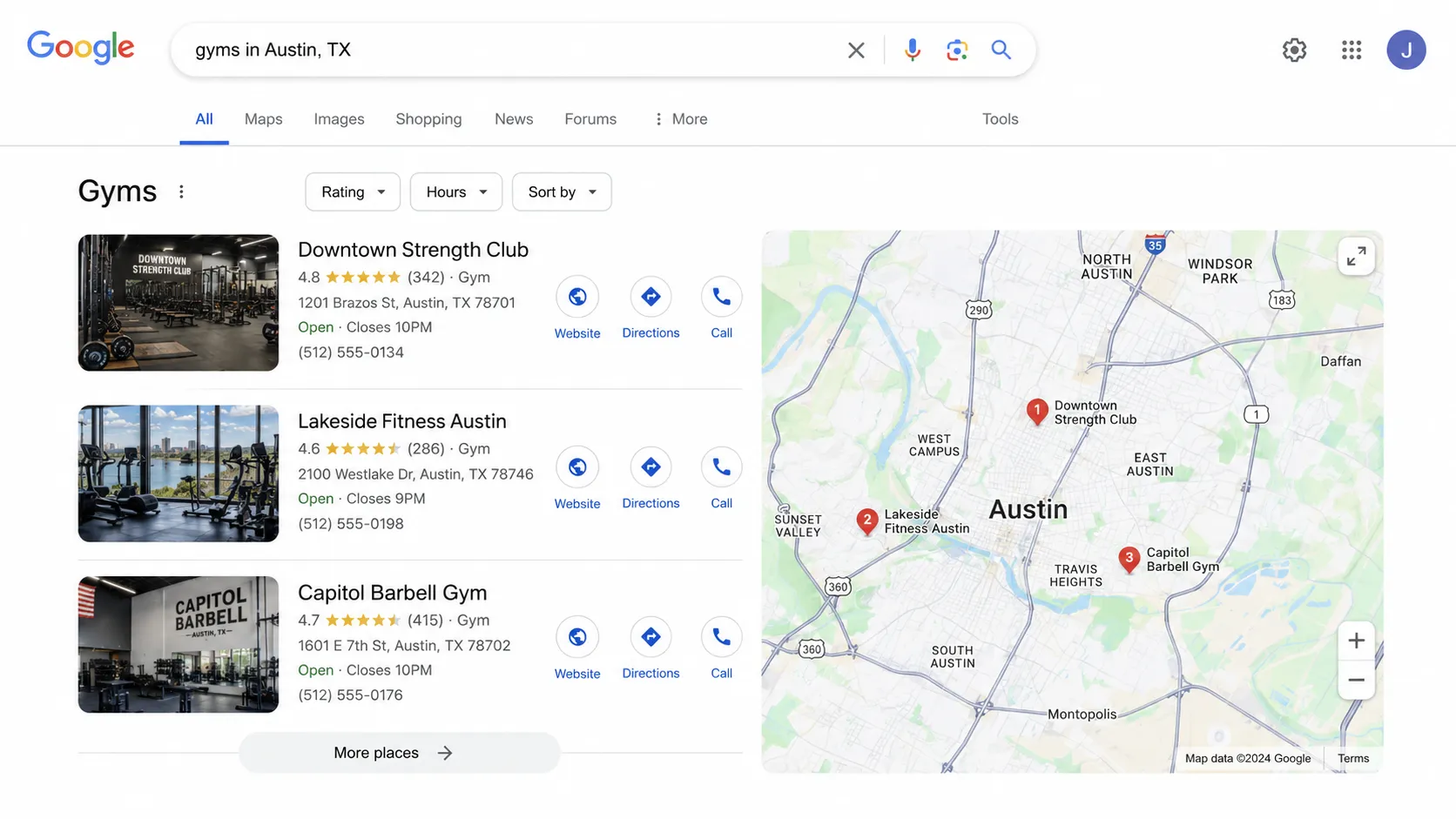
If you haven’t claimed and optimized yours, that’s the single highest-impact move you can make right now. Here’s what complete GBP optimization looks like for a gym:
1/ Category accuracy
Choose “Gym” or “Fitness Center” as your primary category. Add secondary categories like “Personal Trainer” or “Yoga Studio” if they apply.
2/ Photos
Upload at least 10 photos showing equipment, training areas, group classes, and your team. Listings with photos receive 42% more direction requests than those without.
3/ Posts
Publish weekly updates on class schedules, promotions, or fitness tips to keep your profile active and show Google you’re engaged.
4/ Q&A
Seed your own Q&A section with questions your prospects actually ask (“Do you offer trial sessions?” “Is there parking?”). Answer them before anyone has to ask.
5/ Reviews
Ask every new member to leave a Google review. Review velocity, meaning how frequently new reviews come in, is a direct ranking signal for Local Pack placement.
The goal is to get into the Google Local 3-Pack, the three businesses that appear in the map section at the top of results. Gyms in the Local 3-Pack get significantly more traffic and calls than those ranked below them. GBP is your fastest lever for getting there.
How to Find SEO Keywords for a Gym That Actually Bring in Members
The highest-converting gym keywords follow this pattern:
- location + service type + specificity.
Instead of targeting:
- “gym”
- “personal trainer”
- “fitness classes”
Target searches like:
- “personal trainer for weight loss in Austin TX”
- “24-hour gym with personal trainer in Phoenix AZ”
- “CrossFit gym for beginners in Tampa FL”
- “strength training coach for women in Denver”
These searches come from people who’ve already decided to act. They’re not browsing. They’re ready to book. Using a reliable SEO tool for keyword research tells you which of these searches has volume in your area, how competitive each term is, and what related phrases people are also searching. That data decides which pages you build first.
Stop Relying on Your Homepage: Build Service and Location Pages
This is where most gym websites leave the most leads on the table. One homepage cannot rank for 15 different services across 5 neighborhoods. That’s one of the biggest challenges in SEO for gyms. Each distinct service and each distinct location needs its own page.
Service pages target workout types and training goals:
- “Weight loss personal training in [city]”
- “HIIT classes in [city]”
- “Senior fitness training in [city]”
- “Online personal training for beginners”
Each page should cover the specific program, what results clients can expect, trainer credentials, a clear pricing or booking call to action, and a few client examples or testimonials.
Location pages target neighborhoods and surrounding cities:
- “Personal trainer in Scottsdale AZ”
- “Gym near Tempe AZ”
- “Fitness coach in North Phoenix”
Each location page captures a different segment of local search demand. A trainer who serves five neighborhoods and builds five location pages now has five separate chances to rank instead of one.
On-Page SEO for Gyms: Fix These Things to Rank Higher
On-page SEO means optimizing what’s on your website so Google can read, understand, and rank each page correctly. For gyms, three areas matter most.
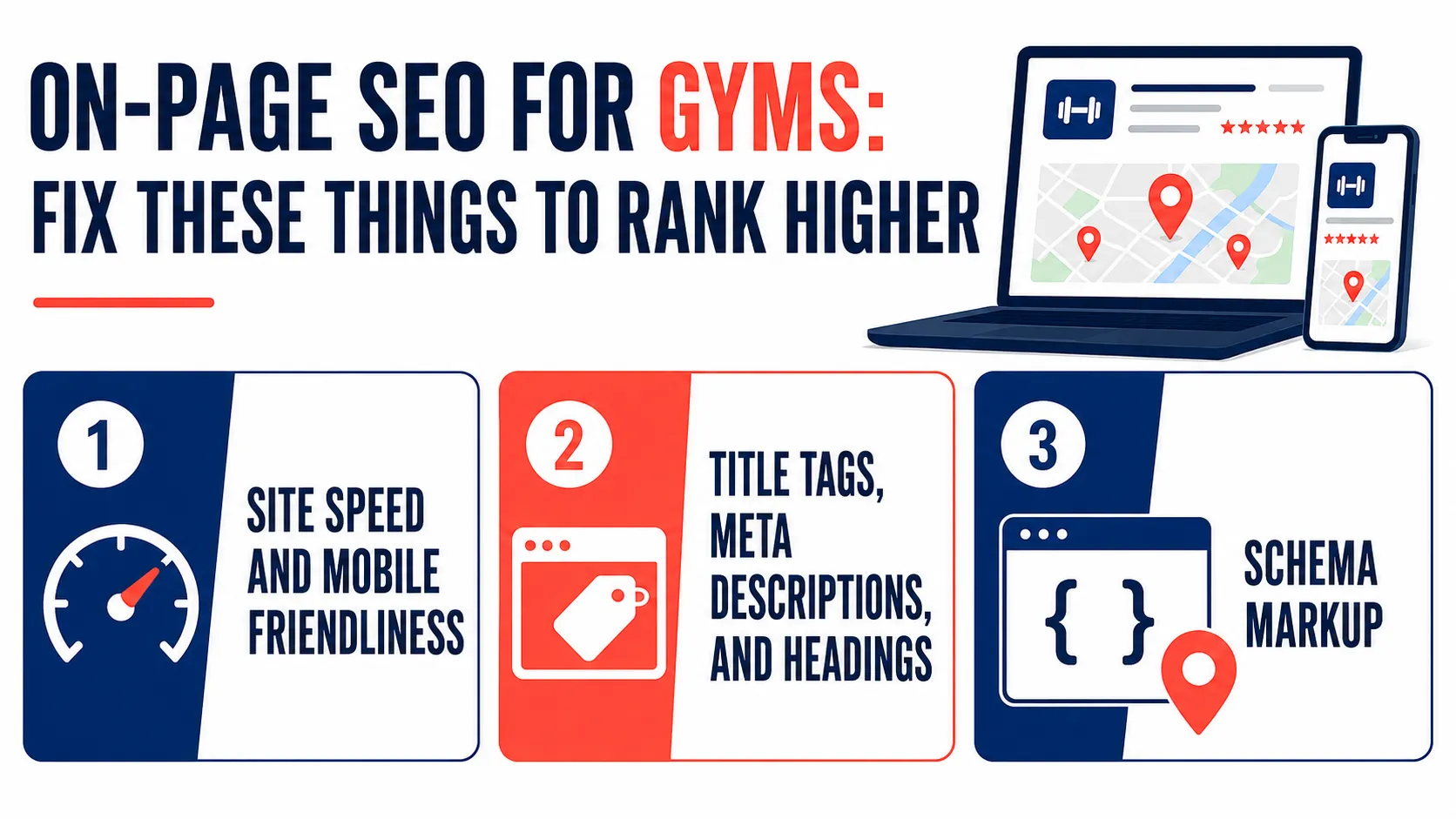
1/ Site Speed and Mobile Friendliness
A gym website that takes more than 3 seconds to load loses visitors before they read a word. Most local searches happen on phones, so mobile performance isn’t optional. Run your site through Google’s PageSpeed Insights and fix the top issues first: image compression, unnecessary scripts, and render-blocking elements.
2/ Title Tags, Meta Descriptions, and Headings
Your title tag is the headline people see in Google search results. It should clearly mention the service and location the page targets.
The meta description appears below the title tag. While it doesn’t directly affect rankings, it can improve click-through rates by giving people a reason to visit your site.
Your H1 tag should clearly describe the page’s main topic, while supporting headings help organize the content. Use headings that reflect how potential members actually search, not internal labels or gym jargon.
Recommended Reading:
Knowing the 15 most important on-page SEO tactics gives you a complete checklist to audit every page systematically.
3/ Schema Markup
Adding LocalBusiness and SportsActivityLocation schema to your pages tells Google your address, hours, and services explicitly. It increases your chances of appearing in rich results with stars, hours, and pricing visible directly in search, without the user needing to click through.
Off-Page SEO for Gyms: Build Authority Beyond Your Website
Off-page SEO covers everything that builds your site’s authority from outside your own website. Two things move the needle for gyms.
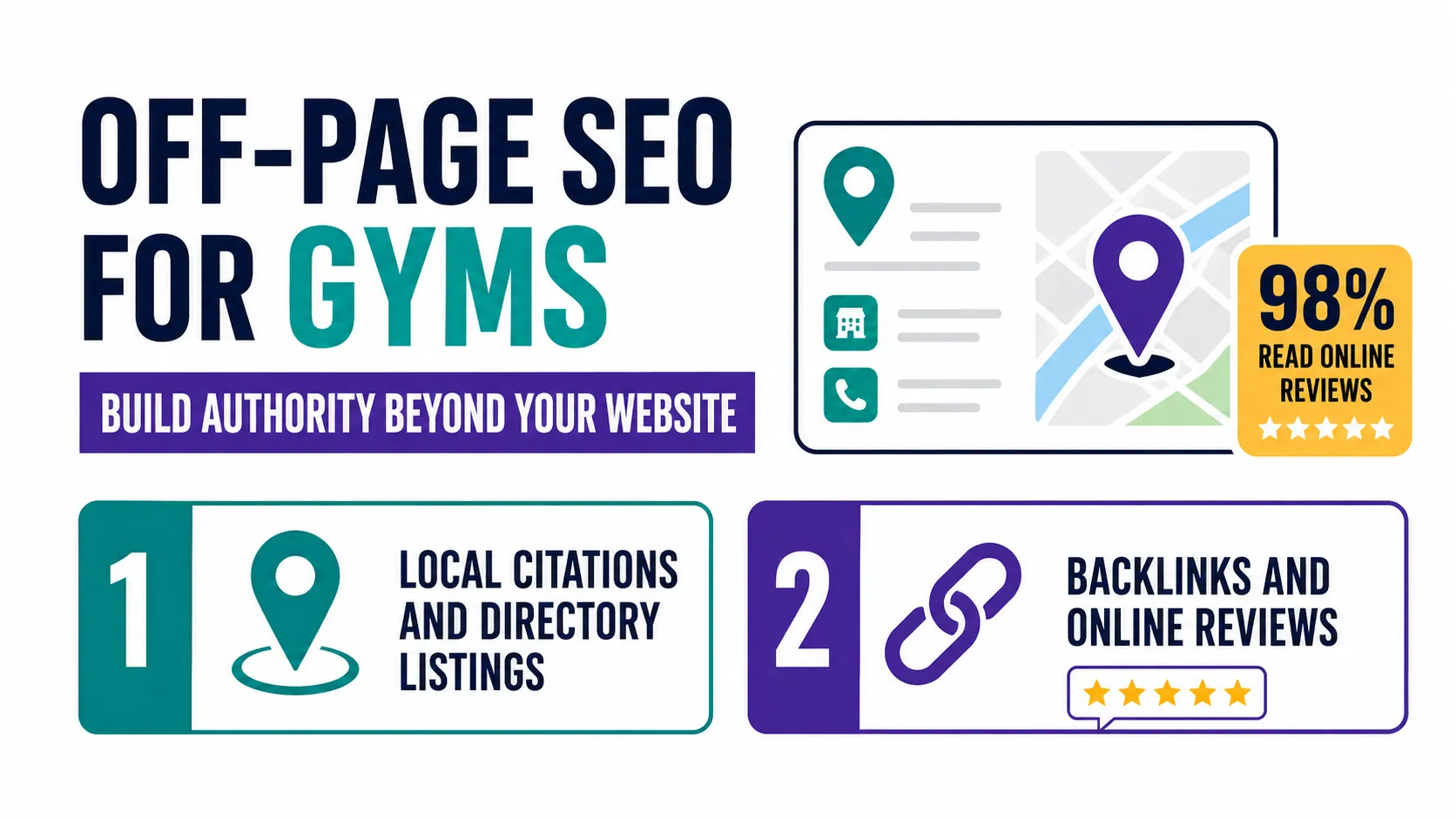
1/ Local Citations and Directory Listings
A citation is any mention of your gym’s name, address, and phone number on an external site. Get listed on Yelp, Bing Places, Apple Maps, and fitness-specific directories. Every consistent listing reinforces your local authority in Google’s eyes. The role of citations in local SEO is significant: inconsistent NAP data across directories is one of the most common reasons gyms rank lower than they should.
2/ Backlinks and Online Reviews
Backlinks from local sources, fitness publications, or neighborhood blogs tell Google your gym is trusted and relevant. A few ways to start earning them:
- Reach out to local health and fitness bloggers for features or mentions
- Sponsor community events, races, or sports teams in your area
- Get featured in city-specific “best gym” roundups and listicles
Reviews work on a similar trust principle. 98% of consumers read online reviews before visiting a local business, and a gym with 80 recent, positive reviews will outrank a competitor sitting on 12 old ones, even if that competitor’s website is technically better built. The fix is simple: text every new member a review link in their first week, and respond to every review you get, good or bad.
Content SEO for Gyms: How to Reach Members Before They’re Ready to Join
Many gym prospects start with informational searches weeks or months before they’re ready to commit. Capturing them early builds the trust that converts later.
These early-stage searches look like:
- “how much does a personal trainer cost in Chicago”
- “how often should beginners lift weights”
- “personal trainer vs gym membership which is better”
Publishing blog content around these questions does two things: it brings in traffic from people in research mode, and it builds topical authority, meaning Google treats your site as a credible fitness source rather than just one gym page.
This kind of content moves people from “just researching” to “ready to book.” The AI search grader tool can also show you whether your gym is appearing in AI-generated answers on platforms like ChatGPT and Perplexity, which is where an increasing share of local search is moving.
AI Search Visibility for Gyms: How to Get Cited in ChatGPT and AI Overviews
Gyms that structure their content clearly are far more likely to appear in these AI-generated answers than gyms with thin, generic pages.
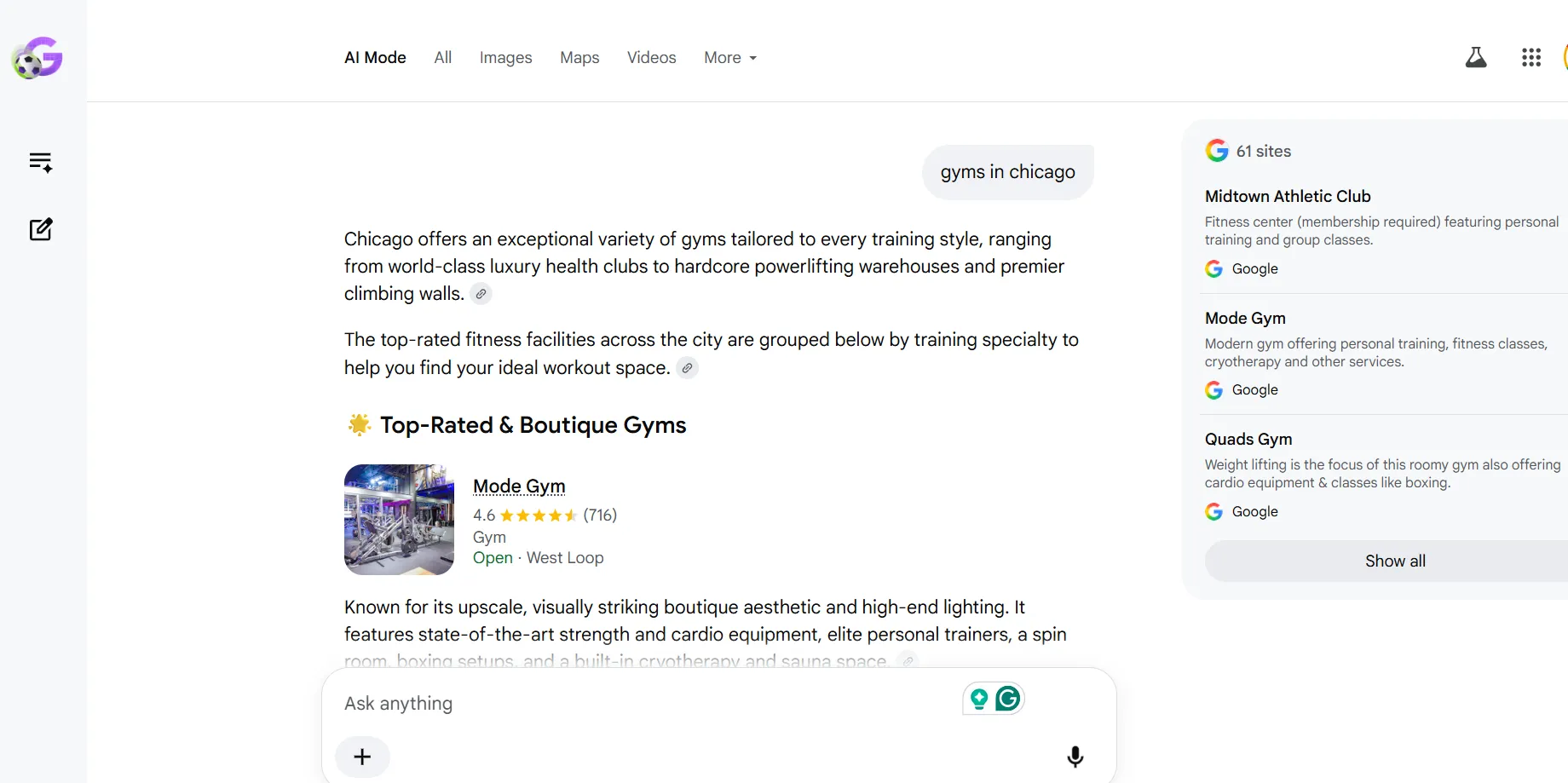
What makes content AI-retrievable:
- Clear, direct headings that match how people ask questions
- Answer capsule format: lead every section with a direct answer in the first sentence, then expand
- Location-specific detail throughout, not just in the URL
- Specific services, pricing ranges, and outcomes rather than vague descriptions
The local SEO strategies that work for Google Map Pack placement also signal relevance to AI engines. The two aren’t separate optimizations. Structured, specific, locally grounded content wins on both.
How We Help Gyms and Fitness Trainers Execute SEO Without the Time Sink
Running classes, managing trainers, and keeping members happy doesn’t leave much room for keyword research and page building. That’s exactly the gap we close.
We’re an AI SEO agency that runs this entire workflow using CometRank, our proprietary SEO software. Six AI agents handle the execution:
- The Analyst maps what your target members are actually searching
- The Strategist identifies every high-intent local keyword cluster
- The Creator builds out service pages and location pages at scale
- The Optimizer makes sure every page is conversion-ready
- The Authority Builder runs the citation and backlink strategy
- The Quality Guardian checks every piece before it goes live
A human SEO Captain reviews the intent mapping, content quality, and internal linking before anything publishes. Nothing goes live as raw AI output. Every deliverable gets a human pass first. Book a demo to see what the opportunity looks like for your gym’s specific location and service mix.
Conclusion
Most gym websites aren’t losing to better gyms, they’re losing to ones easier for Google to understand. That’s what SEO for gyms really comes down to. The gyms growing fastest aren’t the ones with the biggest budgets. Follow the steps in this guide, and your website will start ranking ahead of your competition.
SEO for Gyms: Frequently Asked Questions
1/ How long does SEO take to show results for a gym?
Most gyms see measurable movement in local rankings within 3 to 6 months of consistent effort. Google Business Profile improvements and review velocity often produce visible changes faster, sometimes within 4 to 8 weeks. Organic website rankings take longer because they depend on building topical authority and earning backlinks over time.
2/ Do gyms need a Google Business Profile to rank locally?
Yes. GBP is the primary driver of Local Pack and Google Maps placement, which is where most gym-related searches convert into actual visits. Without a complete, active GBP, a gym is largely invisible in the searches that drive walk-in traffic.
3/ What keywords should a personal trainer target for local SEO?
Focus on location-plus-service queries: “personal trainer for weight loss in [city],” “strength training coach for beginners in [city],” and “online fitness coach [city].” These convert far better than generic terms because they capture people who have already decided what they want and are just looking for who to hire.
4/ Is SEO better than Google Ads for gyms?
Both have a role, but they work differently. Google Ads can generate trial bookings immediately. SEO builds a channel that generates leads without a per-click cost over time. Most gyms that depend solely on ads are renting their lead flow. SEO gives you ownership. Running both is the strongest position, but if budget is tight, SEO builds more durable value long term.
5/ How do reviews affect gym SEO rankings?
Reviews are a direct ranking signal for Google’s Local Pack. Google factors in review quantity, recency, and average rating when determining which three businesses to show in the map section. A gym with consistent new reviews from verified members will consistently outrank a gym with an older, static review profile.
5/ How to get your gym to show up on Google Maps?
Claim and fully complete your Google Business Profile, verify your location, choose the right business categories, upload photos, and start generating reviews from real members. Also ensure your name, address, and phone number are identical on your website and every local directory. These steps together are what determines your Maps placement.