
Why do newer food manufacturers outrank you for the exact supplier searches your team should be winning?
It’s not certifications. It’s not production capacity. It’s structure. The manufacturers ranking above you built dedicated pages for every product category, certification, and buyer question, while most food manufacturing websites still run on one generic “Products” page. In this article, we cover exactly what a working SEO for food manufacturing companies strategy includes so your site starts capturing supplier searches instead of losing them to competitors.
Why Most Food Manufacturing Websites Fail to Rank for Supplier Searches
Most food manufacturing sites are built like digital brochures, not search acquisition systems.
Common gaps include:
- One generic “Products” page instead of category-specific pages
- No pages for individual manufacturing capabilities
- No certification pages
- No industry-specific landing pages
- No educational content for early-stage buyers
Google needs a specific page to rank for a specific query. If a buyer searches “private label granola manufacturer for grocery brands” and your site only has a broad “snack manufacturing” page, you’re competing with one blunt page against a competitor’s precise one.
This same structural gap is why many manufacturers also stay invisible in ChatGPT and Google AI Overviews when buyers ask AI tools to summarize suppliers instead of Googling directly.
How Food Industry Buyers Actually Search for Manufacturers
Procurement teams rarely type “food manufacturing company.” They combine specific signals instead.
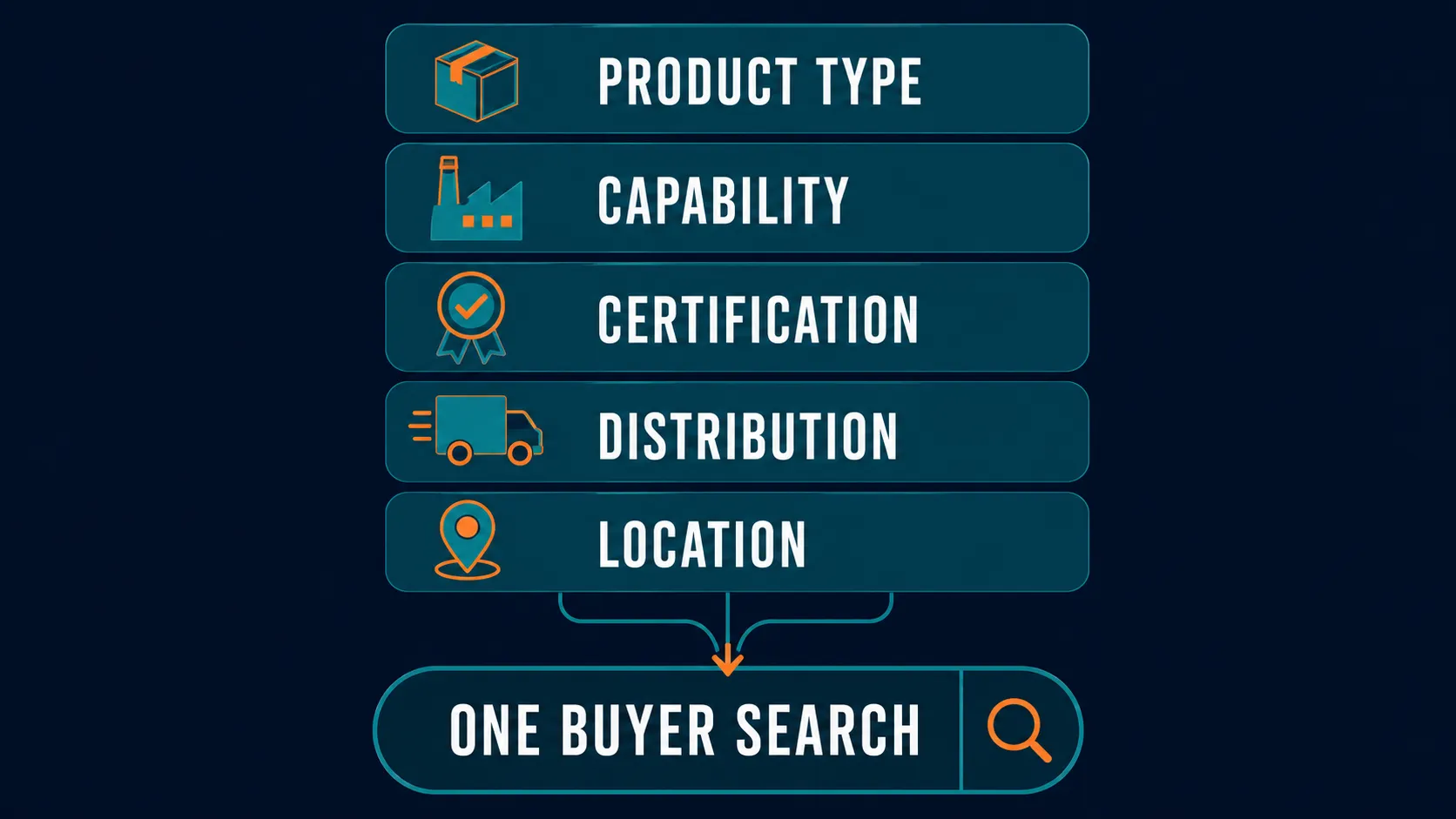
A typical search stacks:
- Product type
- Manufacturing capability
- Certification
- Distribution channel
- Location
Examples: “organic protein bar contract manufacturer USA,” “FDA certified beverage co-packer for energy drinks,” or “gluten free bakery manufacturer for supermarket chains.” Each one signals a buyer close to issuing a request for quote.
Your page structure should mirror these combinations directly, not force buyers to guess which page covers their exact need.
Buying decisions in food manufacturing rarely rest with one person. A procurement lead, a food scientist, and a QA specialist often review the same shortlist independently, and each one searches with different priorities. The procurement lead searches for capacity and pricing signals. The food scientist searches for ingredient handling and formulation support. QA searches for certifications and audit history. A single generic page can’t answer all three.
Why Food Safety Certifications Are a Ranking Signal Buyers Trust
Certifications aren’t just a compliance checkbox. They’re search terms buyers use to filter suppliers before they ever pick up the phone.
Buyers searching for a co-packer or contract manufacturer routinely add certification terms to their query: HACCP, SQF, BRCGS, FSMA, GMP, USDA Organic, Kosher, or Halal. If your site never mentions these by name, you don’t show up for that search, no matter how qualified your facility actually is.
Build this into your content with:
- A dedicated certifications page listing every standard your facility holds
- Certification mentions on relevant product and capability pages, not buried in a PDF
- Plain-language explanations of what each certification means for the buyer’s own compliance chain
A buyer evaluating three manufacturers will pick the one whose website answers their compliance questions fastest. Certifications also carry weight with AI search tools, since ChatGPT and Google AI Overviews pull directly from pages that state compliance standards clearly rather than vaguely.
Building High-Intent Landing Pages for Food Manufacturing SEO
The most important SEO asset on a food manufacturing website is a structured landing page for every product category, capability, or certification.
For a keyword like “organic snack contract manufacturer USA,” a strong landing page includes:
- Manufacturing capabilities and equipment
- Certifications, listed by name
- Product types produced (granola bars, protein snacks, trail mixes)
- Industries served (retail grocery, DTC startups, private label distributors)
- Packaging formats available
- Production capacity and batch sizing
- A request-a-quote form as the CTA
This same principle extends to your spec sheets and product catalogs. Spec sheet and catalog SEO turns static PDFs into indexable pages that answer a buyer’s technical questions directly in search. Generic pages that try to cover every product at once rarely rank, which is exactly why generic SEO doesn’t work for B2B manufacturing companies.
Add schema markup to each landing page too. Product and Organization schema help search engines and AI tools parse your certifications, production capacity, and location accurately, which improves the odds of getting pulled into a featured snippet or an AI-generated supplier list.
In-House SEO vs. a Specialized Food Manufacturing SEO Partner
Should a food manufacturer handle SEO in-house or bring in a specialized partner? It depends on how many category, capability, and certification pages your buyer searches actually require.
| Factor | In-house SEO | Specialized food manufacturing SEO |
| Certification and compliance accuracy | Depends on internal QA involvement | Built into every page from the start |
| Page volume for product/capability coverage | Usually limited to a handful of pages | Scales across full product and cert matrix |
| Buyer-intent keyword mapping | Often generic industry terms | Mapped to exact supplier-search phrasing |
| Time to see ranking movement | Slower, competes with other priorities | Faster, dedicated execution |
Neither path is automatically wrong. A manufacturer with three product lines and one facility may manage this in-house. A manufacturer with multiple categories, certifications, and locations usually needs dedicated execution to keep pace.
Use Case Studies to Win Buyer Trust
Ranking gets a buyer to your site. Case studies get them to submit an RFQ.
Strong case study pages answer:
- What was the client’s manufacturing challenge?
- What process and packaging format did you use?
- What production volume did you support?
- What was the distribution outcome?
A page targeting “private label beverage manufacturing case study” does more than prove capability. It matches exactly what a buyer searches once they’ve shortlisted your facility and want proof before requesting a quote.
For example, a case study on helping a DTC snack brand scale from 5,000 to 50,000 units a month shows the exact production jump a growing buyer is trying to plan for. Specifics like batch size, packaging format, and timeline convert far better than a generic “we deliver quality” testimonial.
Create Educational Content That Attracts Early-Stage Buyers
Many buyers start researching before they know which supplier they want. They’re comparing processes, certifications, and costs first.
Blog topics that capture this stage include:
- How to choose a food contract manufacturer
- Cost of private label snack manufacturing
- Food manufacturing certifications explained
An article targeting “how to choose a private label snack manufacturer” should cover production capacity, certification requirements, ingredient sourcing, packaging options, and minimum order quantities. This content brings buyers in before they’ve picked a supplier, and positions your facility as the answer once they do.
Buyers who read this kind of content arrive at your capability pages already qualified, which shortens the sales cycle instead of just adding traffic.
Keyword Research for Food Manufacturing SEO
What keywords should a food manufacturing company target? Start with terms that combine product type, capability, certification, and location, since that’s how buyers actually search.
Examples: “organic trail mix contract manufacturer USA,” “protein snack co manufacturer for fitness brands,” “private label keto snack manufacturer,” “beverage co packing services for energy drinks.”
Run a competitive keyword analysis to find gaps your rivals haven’t covered yet. SEO tools for keyword research can surface supplier-intent terms your team may be missing entirely.
Backlinks for Food Manufacturers: What Helps and What Hurts Rankings
Backlinks tell Google your facility is a credible, established supplier, not just another listing. But not every link helps.
Helpful backlinks
- Trade association and industry body listings
- Certification body directories (organic, kosher, halal boards)
- Distributor and retail partner websites that reference your facility
- Industry publications covering your certifications or expansions
Harmful backlinks
- Paid link farms and low-quality directory blasts
- Irrelevant guest posts unrelated to food manufacturing
- Reciprocal link schemes with unrelated industries
A handful of relevant, earned links from trade bodies outperforms hundreds of generic directory submissions. Search engines weigh the relevance of a linking site more heavily than the raw count, so ten links from food industry sources will typically outperform a hundred from unrelated directories.
AI Search Visibility: How ChatGPT and Google AI Overviews Recommend Suppliers
Buyers increasingly ask AI assistants to summarize supplier options instead of scrolling through search results themselves.
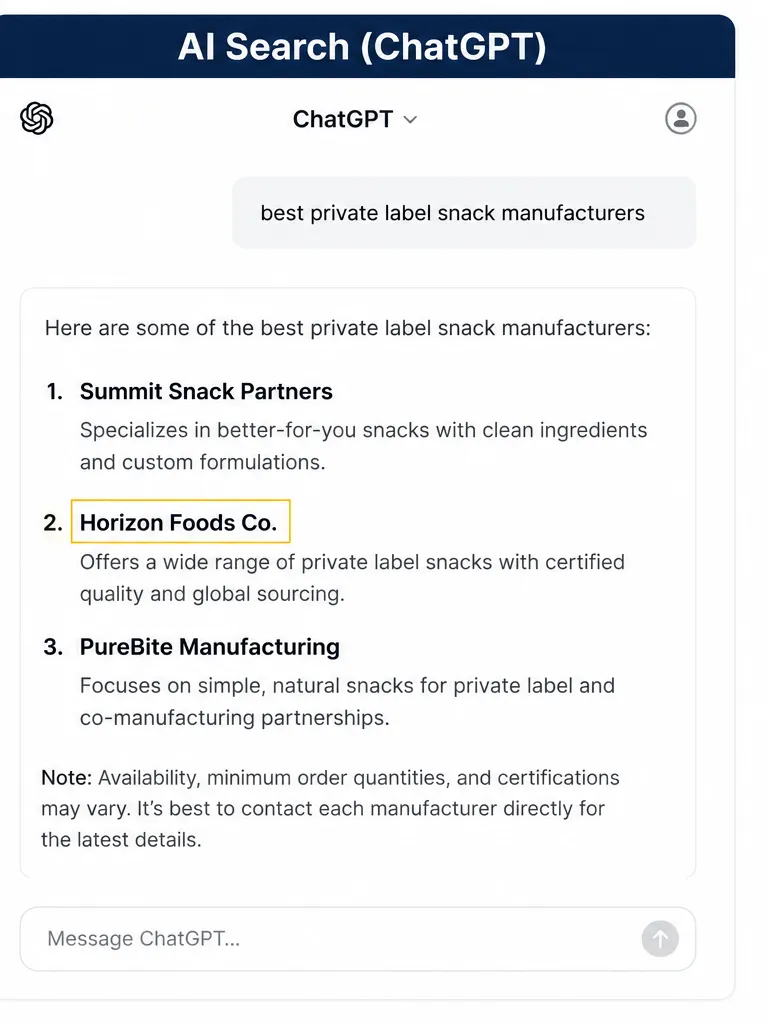
If your facility doesn’t appear when someone asks ChatGPT or Google AI Overviews to list beverage co-packers or snack manufacturers, you’re invisible at the exact moment a shortlist gets built.
Test this yourself:
- Ask an AI assistant a buyer-style question, like “best private label snack manufacturers in the US”
- Note which competitors get named and why
- Check whether your certifications, case studies, and capability pages give the AI enough to cite you
An AI search monitoring platform can track this across queries automatically, and an AI search grader shows exactly where your content gaps are keeping you out of AI-generated supplier lists.
Buyers are also completing more of this research before ever contacting a manufacturer directly. Gartner’s B2B buying journey research shows buyers now prefer a largely self-directed, often rep-free process, which makes AI and search visibility a bigger factor in getting shortlisted at all.
What a Complete SEO for Food Manufacturing Companies Strategy Includes
A complete SEO for food manufacturing companies strategy combines:
- Product category, capability, and certification landing pages
- Case studies and spec sheet optimization
- Educational content for early-stage buyers
- Buyer-intent keyword mapping
- Earned backlinks from trade and certification bodies
- AI search visibility monitoring
This structured approach ensures your site shows up across every stage of a buyer’s search, not just the moment they already know your name.
How CometRank Handles This for Food Manufacturing Companies
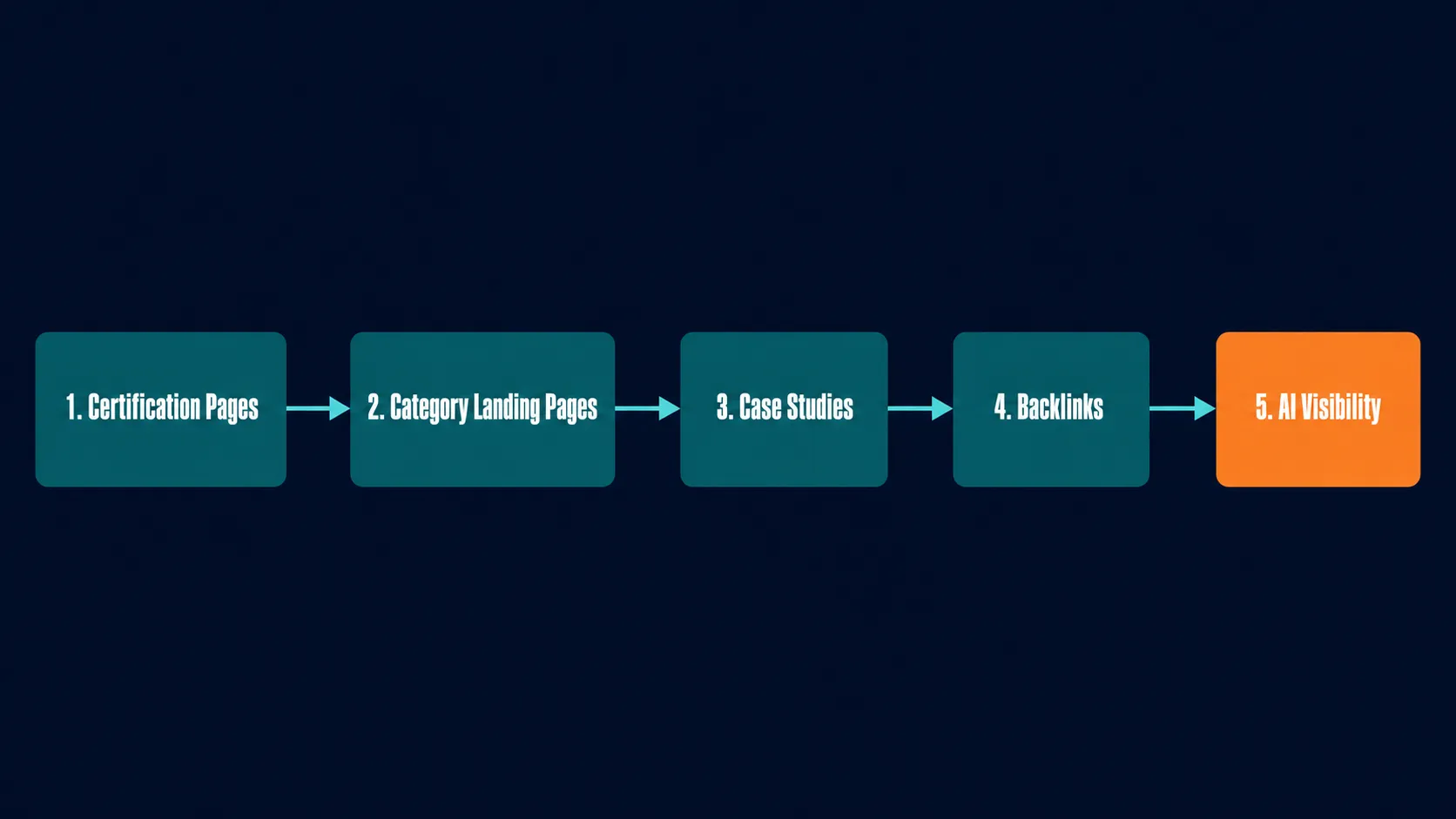
Executing food manufacturing SEO properly means building certification pages, category landing pages, case studies, and a backlink strategy all at once, while keeping every claim compliant. Most manufacturing teams don’t have the bandwidth to do this in-house, and most agencies move too slowly to keep pace with a full product and certification matrix.
We’re an AI SEO agency that runs this entire workflow for clients using CometRank, our proprietary SEO software. CometRank runs six AI agents, Analyst, Strategist, Creator, Optimizer, Authority Builder, and Quality Guardian, across research, content creation, optimization, and backlink acquisition. A human SEO captain reviews everything before it goes live. If you’re looking for an AI SEO for manufacturing companies, this is what the execution actually looks like at scale.
To see how CometRank handles this for your facility, book a demo and we’ll map out exactly which supplier searches you’re missing.
Turning Search Into a Supplier Acquisition Channel
Buyers are already searching for a manufacturer like yours. The only question is whether they find you or a competitor first. A working SEO for food manufacturing companies strategy structures pages around how buyers actually search, backs every claim with certifications and proof, and checks visibility in AI-generated answers as often as Google rankings. Start with your highest-volume product category page this week.
SEO for Food Manufacturing Companies: Frequently Asked Questions
1/ How is SEO different for food manufacturers compared to other industries?
Food manufacturing SEO has to account for certifications, compliance language, and multi-stakeholder buyers like procurement, food science, and QA. Generic B2B SEO advice skips all three, which is why category and certification pages matter more here than in most industries.
2/ What role do certifications play in ranking for supplier searches?
Certifications like HACCP, SQF, BRCGS, and USDA Organic function as search terms buyers actively use. Naming them clearly on your site, not just in a downloadable PDF, helps you rank for the exact queries compliance-focused buyers type.
3/ How long does it take to see SEO results for a food manufacturing company?
Most manufacturers see measurable ranking movement within four to six months of publishing structured category and certification pages. Highly competitive terms take longer, while niche capability searches can rank within weeks.
4/ Do I need a separate landing page for every product and certification?
Yes, wherever search volume supports it. A single generic products page can’t rank for the specific combinations buyers search, like “organic protein bar contract manufacturer USA.”
5/ Why does local SEO matter if I sell to buyers nationwide?
Many procurement teams still add location to their search, either to manage shipping costs or to meet regional sourcing requirements. A location-aware page can capture searches a purely national page misses.
6/ How do I know if my facility shows up in AI-generated supplier lists?
Ask ChatGPT or Google AI Overviews a buyer-style question, like naming top suppliers in your category, and check whether your facility appears. If it doesn’t, your certifications and case studies likely aren’t structured clearly enough for AI tools to cite.