
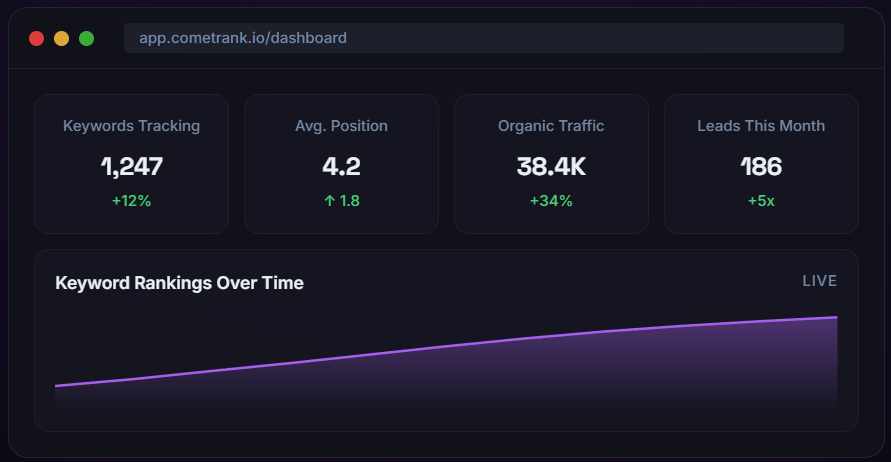
Why does your assisted living community rank on page two while a competitor with worse care ranks first?
It usually has nothing to do with quality of care. Families searching for senior living options are stressed, moving fast, and clicking on whoever shows up first with the answers they need:
- Cost
- Care level, and
- Availability near them
If your website doesn’t answer those questions clearly, Google skips you and sends the inquiry to someone else.

In this article, we cover how to do SEO for assisted living communities so your facility shows up at the exact moment a family is ready to tour.
Why Does SEO for Assisted Living Communities Need a Different Playbook?
SEO for assisted living communities is not the same game as ranking a local plumber or dentist. Families searching for senior care are often making the decision for a parent, not themselves, and that decision carries guilt, urgency, and financial pressure all at once. A generic local SEO checklist misses this entirely. The searches themselves prove it. Families do not just type “assisted living near me.”
They search things like:
- “assisted living near Austin TX with memory care”
- “cost of assisted living in Phoenix AZ per month”
Those queries mix location, care type, and budget in a single search, which means your website needs pages built around all three, not one generic “About Us” page hoping to rank for everything. Communities that win here treat every page as an answer to a specific family question. Communities that lose here publish one broad page and wonder why inquiries never come.
How Do Families Search Before Choosing an Assisted Living Community?
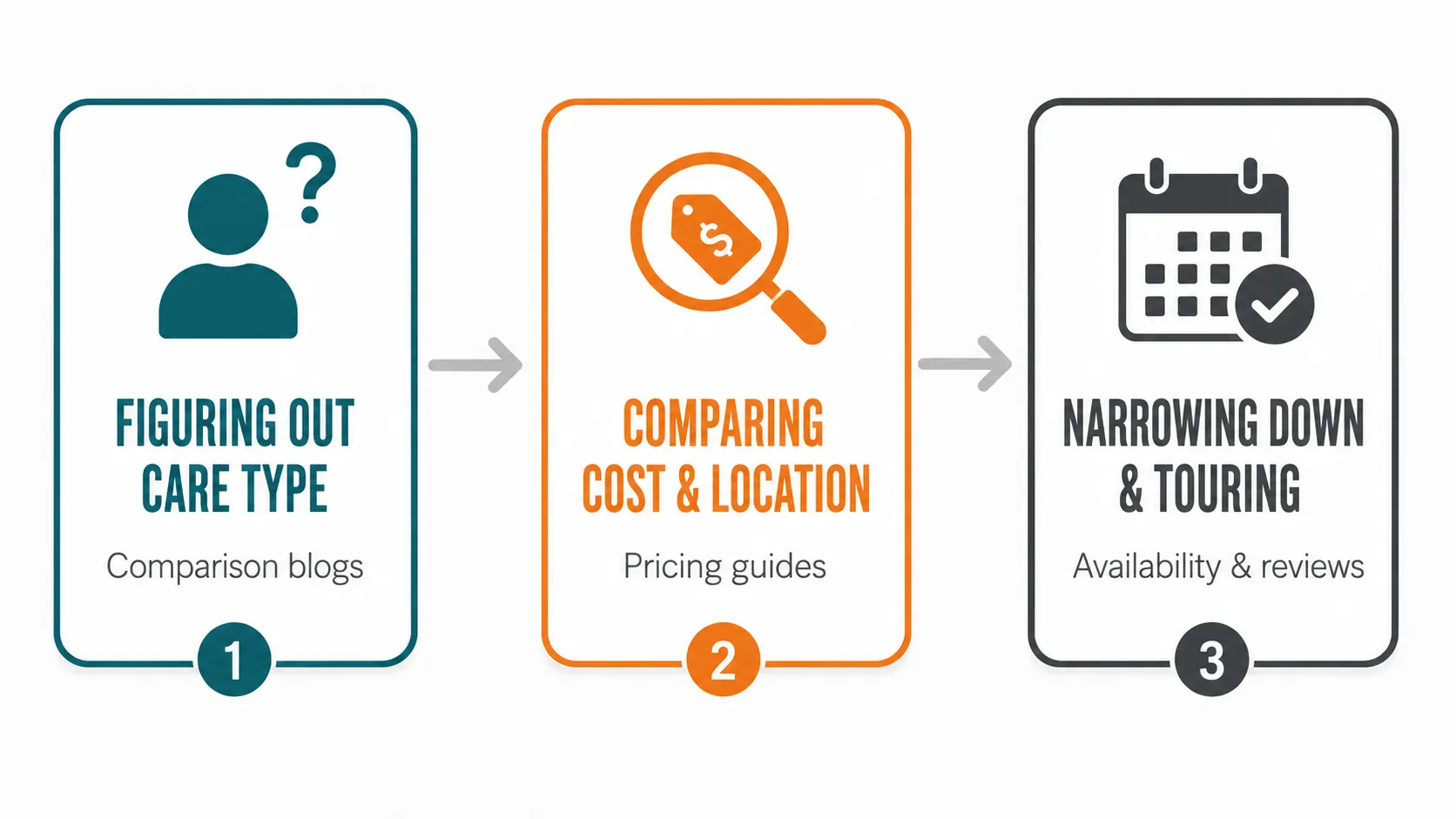
Families move through three stages before they call: figuring out what type of care they need, comparing cost and location, then narrowing down to a shortlist to tour. Each stage uses a different kind of search, and each search deserves its own page.
| Search Stage | Example Search | Page That Should Answer It |
| Figuring out care type | assisted living vs memory care | Comparison blog post |
| Comparing cost | cost of assisted living in Phoenix AZ | Pricing guide page |
| Narrowing by location | assisted living near Austin TX | Location landing page |
| Checking reputation | best senior living communities in Tampa FL reviews | Reviews-focused landing page |
| Ready to move fast | senior care available now Houston TX | Availability page with a direct call CTA |
A page built for “assisted living near Scottsdale AZ with memory care” should show services offered, staff credentials, amenities, pricing ranges, testimonials, and a tour scheduling button above the fold. Miss any of those and the family bounces to the next result.
Which Care Levels Should Your Keyword Strategy Target?
Assisted living SEO fails most often because communities target one keyword (“assisted living”) when families are actually searching for something more specific. Care level is the first filter every family applies, so it needs to be the first filter your content strategy applies, too.
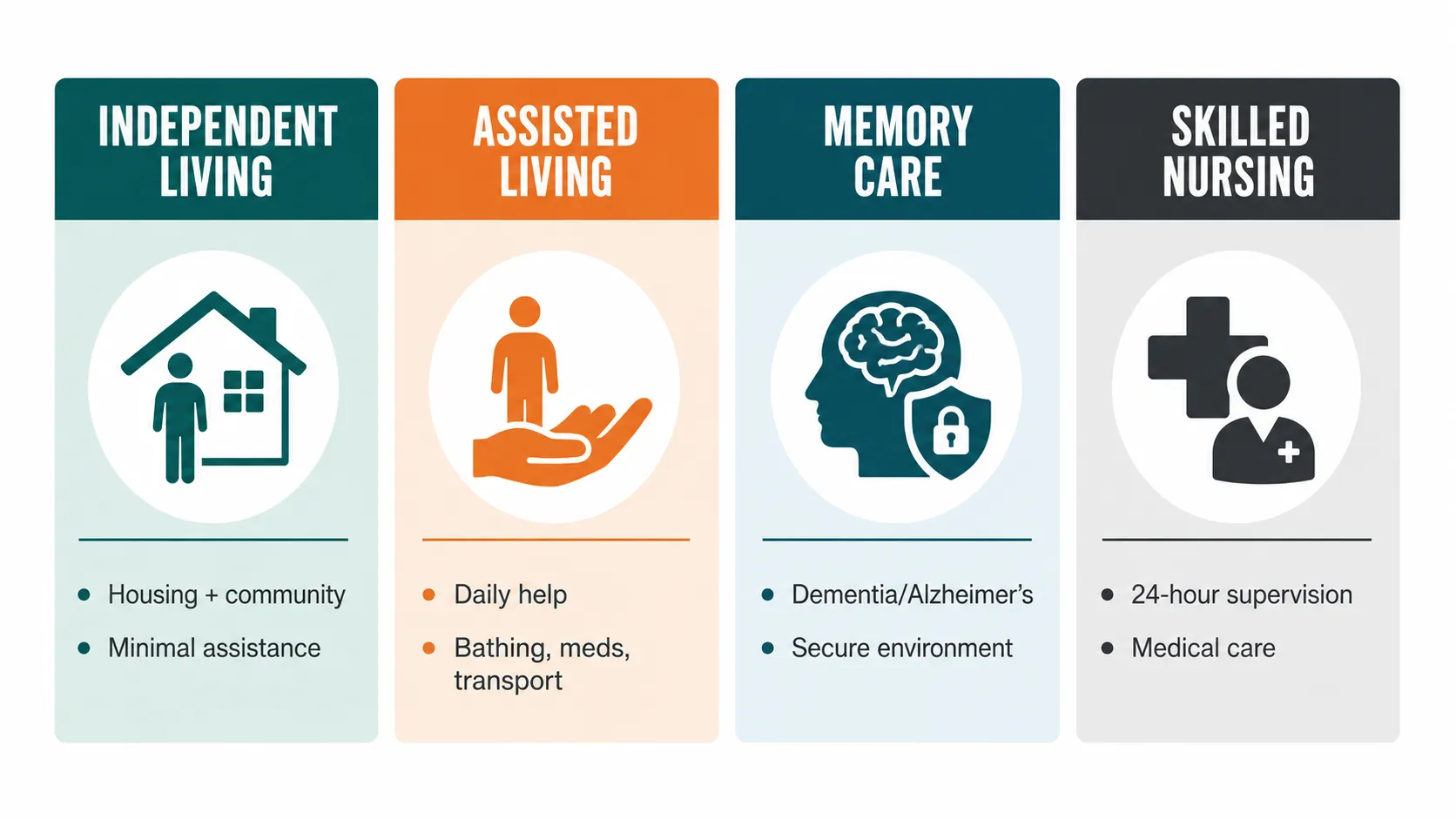
Break your keyword targeting into the levels you actually offer:
- Independent living, for residents who need housing and community but little daily assistance
- Assisted living, for residents who need help with bathing, dressing, medication, or transportation
- Memory care, for residents managing dementia or Alzheimer’s who need secure, specialized environments
- Skilled nursing, for residents who need 24-hour medical supervision
Each of these deserves its own page with its own keyword. A single “our services” page that lists all four in one paragraph will not rank for any of them, and it forces Google to guess which page to show for a memory care search when your community may not even provide that level of care.
This matters more every year: the population aged 65 and older is projected to grow from 58 million to 82 million by 2050, according to Population Reference Bureau demographic projections, which means more families searching for exactly this kind of care-level clarity every single year. Communities that build out care-level pages now are positioning themselves ahead of a search volume increase that is already underway.
How Do You Optimize Your Google Business Profile for Assisted Living Local SEO?
Your Google Business Profile is the first thing most families see, often before they ever click through to your website. Get it wrong, and you lose the click before the SEO even starts.
Three things matter most:
- Keep your name, address, and phone number identical across your website, Google profile, and every directory listing. Inconsistent NAP data confuses Google and drops your local rankings.
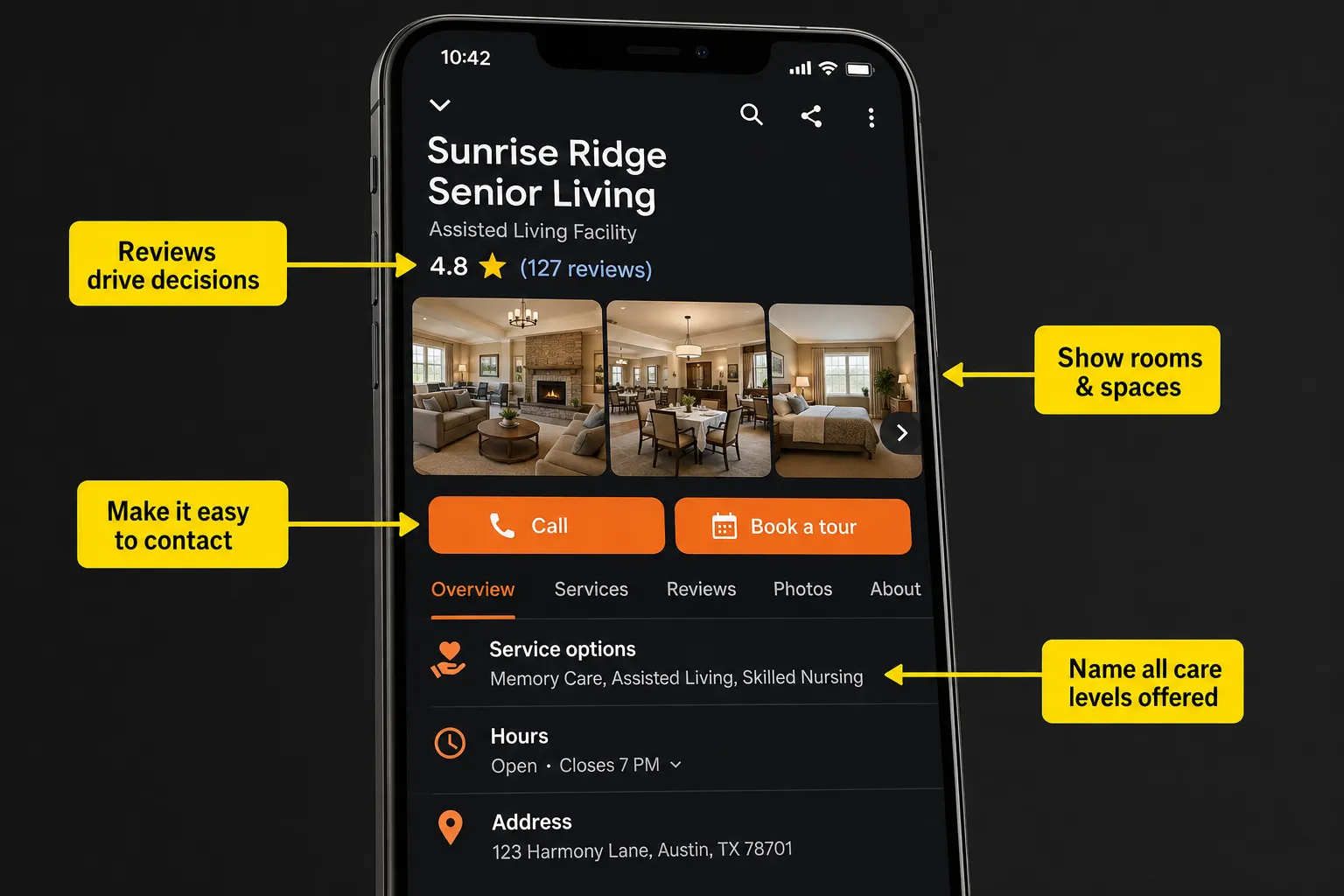
- Fill in every field: hours, care levels offered, photos of common areas and rooms, and a description that names your city and care types directly.
- Respond to every review, good or bad. Families read reviews before they read anything else on your site, and a facility that never responds looks like nobody is home.
We break down the exact fields to fill in first in our profile optimization checklist, which works the same way for senior care as it does for any local business, just with higher stakes attached to every review.
What Content Actually Converts Families Into Toured Leads?
Content that ranks for assisted living SEO has to do two jobs at once: answer the question Google thinks the family is asking, and reduce the anxiety a family feels about the decision. Miss the second job, and you rank, but nobody calls.
The formats that do both:
- Cost guides that break down what is included versus what costs extra, since “how much does this actually cost” is the question every family is afraid to ask directly
- Comparison articles like “assisted living vs home care,” which help families self-select before they ever pick up the phone
- Checklists such as “what to look for in a senior living facility,” which build trust by being genuinely useful with no sales pitch attached
- Condition-specific pages, like memory care programs for a specific city, which speak directly to the exact situation a family is searching for
Reviews and testimonials belong inside this content too, not just on your Google profile. A strong reputation management strategy turns family feedback into proof that shows up right where a hesitant reader needs it most.
How Do You Scale Location Pages Without Diluting Rankings?
Most assisted living operators with multiple communities make the same mistake: they build one page per location and copy-paste 80% of the content. Google notices, treats the pages as duplicates, and ranks none of them well.
The fix is building each location page around what is actually different: local pricing, local staff, local amenities, and the specific neighborhoods and hospitals nearby. This is what we mean by content scale awareness: every page you publish has to earn its own ranking, not borrow one from a template. If you are managing several communities across different cities, a dedicated multi-location SEO strategy keeps every page targeting a distinct intent instead of quietly competing with your own other pages for the same search.
Which Backlinks Help (and Hurt) Assisted Living SEO Rankings?
Backlinks tell Google that other trustworthy sites vouch for your community. In senior care, where trust is the entire sale, this matters more than almost any other vertical.
Backlinks From Senior Care Directories and Local Health Organizations That Build Trust
Links from state senior living associations, hospital referral pages, Area Agencies on Aging, and local chamber of commerce directories carry real weight. They tell Google (and families) that your community is recognized by organizations that actually vet care providers. Guest posts on caregiver blogs and local news coverage of community events work the same way. We cover how to identify and pursue these opportunities in our guide on how SEO citations work.
Paid Lead-Reselling Directory Links That Hurt Rankings
Some directories build pages about your specific community that outrank your own website, then sell your own leads back to you. Linking to or relying on these networks does not build authority. It trains Google to treat the directory as the authority on your community instead of you, and it puts a middleman between you and every inquiry.
How Do You Show Up in ChatGPT, Perplexity, and Google AI Overviews?
Families are starting their search in AI tools before they ever open Google. Someone typing “what’s the difference between assisted living and memory care in Austin” into ChatGPT or Perplexity gets a direct answer, and that answer is built from whichever sites answer the question most clearly.
To get pulled into those answers, structure your content the way these tools read it:
- Open each page or section with a direct, self-contained answer in the first two sentences
- Use clear headings phrased as real questions, the way a family member would actually type them
- Keep facts specific: exact care levels, exact cities, exact starting price ranges, not vague marketing language
Google AI Overviews work the same way, pulling from pages that answer a question cleanly instead of burying the answer under three paragraphs of brand copy. You can check where your own site currently stands with our AI search visibility grader.
Common Assisted Living SEO Mistakes That Cost You Move-Ins
Most of the SEO problems we see in senior care come down to the same handful of mistakes:
- Targeting only broad terms like “assisted living” instead of the specific, high-intent searches families actually use, which puts you in the hardest possible competition for the least qualified traffic
- Skipping dedicated pages for each location, which means most local demand never finds you since Google has nothing city-specific to rank
- Publishing thin pages with no pricing, no care details, and no photos, which fail to rank and fail to convert even when a family does land on them
- Weak internal linking between care-level pages, location pages, and blog content, so pages compete with each other instead of reinforcing each other’s authority
- Publishing inconsistently, which stalls rankings that need steady, regular content to compound over time
Fixing even two or three of these usually moves the needle faster than a full website redesign.
How CometRank Handles Assisted Living SEO for You
Everything above works, but running it consistently across care-level pages, location pages, content, backlinks, and AI visibility is a lot for a team that is also running a community. That is exactly the gap we built CometRank to close.
We’re an AI SEO agency that runs this entire workflow for assisted living operators using CometRank, our proprietary software. Six AI agents handle it:
- Analyst studies your competitors and local market
- Strategist maps out which searches to target first
- Creator builds the location and care-level pages
- Optimizer keeps everything internally linked and conversion-ready
- Authority Builder runs backlink outreach to senior care and healthcare sources
- Quality Guardian checks every page before it goes live
A dedicated SEO Captain reviews the whole workflow, so nothing publishes without human oversight.
If you want to see what this looks like for a community like yours, book a demo and we’ll walk through it.
The Takeaway
Ranking for SEO for assisted living communities is not about outsmarting Google. It’s about answering the exact question a family is asking, at the exact stage they’re asking it, faster and more clearly than the community next door. Build your care-level pages, your location pages, and your trust signals around that one idea and the inquiries follow. Start with the page a family is most likely to search for this week: your highest-demand location or care level, and build out from there.
Frequently Asked Questions on Seo For Assisted Living Communities
1. What is the fastest way to improve SEO for assisted living communities?
Fixing the Google Business Profile delivers the fastest results. Accurate NAP data, complete service details, and active review responses can move local rankings within weeks, while content and backlink strategies take longer to show results.
2. Do assisted living communities need a separate page for each care level?
Yes. Independent living, assisted living, memory care, and skilled nursing are searched differently, and a single page trying to cover all four will not rank well for any of them.
3. How long does assisted living SEO take to show results?
Most communities see local ranking improvements within two to three months and meaningful inquiry growth within four to six months, depending on how competitive the local market is.
4. Is local SEO more important than content marketing for senior living communities?
Both matter, but local SEO usually delivers faster returns since most searches include a city or neighborhood. Content marketing builds the trust that turns that local visibility into a booked tour.