
How are newer salons and estheticians outranking you for the exact searches your ideal clients are typing right now?
Somewhere between your website, your Google listing, and how you’re showing up in search, something is costing you appointments that should be yours. Most beauty professionals assume it comes down to reputation or ad spend, but the businesses winning local search right now are doing something structural that has nothing to do with either.
In this article, we cover how to do local seo strategies for beauty professionals so your calendar fills with booked appointments instead of empty slots.
Why Beauty Businesses Lose the Booking Race in Local Search
Most salons, estheticians, and independent beauty pros still rely on Instagram or word of mouth for new clients. That creates lead flow that swings hard with the seasons.
Search behavior tells a different story. People search “hydrafacial near me,” “bridal hair stylist Los Angeles CA,” and “acne facial specialist Chicago IL” when they are ready to book, not when they are browsing.
If your website and listings are not built around these exact searches, you do not show up. Someone else gets the appointment instead.
This is not a traffic problem. It is a structure problem, and it usually shows up in three places:
- Service pages that are too generic
- A Google Business Profile that has not been touched since it was created
- A website with no local content at all
Fixing all three is what separates a full calendar from one that still depends on referrals.
Map Every Service to a High-Intent Local Keyword
Local SEO starts with intent mapping, not a generic services page.
Each service should target a specific, location-based keyword that mirrors how a client actually searches when they are ready to book. A generic “Services” page competes for nothing in particular, so it tends to rank for nothing in particular either.
Start by listing every service you offer, then pair each one with the city or neighborhood you want to be found in. A lash studio with three service tiers and two service areas should end up with at least six intent-matched pages, not one page trying to cover all of it.
Example: Lash Artist in Dallas TX
Instead of one generic “Services” page, build individual pages:
- Classic lash extensions Dallas TX
- Volume lash extensions Dallas TX
- Lash fill appointment Dallas TX
Each page should include:
- Service details: duration, pricing range, process
- Who it is for: first-time clients, bridal prep, touch-ups
- Before and after expectations
- A clear booking CTA
This turns your website into a lead capture system instead of an online brochure.
Optimize Your Google Business Profile for Booking Intent
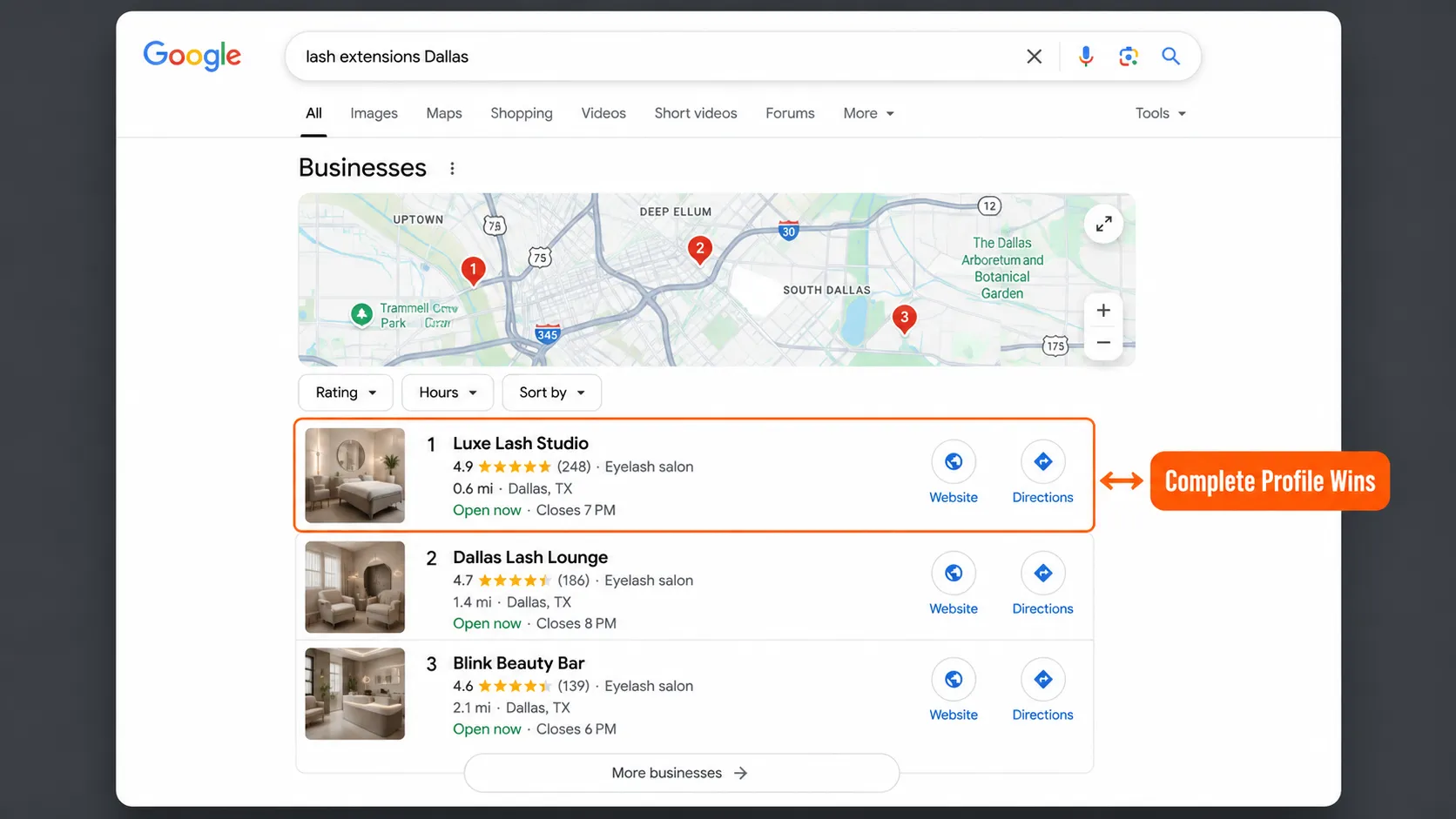
Your Google Business Profile is one of the highest-converting assets you own in local search. Google’s own local ranking guidance confirms that ranking mainly comes down to relevance, distance, and prominence, and a complete, active profile is how you win the first and third factors.
For a full walkthrough, follow a structured approach like this guide on google business profile for local seo, where optimization is treated as a conversion system, not just a listing.
Here’s what to optimize on your profile, in order of impact:
- Primary category, such as “Beauty Salon” instead of a broader label like “Facial Spa”
- Service list with keyword-rich descriptions
- High-quality before and after images, updated regularly
- Weekly Google Posts for offers and availability
- A structured review generation system, covered below
Implementation example. Instead of “We offer facials and skincare services,” use “Acne facial treatments in Austin TX designed for hormonal and adult acne with customized extraction and LED therapy.”
This aligns your listing directly with search intent and improves ranking relevance without touching your website at all.
Category selection deserves extra attention. Picking a primary category that is too broad, or one that does not match your main service, limits which searches you are even eligible to appear in. Add secondary categories for specialty services, such as “Eyelash Salon” alongside “Beauty Salon,” so you compete for both the broad and the specific search.
Comparing Local SEO Strategies for Beauty Professionals: DIY vs an AI SEO Platform
Most beauty professionals do not fail because they picked the wrong strategy. They fail because execution takes more hours than a busy calendar allows. Building intent-matched pages, keeping a profile current, and tracking AI visibility are each manageable alone. Doing all of them consistently, on top of a full booking schedule, is where most plans stall.
| Local SEO Task | Manual DIY Effort | With an AI SEO Platform |
| Intent-mapped service pages | Days per page, one at a time | Built and published at scale |
| Google Business Profile upkeep | One-time setup, rarely revisited | Monitored and refreshed continuously |
| Citation consistency | Manual audits every few months | Tracked and corrected automatically |
| Review response and requests | Ad hoc, when time allows | Prompted and tracked systematically |
| AI search visibility | Rarely measured at all | Tracked across ChatGPT, Perplexity, and Google AI |
Keep NAP Consistent Everywhere Your Business Is Listed
Your Name, Address, and Phone number need to match exactly across your website, Google Business Profile, Yelp, and beauty-specific directories like StyleSeat, Booksy, or Vagaro.
Small inconsistencies confuse Google. “123 Main Street, Suite 2” and “123 Main St #2” look identical to a person and different to a ranking algorithm. Common places these mismatches creep in:
- Business name variations, like “Glow Studio” vs “The Glow Studio LLC”
- Address formatting, like “Street” vs “St.” or “Suite 100” vs “#100”
- Phone number formats, like (555) 123-4567 vs 555-123-4567
Run a citation audit at least twice a year. Search your business name plus your city, then update or merge any outdated listings you find.
This is unglamorous work, but most competitors skip it, which makes it an easy way to pull ahead.
Pay particular attention to beauty-specific booking platforms. Clients often find salons through StyleSeat or Booksy before they ever reach Google, and an outdated address or phone number on those platforms costs bookings just as directly as a wrong listing on Google itself.
Build Location-Specific Landing Pages for Every Area You Serve
If you serve multiple areas, you need dedicated pages, not one generic location mention. A strong multi-location structure follows the same principles outlined in this breakdown of seo strategy for multiple locations, adapted to local service providers. This is where many beauty businesses lose rankings.
Example Structure
For a mobile makeup artist:
- /bridal-makeup-artist-miami-fl
- /bridal-makeup-artist-fort-lauderdale-fl
- /bridal-makeup-artist-west-palm-beach-fl
Each page should include:
- City-specific keywords
- Local testimonials
- Venue familiarity, such as popular wedding venues
- Travel policy details
This signals relevance to Google and increases visibility across every area you serve. Avoid the shortcut of duplicating one page and swapping the city name. Google recognizes thin, repeated content quickly, and it works against every other page on your site.
Turn Reviews Into a Ranking and Conversion System
Reviews influence both ranking and conversion rates, but most beauty professionals collect them passively, which limits their impact.
Build a simple system instead:
- Ask at the moment of satisfaction, right after the appointment
- Send a direct review link by text so there is no extra searching involved
- Prompt clients to mention the service name, location, and result, such as “lash lift in Houston TX that lasted three weeks”
- Respond to every review within 48 hours, positive or negative
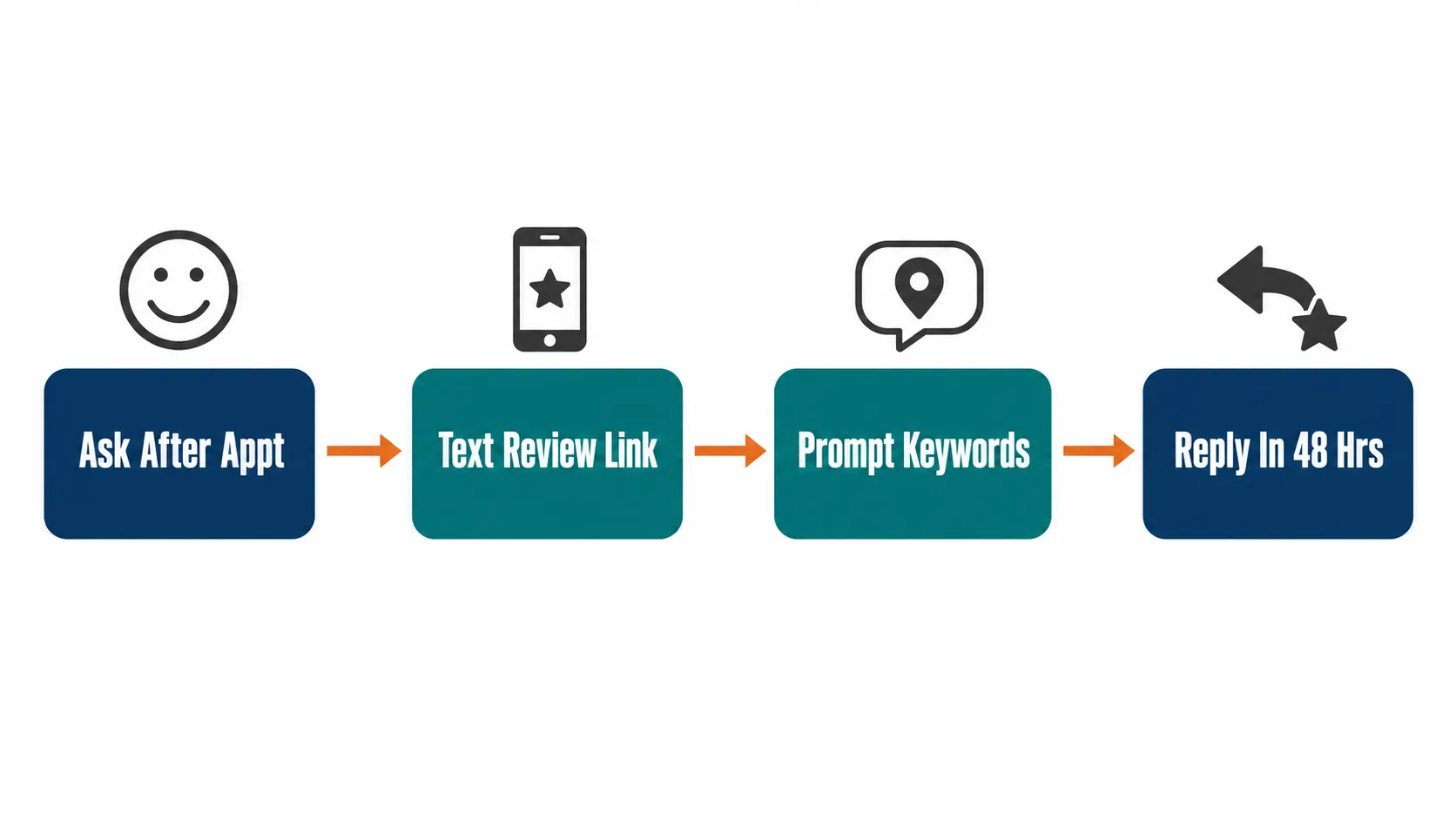
This reinforces keyword relevance for local search while building the trust that turns a browser into a booking. Review velocity, meaning a steady stream of fresh reviews rather than an old pile of five-star ratings, matters more than the total count alone.
Create Service and Problem-Based Content Real Clients Search For
Blog content should target real client questions, not generic beauty tips. This is where most SEO strategies fall apart.
High-intent content examples:
- “how long do lash extensions last in humid climates Miami FL”
- “best facial for acne scars Los Angeles CA”
- “bridal makeup trial timeline Chicago IL”
Each article should answer a specific question, tie back to a service page, and include a booking CTA. Skip generic listicles like “10 beauty trends for 2026.” They rarely match a real booking search and rarely convert.
The same problem-based approach works across other local, appointment-driven categories, including adjacent fields like med spas.
Backlinks for Beauty Professionals: What Helps and What Hurts Your Rankings
Backlinks tell Google your business is trusted beyond your own website. For beauty professionals, the right links come from your actual community, not from a spreadsheet of random directories. A handful of relevant, local links tends to outperform hundreds of generic ones.
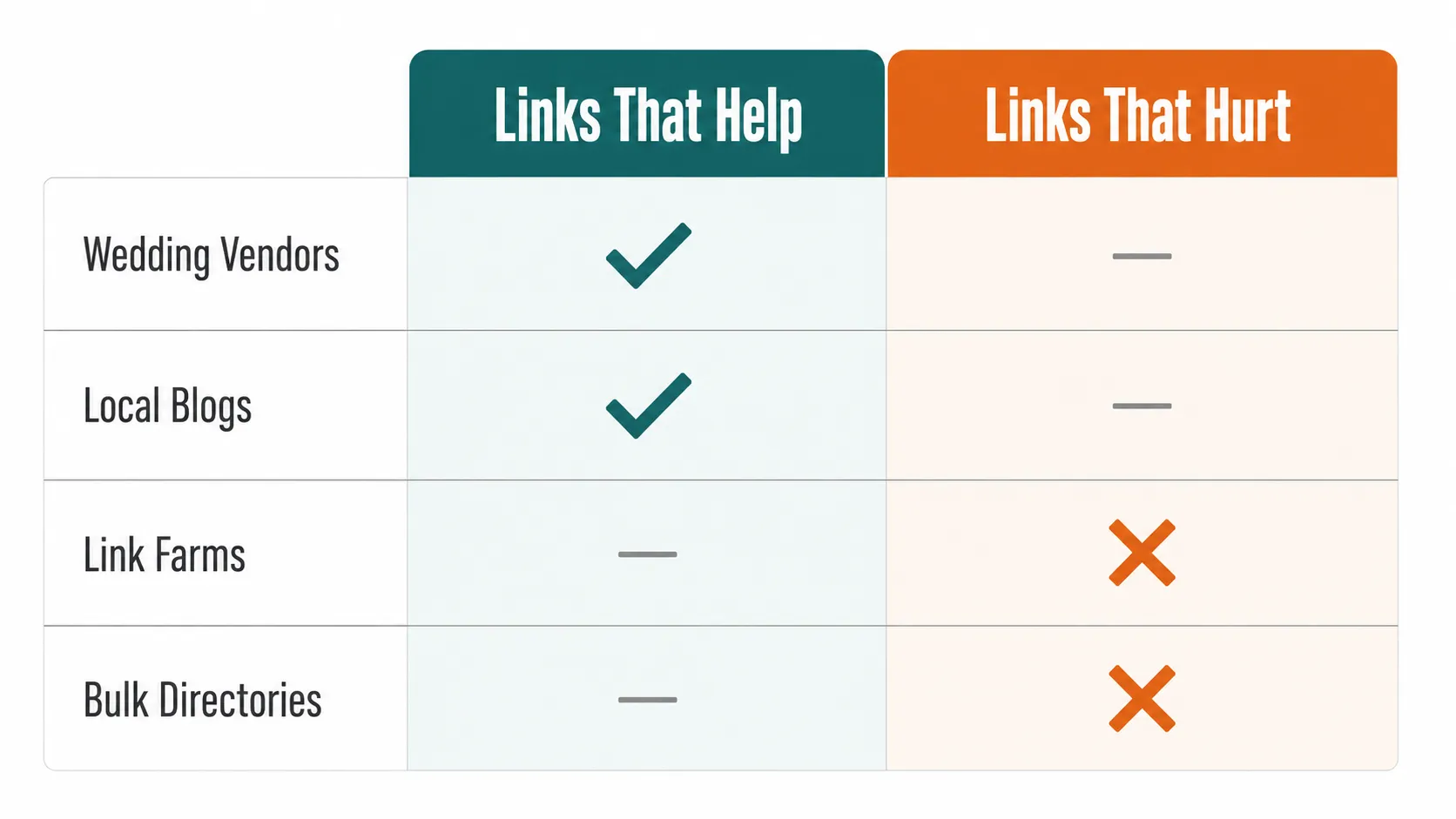
Backlinks That Help Your Rankings
- Links from wedding venues, photographers, and planners you regularly work with
- Guest posts or features on local lifestyle and beauty blogs
- Coverage from local news sites after a community event or sponsorship
- Listings in reputable beauty-specific directories like StyleSeat or Booksy
Backlinks That Hurt Your Rankings
- Paid link networks or link farms promising fast rankings
- Bulk directory submissions with no relevance to beauty or your city
- Links purchased in bulk from an agency that will not explain where they come from
If an agency cannot explain exactly where your links are coming from, treat that as a red flag rather than a technicality. Review criteria like those outlined in questions to ask when hiring an seo company before you sign anything, since a bad backlink strategy can undo months of legitimate ranking progress in one algorithm update.
Show Up in ChatGPT, Perplexity, and Google AI Overviews
Clients now start their search for a stylist or esthetician inside AI tools, not just Google. When someone asks ChatGPT for “the best facial for acne scars near me,” the answer comes from content that is structured, direct, and easy to cite. This is generative engine optimization, and it works alongside, not instead of, traditional local SEO.
Here’s what helps beauty professionals show up in AI answers:
- Direct, self-contained answers near the top of each service page
- Consistent NAP and service details across every citation, since AI tools cross-reference the same sources Google does
- Genuine reviews and press mentions the AI can pull from as evidence
- FAQ sections that answer real questions in plain language
Most beauty websites have never checked whether they show up in AI search at all, which makes this one of the fastest-growing gaps to close.
The businesses that show up here are usually the same ones getting the fundamentals right elsewhere: complete Google Business Profiles, consistent citations, and content that answers a real question in the first two sentences. AI search visibility rewards the same structure that traditional local SEO does, it just adds a new place to be found.
How CometRank Handles Local SEO for Beauty Professionals
Executing local SEO properly for a beauty business means building intent-matched pages for every service and location, keeping your Google Business Profile and citations current, generating reviews consistently, and monitoring AI search visibility, all at once, month after month. Most salons and independent pros do not have the bandwidth to do this in-house, and most agencies move too slowly to make a meaningful dent before the next slow season hits.
We’re an AI SEO agency that runs this entire workflow for clients using CometRank, our proprietary SEO software, through six AI agents:
- The Analyst finds high-intent local searches your business is missing
- The Strategist maps those searches to the right pages
- The Creator builds and publishes the pages at scale
- The Optimizer improves rankings and internal linking over time
- The Authority Builder strengthens citations and local backlinks
- The Quality Guardian checks every page before it goes live
A human SEO captain reviews the full output on top of that, so nothing ships without a second set of eyes. To see how CometRank handles this for your business, book a demo, and we’ll map out exactly which searches you’re missing before the call ends.
Turn Local Searches Into Booked Appointments
Local SEO for beauty professionals is not about being online. It is about owning the exact search someone types when they are ready to book.
The businesses that win consistently target service and location keywords, keep their Google Business Profile and citations accurate, and treat reviews and AI search visibility as ranking assets rather than afterthoughts. None of this requires a bigger following or a bigger budget, just a more deliberate structure than whatever your nearest competitor has in place. That is how you turn visibility into a full calendar with local seo strategies for beauty professionals that actually work.
Frequently Asked Questions About Local SEO for Beauty Professionals
1/ How is local SEO different from general SEO for beauty professionals?
Local SEO focuses on ranking for searches tied to a specific city or neighborhood, like “lash extensions near me,” while general SEO targets broader, non-location terms. Beauty businesses rely almost entirely on local SEO because clients search for services close to where they live or work.
2/ How long does local SEO take to show results for a salon or spa?
Most beauty businesses see initial movement within 8 to 12 weeks, with stronger gains after 4 to 6 months of consistent work. Timelines vary based on how competitive your city is and how much of the foundation, like citations and reviews, was already in place.
3/ What should be included in a Google Business Profile for a beauty business?
A complete profile needs an accurate primary category, a full service list with pricing where possible, weekly photo updates, and a steady flow of reviews. Business description text should mention your specific treatments and city rather than generic phrases.
4/ How many reviews does a salon need to rank well locally?
There is no fixed number, but review velocity, meaning a steady stream of fresh reviews, matters more than hitting a specific total. Salons that request reviews consistently after every appointment tend to outperform those with a large but stagnant review count.
5/ Do I need a separate page for every location I serve?
Yes, if you serve distinct neighborhoods or cities, each one needs its own page with unique content, not a single page with swapped city names. Duplicate content across location pages tells Google the pages are not genuinely distinct.