Is your CRE firm showing up when prospects search on Google?
Most CRE firms depend on referrals and listing platforms for leads. But tenants, investors, and property owners are searching online every day, and if your firm isn’t visible, those opportunities go elsewhere.
A strong commercial real estate SEO strategy helps you capture that demand.
In this article, we’ll cover the key strategies CRE firms can use to improve search visibility, generate qualified leads, and stay competitive online.

What Makes Commercial Real Estate SEO Different From Regular SEO
Commercial real estate SEO strategy works differently because your buyers are different.
A residential buyer browses casually. A commercial decision-maker has a specific objective: leasing warehouse space, evaluating a market, finding a broker, or closing a deal. Every search reflects a concrete business need.
- Tenants search: “industrial warehouse for lease in Phoenix AZ”
- Investors search: “multifamily investment opportunities Tampa FL cap rate”
- Brokers search: “commercial real estate broker retail tenants Chicago”
Each query is a potential deal. A strong commercial real estate SEO strategy builds pages that capture each one. These searches compound over time in a way no ad budget can replicate.
Keyword Strategy: How to Map Search Intent Before Touching a Page
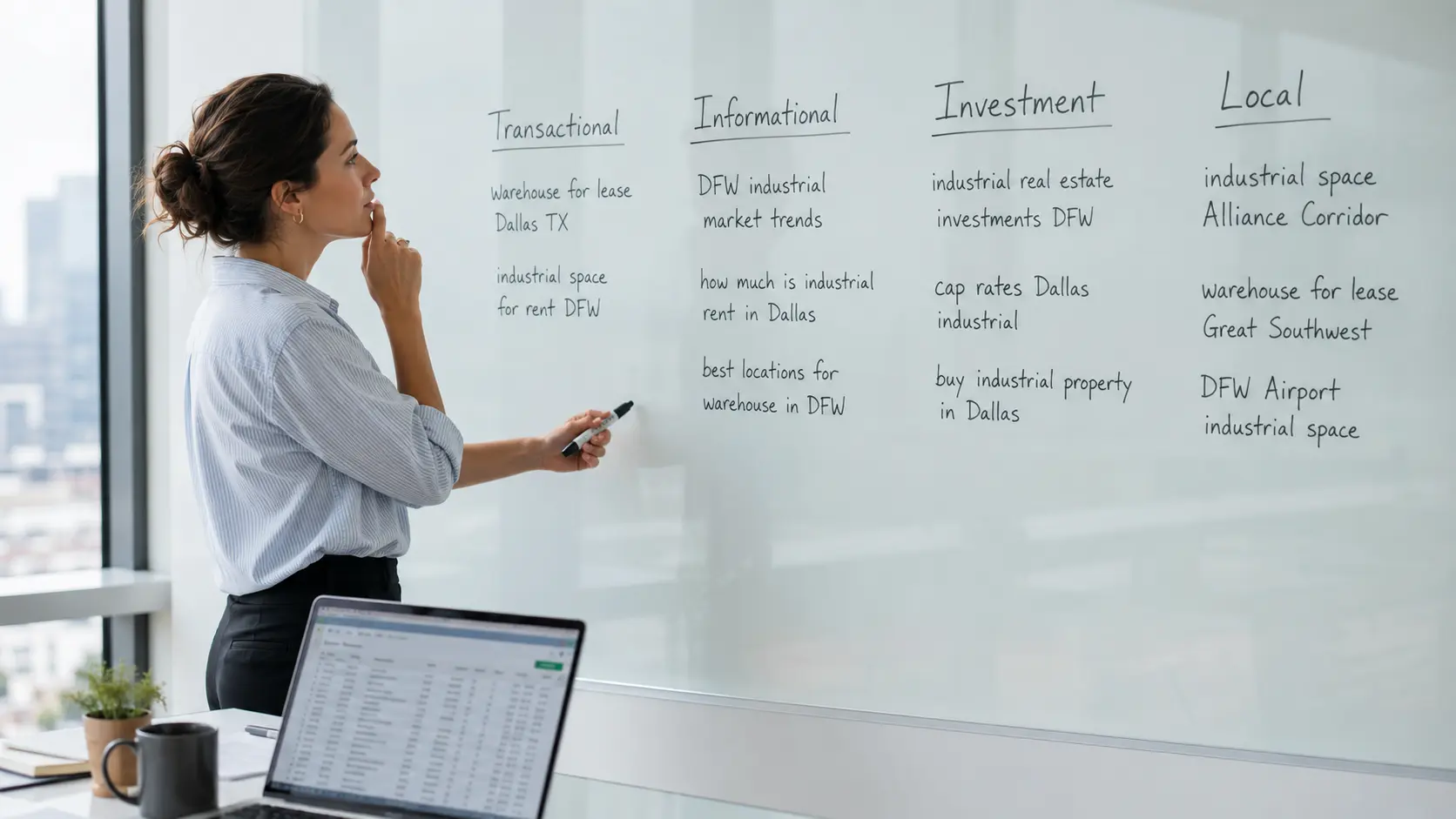
The strongest commercial real estate SEO strategy starts with intent mapping: classifying every keyword by what the searcher is trying to do. Four types matter most.
1/ Transactional Keywords
Transactional keywords signal someone ready to act.
- “office space for lease in Austin TX”
- “commercial real estate broker for retail tenants in Miami”
- “industrial warehouse leasing broker Phoenix AZ”
2/ Informational Keywords
Informational keywords capture researchers earlier in the funnel.
- “how to choose warehouse space for e-commerce fulfillment”
- “what is a NNN lease”
- “average industrial lease rates Dallas TX”
3/ Investment-intent Keywords
Investment-intent keywords attract capital allocators running deal analysis.
- “cap rate industrial property Phoenix”
- “NNN lease investment risks”
- “commercial property ROI calculator”
4/ Local Keywords
Local keywords are where most CRE firms win fastest. Competition is thinner than national terms.
- “commercial real estate broker Dallas TX”
- “retail space for lease Miami Design District”
- “office building broker Chicago Loop”
Each keyword type maps to a different page. Transactional and local queries need dedicated landing pages. Informational and investment-intent queries need content. Trying to serve all four from one generic page is why most CRE websites generate no organic leads.
For a deeper look at keyword research mechanics, see our guide on real estate SEO keyword research.
On-Page SEO for Commercial Real Estate: What Actually Moves Rankings
On-page SEO is everything on your page that search engines use to understand what it is about and who it is for.
Most CRE websites fail for one reason: every page sounds the same. Generic service descriptions, no location specificity, no property-type depth. Search engines cannot rank a page they cannot categorize.
Every high-performing CRE page needs:
1/ H1 tag
Property type + market + intent. “Industrial Warehouse for Lease in Dallas TX” beats “Commercial Properties Available.”
2/ Meta title
Lead with the keyword, add a benefit and keep it under 60 characters.
3/ Body content
Unique copy per property type. Cover square footage, access, zoning, lease structures, local demand drivers. Copy-pasting from your LoopNet listing makes the page invisible.
4/ Image alt text
Describe the image with location and property type.
5/ Internal links
Market overview pages link to property type pages, to broker profiles, to blog content.
| On-Page Element | Weak Version | Strong Version |
| H1 Tag | “Commercial Properties Available” | “Industrial Warehouse for Lease in Dallas TX” |
| Meta description | “We offer commercial real estate services.” | “Find Dallas industrial warehouse space from 10,000–200,000 sq ft. Same-day broker inquiry.” |
| Body copy | Copied from portal listing | Original copy with local demand context and property specs |
| Internal links | None | Market page → listing → broker profile |
| Image alt text | “warehouse.jpg” | “Industrial warehouse for lease Dallas TX 50,000 sq ft” |
Tenants, investors, and owner-users use similar words but want different outcomes. One page cannot serve all three.
| Searcher Type | What They Want | Page That Should Rank | Conversion Goal |
| Tenant | Space, terms, access, timing | Listing page, leasing services page | Tour request or inquiry |
| Investor | Cap rate, NOI, tenant mix, exit risk | Market report, asset page | Offering memo request |
| Owner-user | Building to buy and occupy | Property type page with financing context | Buyer consultation |
| Landlord | Representation, vacancy reduction | Landlord rep page or case study | Listing appointment |
Build separate pages for each searcher type in each market you serve.
Off-Page SEO and Authority Building: What Makes CRE Firms Rank Competitively
Off-page SEO is everything outside your website that tells search engines your site is trustworthy. For CRE firms, it means being cited by sources your audience already respects.
1/ Platform citations come first
Complete your profiles on LoopNet, CoStar, and CREXi with consistent NAP data, your website URL, and broker details. Inconsistency across these platforms weakens your local authority signals.
2/ Industry publications earn the strongest links
Local business journals, trade outlets, and investment newsletters are high-authority targets. Offer them something useful: your own vacancy data or a named broker quote on a market trend. Data gets cited. Opinions get ignored.
3/ Market reports are your most scalable link asset
A quarterly vacancy report with absorption trends and rent ranges attracts links from journalists, lenders, and chambers of commerce. Send it outward. When they reference it, you earn authority and referral traffic simultaneously.
Build the off-page foundation that supports the real estate backlinking strategy that keeps pages ranking long-term.
Local SEO for Commercial Real Estate: Winning Submarket and City Searches
Local SEO optimizes your presence for location-specific searches: Google Maps, “near me” queries, and city-level property searches. For CRE firms, it captures tenants, investors, and owners looking for someone who operates in their specific market.
Google Business Profile setup
- Primary category: Commercial Real Estate Agency
- Service areas: specific submarkets and corridors, not just a broad metro
- Photos: your office and team, not stock images
- Reviews: ask satisfied clients, respond to every review
Location pages are the on-site foundation
One dedicated page per market. Each page should cover vacancy trends, lease rates, major employers, transport access, active listing links, and a broker inquiry CTA. Do not build one thin “markets we serve” page for twenty cities. A “Dallas Industrial Real Estate Market” hub links to subpages for Great Southwest, DFW Airport, and Alliance Corridor. Each subpage links to listings and broker profiles.
Full setup guidance is in our breakdown of Google Business Profile for local SEO.
Technical SEO for Commercial Real Estate: The Foundation Everything Else Sits On
Technical SEO covers the behind-the-scenes elements that determine whether search engines can find, crawl, and index your pages. A CRE firm can publish excellent content and still rank for nothing if the technical foundation is broken.

1/ Page speed
CRE sites are image-heavy. Compress every property photo, use WebP format, implement lazy loading. Google’s Core Web Vitals score affects rankings directly.
2/ Mobile optimization
A large share of property searches happen on mobile. If your site renders poorly on a phone, you lose those users and those rankings.
3/ Crawlability
Audit regularly. Check that location pages, property type pages, and broker profiles are indexed and not blocked by your robots.txt file.
4/ Schema markup
Add RealEstateListingSchema on listing pages (property type, location, availability, price range, contact). Add the LocalBusiness schema for your firm. Add Article schema for market reports.
5/ URL structure:
Use clean, descriptive URLs that clearly show the property type and location. For example, /dallas/industrial-warehouse-for-lease/ is far more informative than /property-listings/?id=4872.
Schema markup does not replace good content. But on a page with strong property detail and clear location signals, structured data helps search systems surface it correctly. Our guide on real estate schema markup strategy covers implementation specifics.
Recommended Reading:
For a full audit process, see how to conduct a technical SEO site audit.
AI Search Visibility: Why CRE Firms Now Need to Rank on ChatGPT and Perplexity Too
A CFO comparing office districts at midnight is not just using Google. They might ask ChatGPT “best commercial real estate brokers in downtown Atlanta” or Perplexity “cap rate trends for industrial properties in Phoenix 2026.” If your firm is not cited, you are invisible to your most sophisticated prospects.
AI tools like ChatGPT, Perplexity, Claude, and Gemini pull from sources they consider authoritative. The same signals that help you rank on Google help you get cited in AI answers.
What improves AI visibility for CRE firms:
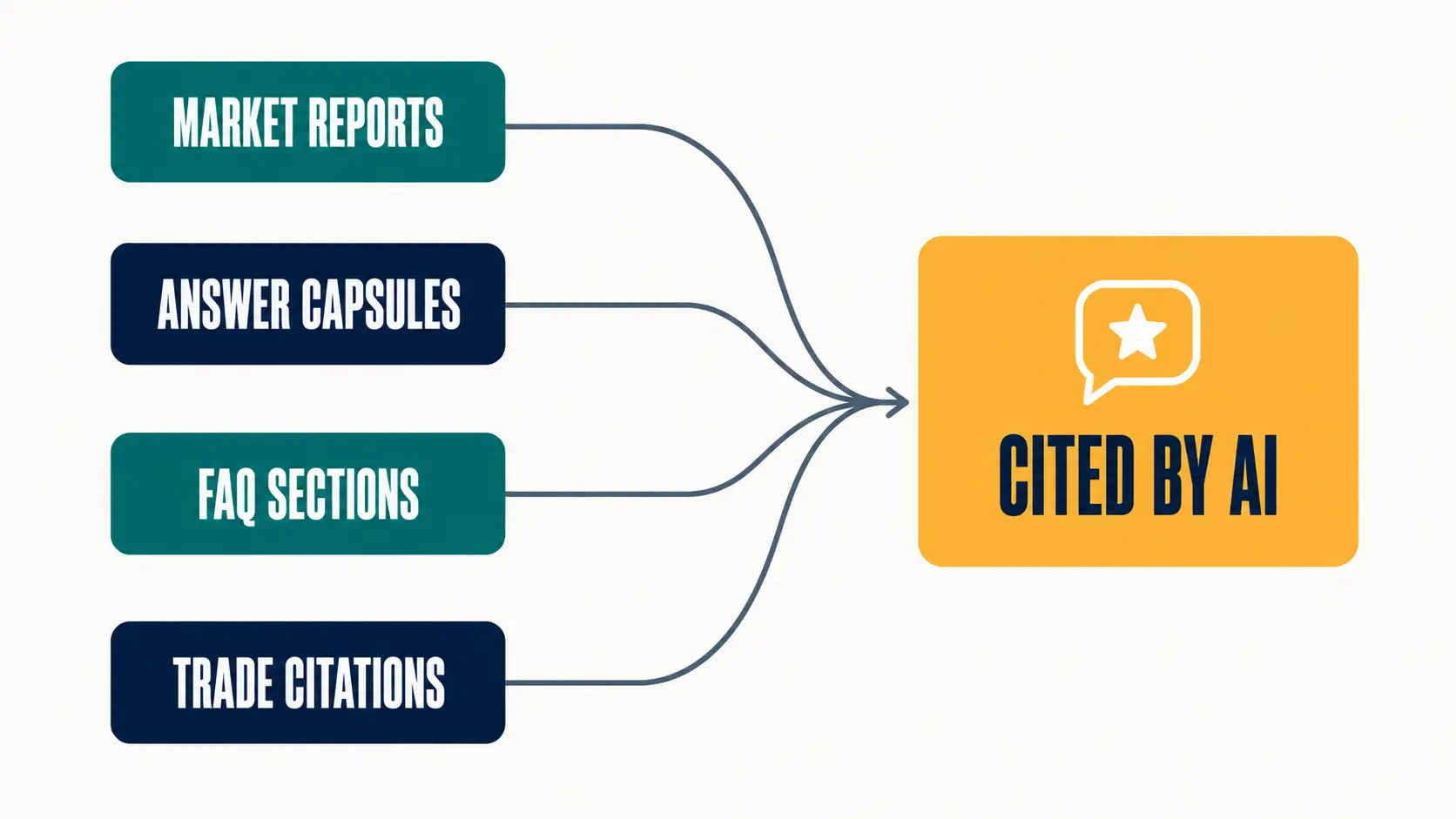
- Publish original market reports with named data: vacancy rates, absorption figures, rent trends. AI tools cite pages with specific numbers.
- Write answer capsules at the top of each content section. AI engines extract opening sentences.
- Build FAQ sections on every major page. Questions map directly to how AI tools format answers.
- Earn citations from trade publications, local business journals, and financial news outlets.
The SEO for real estate agents playbook covers the overlap between traditional SEO and AI visibility signals in more detail.
Content Strategy: Building the Cluster Architecture That Compounds Over Time
A single page cannot rank for everything in your market. Search engines reward topical authority. This is the content layer of a complete commercial real estate SEO strategy.
The cluster model for a CRE firm:
Pillar page (hub): “Dallas Industrial Real Estate Market” Supporting content (spokes):
- “Dallas industrial real estate market trends 2026”
- “Best logistics corridors in Dallas for distribution centers”
- “Average industrial lease rates Dallas TX”
- “How to choose warehouse space for e-commerce fulfillment”
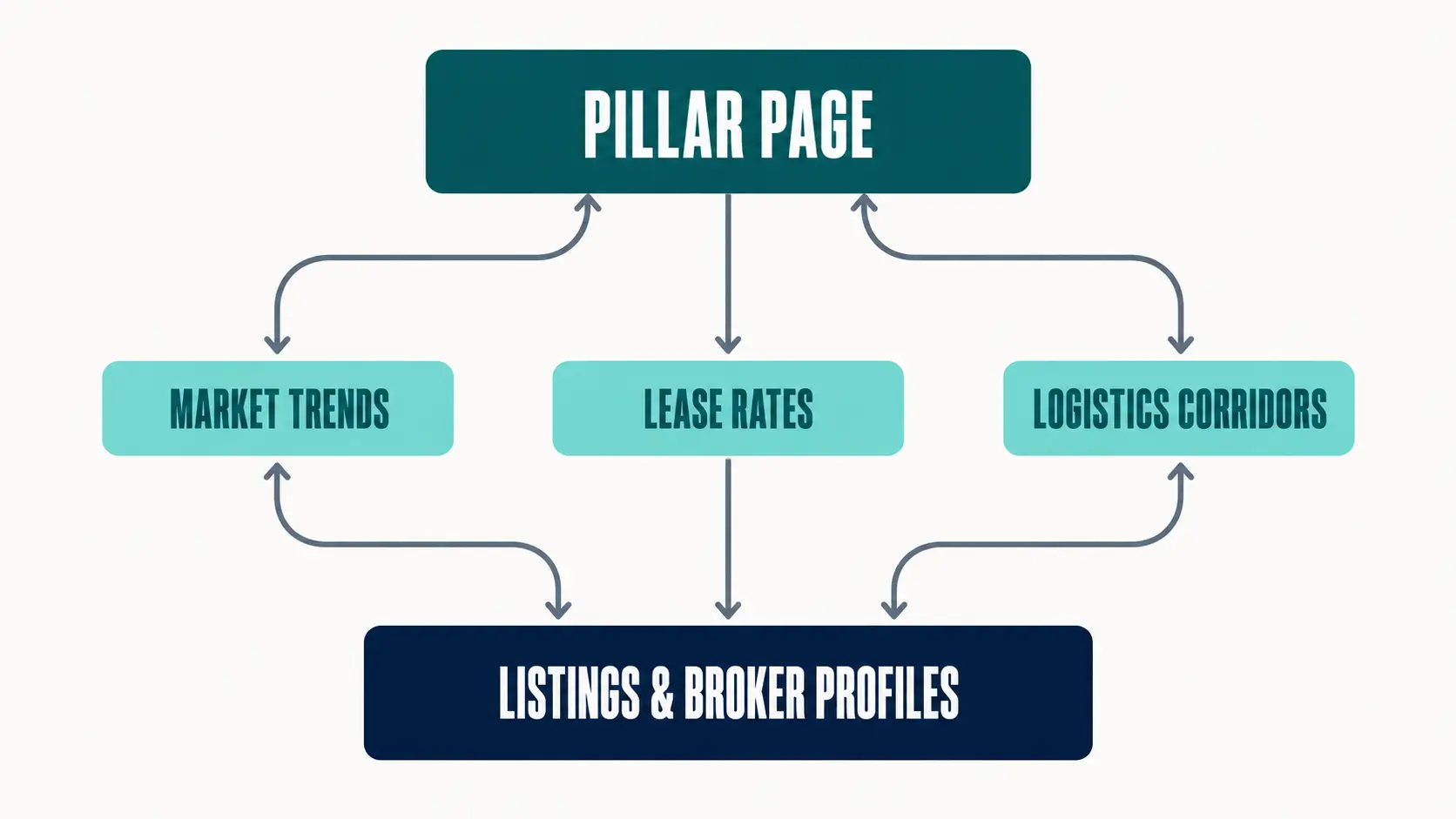
Each spoke links back to the pillar. The pillar links out to listings, broker profiles, and services. Search engines see a site that owns the topic.
Market reports are your highest-leverage content investment. A quarterly vacancy analysis with submarket breakdowns, demand drivers, and rent trends generates backlinks, earns media coverage, and captures investment-intent searches no listing page can reach.
Investor education content keeps sophisticated prospects in your ecosystem. Content explaining cap rate changes by asset class, NNN lease structures, and rent rollover risk captures researchers before they request an offering memorandum. Those become the most qualified leads in your pipeline.
For firms thinking about how commercial versus residential real estate SEO differ: commercial search is B2B. The content has to earn trust from sophisticated buyers, not casual browsers.
How CometRank Builds This System for Commercial Real Estate Firms
Executing a full commercial real estate SEO strategy at scale requires consistent execution across multiple areas. Most CRE firms don’t have the bandwidth to manage:
- Content production
- Technical SEO maintenance
- Authority and backlink building
- AI search visibility optimization
We’re an AI SEO agency that runs this entire workflow using CometRank, our proprietary SEO software. Six AI agents handle intent mapping, keyword planning, content creation, on-page optimization, backlink acquisition, and quality control, while a human SEO captain oversees every stage. Our AI SEO for real estate service builds location pages, property-type landing pages, investor content, and market reports designed to rank on Google and earn citations in AI search tools like ChatGPT and Perplexity.
The result is a pipeline of tenant inquiries, investor leads, and broker opportunities that continues long after ad spend stops. Book a demo to see your search opportunity map in minutes.
Conclusion
Commercial real estate deals start with a search. Tenants evaluate markets, investors compare cap rates, developers research corridors. All before they call anyone.
The firms that appear consistently in those searches control the first impression and most of the deal flow. A complete commercial real estate SEO strategy covers every layer: on-page signals, technical foundations, local search, off-page authority, content clusters, and AI visibility.
Build it once. Maintain it consistently. It compounds. Every quarter you spend ranking puts you further ahead of competitors still waiting for referral calls.
Frequently Asked Questions About Commercial Real Estate SEO Strategy
1/ How long does a commercial real estate SEO strategy take to show results?
Most CRE firms see early movement on local and long-tail searches within three to six months. Competitive market-level terms take six to twelve months. Results accelerate after month six, not slow down. Our breakdown of the real estate SEO timeline covers what to expect at each stage.
2/ What pages should a CRE website create first?
Start with core service pages, market pages for each geography you serve, and property-type landing pages for office, retail, industrial, and warehouse. Add investor guides and market reports after the foundation pages are indexed and ranking.
3/ Can a CRE brokerage outrank LoopNet or CoStar?
Not for broad national terms. But you can win submarket searches, broker advisory queries, and market insight content where local expertise matters more than portal size. That’s also where leads are more qualified.
4/ Is Google Business Profile useful for B2B commercial real estate firms?
Yes. Corporate tenants and investors still search by city or “near me” when looking for a local advisor. A complete, well-reviewed profile validates your office presence, shows up in Maps, and supports local authority signals that affect your broader rankings.
5/ What is the difference between on-page and off-page SEO for CRE?
On-page covers everything on your pages: headings, meta tags, content, internal links, schema, and page speed. Off-page covers everything outside your site: backlinks from publications, platform citations on LoopNet and CoStar, and mentions in local business journals. Both matter. Neither works well without the other.
6/ How to make my CRE firm show up in ChatGPT or Perplexity answers?
Publish original market data with specific numbers, write answer-first content at the top of each section, build FAQ sections on key pages, and earn citations from sources AI tools already trust. The same work that helps you rank on Google improves your AI search visibility.