
How are AI-first manufacturers outranking you for the exact RFQs you should be winning?
It’s not their machines. It’s not their pricing. It’s their search presence. The manufacturers pulling ahead publish deep, technical pages for every capability, material, and certification buyers search for, and they show up when buyers ask ChatGPT or Google’s AI Overviews for a supplier.
In this article, we cover exactly what manufacturing SEO requires in 2026 so you stop losing quotable RFQs to competitors who simply show up first.
What Is Manufacturing SEO?
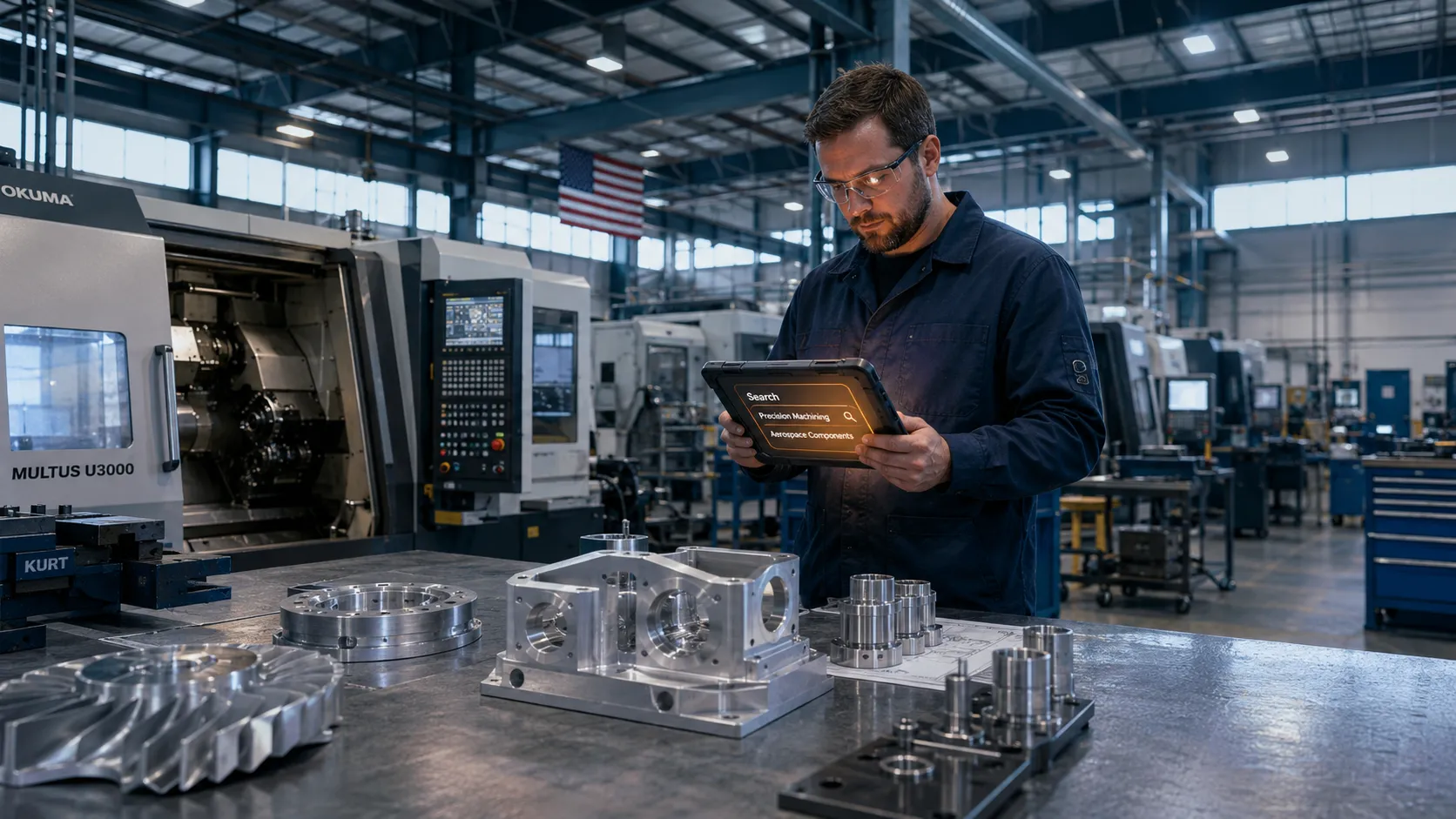
Manufacturing SEO is the process of optimizing a manufacturer’s website so it ranks for the exact searches buyers run before sending an RFQ, like specific capabilities, materials, certifications, and locations. It covers:
- On-site content built around real capabilities
- Technical site health
- Backlinks from real industry sources
- Visibility inside AI tools like ChatGPT and Google AI Overviews
Buyers don’t search the way consumers do. A procurement engineer looking for a supplier types something like “aerospace-grade aluminum CNC machining with AS9100 certification,” not “CNC machining near me.” That specificity is the whole game, and a single RFQ often pulls in more than one searcher:
- An engineer checking technical fit
- A procurement lead comparing suppliers
- A finance approver evaluating cost
If your site doesn’t have a page built around that exact combination of capability, material, and certification, you don’t exist for that search, no matter how good your shop floor is. This is also why manufacturing SEO looks different from local service SEO: a plumber ranks on proximity, a manufacturer ranks on precision, and the more specific your content matches what a buyer actually typed, the more searches you can win.
Why Manufacturing SEO Matters for B2B Lead Generation in 2026
Industrial buying has moved almost entirely online, and most of it happens before a buyer ever talks to your sales team. Gartner projects that by 2025, 80% of B2B sales interactions between suppliers and buyers will occur in digital channels, which means your website is doing the selling long before a call gets booked. For manufacturers, that shift changes who wins the deal:
- Buyers shortlist suppliers based on what they find in search, not who they’ve heard of
- If a competitor’s page answers the exact technical question a buyer typed and yours doesn’t, that competitor gets the RFQ
- You never even hear about it
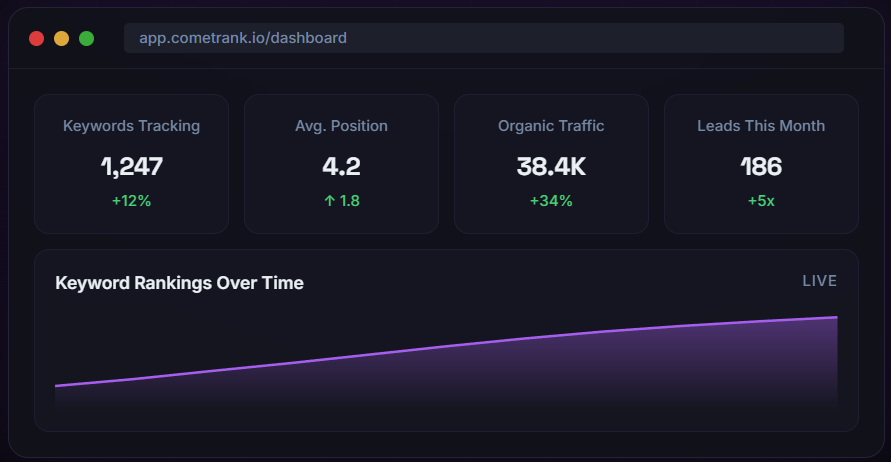
Most manufacturers who invest properly in SEO start seeing qualified traffic and quote requests climb within 3 to 6 months, and the effect compounds. Every new page you publish keeps working long after it’s live, unlike an ad that stops the day you stop paying for it. There’s also a trust dimension most manufacturers underestimate: ranking on page one signals you’re an established, credible supplier before anyone’s spoken to your company, while showing up nowhere sends the opposite signal, even if your work is excellent. Buyers can’t evaluate what they can’t find.
The Three Pillars of Manufacturing SEO That Actually Drive RFQs
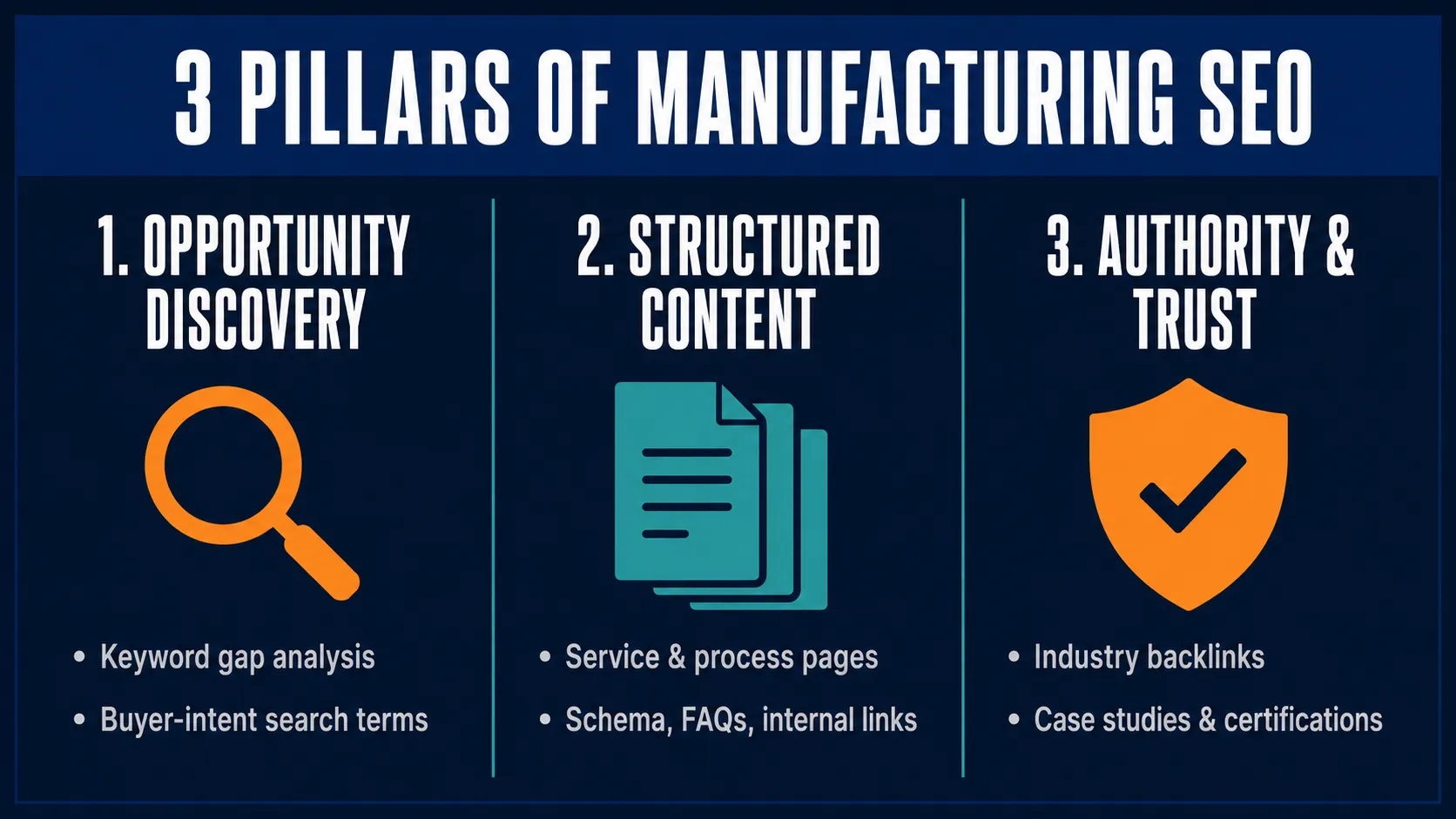
Manufacturing SEO holds up on three pillars: finding the right search opportunities, building content structured around them, and proving your credibility to search engines and buyers alike.
1/ Opportunity Discovery
Start by identifying the long-tail, technical searches that actually drive RFQs, not broad terms like “CNC machining” that every shop is chasing. Look for:
- Capability-specific searches (“5-axis CNC machining for titanium parts”)
- Material-specific searches (“injection molding for medical-grade silicone”)
- Compliance and certification searches (“ISO 13485 contract manufacturer”)
- Supplier comparison searches (“CNC machining vs. sheet metal fabrication for enclosures”)
Keyword tools surface search volume, but the real work is mapping each keyword to the specific page it should live on. A keyword with modest volume but exact buyer intent, like a niche certification search, often converts better than a broad term with ten times the traffic.
2/ Structured Content Creation
Most manufacturing websites lose here. They either publish too little, or they bury five capabilities on one generic “Services” page that Google can’t match to any specific search. Each capability, material, and application deserves its own page, with real specs, tolerances, and certifications, not brochure copy.
A strong capability page answers the buyer’s question in the first few sentences, then backs it up with tolerances, material options, minimum order quantities, and turnaround time. Search engines and AI tools both reward that clarity, and buyers convert faster when they don’t have to call just to get basic specs. Our 9 best SEO tools for manufacturing websites breaks down exactly what to use to audit and build these pages at scale.
3/ Authority and Trust Signals
Search engines and buyers evaluate the same signals: backlinks from real industry sites, mentions on manufacturer directories, and certifications displayed clearly on your site. An AI SEO agency for industrial manufacturers builds these signals systematically instead of hoping they accumulate over time.
Local SEO Still Matters, Even If You Sell Nationally
Even manufacturers who ship across the country need local SEO. A complete, accurate Google Business Profile builds trust with both buyers and search engines, and it’s often the first thing a buyer checks before requesting a quote. It comes down to a few basics:
- Keep your business name, address, and phone number identical across your website, Google Business Profile, and every directory listing
- Claim and optimize a profile for every plant, warehouse, or sales office
- Collect a handful of genuine reviews from real customers
Inconsistent NAP data confuses Google and quietly costs you rankings you’d otherwise win. Buyers searching “custom sheet metal fabrication Ohio” are further along than someone typing a generic term, and convert at a higher rate. Reviews carry weight too, building more trust than a polished homepage, and both buyers and AI tools weigh that signal when recommending suppliers
Common Manufacturing SEO Mistakes That Are Costing You RFQs
The biggest mistake manufacturers make is treating their website like a digital brochure instead of a lead generation system. A handful of patterns show up again and again:
- One “Services” page covering ten capabilities, so Google has nothing specific to rank
- Product PDFs with thin, duplicate copy instead of real web pages
- No certifications or compliance details anywhere on the site
- Buying bulk backlinks instead of earning a handful of relevant ones
Generic content is the root cause behind most of these. Our piece on why generic SEO doesn’t work for manufacturers goes deeper into why copying a template built for a different industry never ranks.
Slow publishing is the other silent killer. A site that adds one page a quarter can’t compete with a site adding pages every week, no matter how good either company’s actual manufacturing is. Search engines reward consistent, ongoing publishing more than a one-time website overhaul.
DIY, Agency, or AI SEO Platform: How Should Manufacturers Execute?
Manufacturers generally choose one of three paths to get this done, and each has real tradeoffs.
| Approach | Speed to Publish | Technical Depth | Typical Cost |
| DIY (in-house) | Slow, 1 to 2 pages a month | Limited to in-house skill | Low direct cost, high time cost |
| Traditional agency | Moderate, 4 to 10 pages a month | Strong strategy, slower execution | $3,000 to $5,000+/month |
| AI SEO platform | Fast, dozens of pages a month | Consistent, scales with oversight | Often lower than an agency retainer |
DIY works if you have real bandwidth and someone technical enough to do it right. A traditional agency works well if you want a fully managed relationship and don’t mind paying for their team’s hours. An AI SEO platform earns its place when you need the output of an agency at a pace and cost neither DIY nor a traditional retainer can match.
There’s no universally right answer here. A shop with one dedicated marketing hire and a small catalog might do fine with DIY. A manufacturer with hundreds of capabilities, materials, and certifications to cover usually can’t publish fast enough without either a large agency team or an AI SEO platform doing the heavy lifting.
Backlinks for Manufacturers: What Helps and What Hurts Rankings
Backlinks still carry real weight for manufacturing SEO, but not all of them help.
Backlinks That Help Manufacturing SEO
Links from real industry sources build authority: trade publications, manufacturer directories, supplier association sites, and guest content on sites your customers read. A single mention on a trusted industry site outweighs dozens of random links, and unlinked brand mentions are worth chasing too. If a publication already named you without linking, a quick outreach email asking for attribution often converts into a real backlink at no cost.
Backlinks That Hurt Manufacturing SEO Rankings
Bulk-bought link packages and irrelevant directory spam can trigger a Google penalty that wipes out your rankings overnight. Relying entirely on a single directory carries the same risk. Our breakdown of why manufacturers can’t rely on directories alone for leads covers what happens when a manufacturer’s whole pipeline depends on one platform’s algorithm
AI Search Visibility for Manufacturers: Getting Cited by ChatGPT, Perplexity, and Google AI Overviews
Buyers are increasingly asking ChatGPT, Perplexity, and Google’s AI Overviews to recommend a supplier before they ever open Google search results. If your site isn’t structured for AI retrieval, you’re invisible in that conversation entirely. AI tools pull answers from pages that:
- State facts clearly and early
- Cite real certifications and capabilities
- Get mentioned by other credible sources across the web
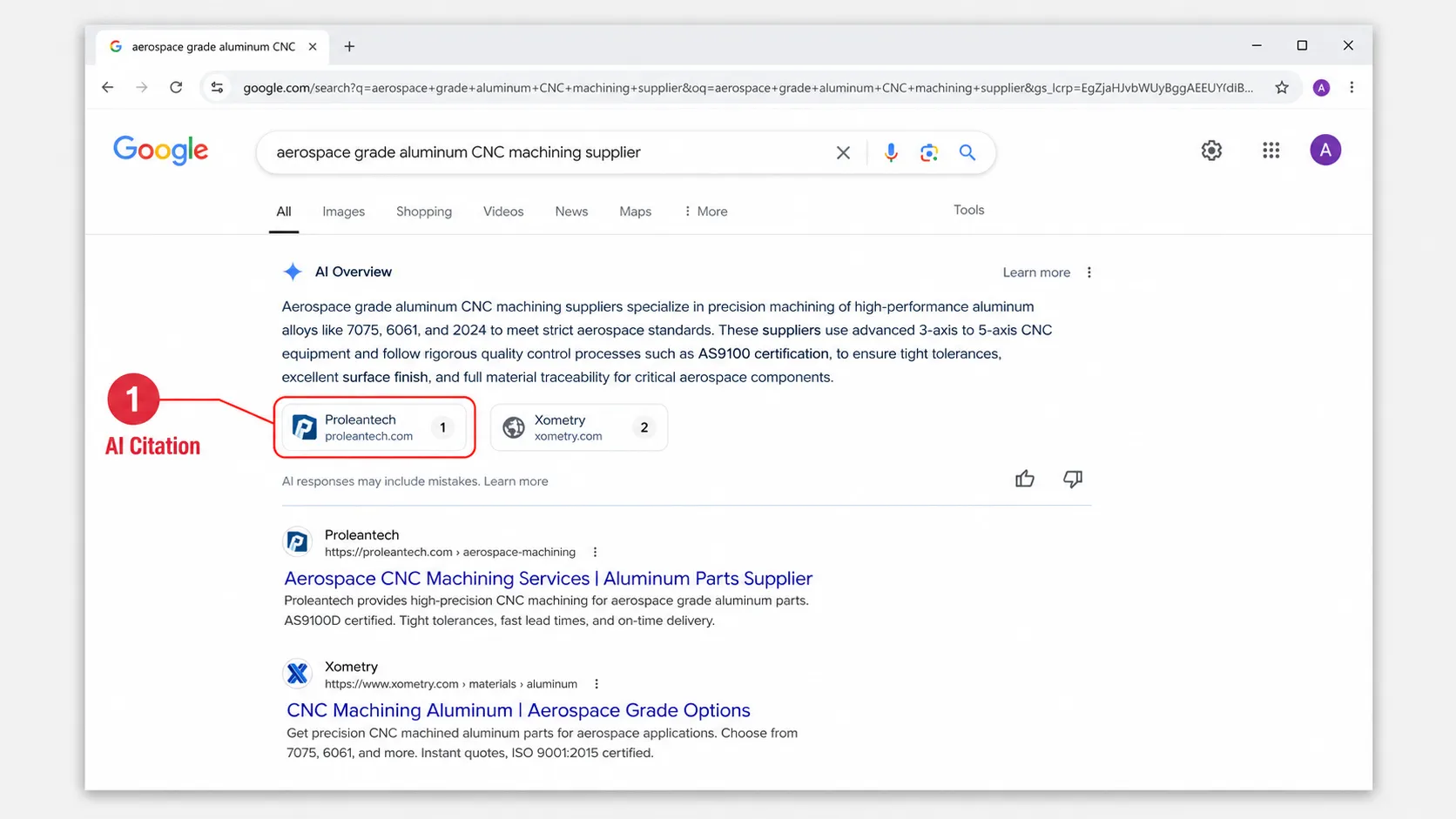
That means your content needs direct, quotable answers near the top of each page, not marketing copy that takes three paragraphs to say what you actually do. This is a newer battlefield than traditional Google rankings, and most manufacturers haven’t touched it yet. That’s an opening, not a threat. Our guide on why your manufacturing website isn’t showing up in ChatGPT walks through exactly what’s missing on most manufacturer sites today.
Getting cited also depends on what other credible sites say about you, not just your own pages. AI tools cross-check claims against outside mentions, so a manufacturer with a few strong industry citations gets recommended more often than one relying purely on its own website copy.
How CometRank Handles Manufacturing SEO at Scale
Executing all of this- opportunity mapping, page creation, local optimisation, backlink outreach, AI search formatting, is more than most manufacturing teams can run in-house. Most agencies can’t move fast enough to cover it either. We’re an AI SEO agency running this workflow with CometRank, our proprietary software, through six AI agents:
- Analyst: studies your business, competitors, and buyer pain points
- Strategist: maps search intent and keywords
- Creator: builds capability, material, and location pages
- Optimizer: formats and internally links pages
- Authority Builder: runs backlink outreach
- Quality Guardian: checks accuracy before publishing
A human SEO captain reviews everything before it goes live. If you’re looking for an AI SEO agency for manufacturing companies, this is what execution looks like at scale.
To see how CometRank handles this for your shop, book a demo, and we’ll map out the exact capability pages your site is missing.
The Bottom Line on Manufacturing SEO
Manufacturing SEO isn’t about ranking for a handful of broad terms anymore. It’s about owning hundreds of specific, technical searches across Google and AI search tools, the exact searches buyers run right before they send an RFQ. The manufacturers who build that presence stop chasing leads and start receiving them. Start with the searches your best customers actually type, build one real page for each, and the rest compounds from there.
Frequently Asked Questions About Manufacturing SEO
1/ What is manufacturing SEO?
Manufacturing SEO is optimizing your website to rank for the specific technical, material, and certification searches buyers run before requesting a quote. It covers content, site health, backlinks, and visibility inside AI search tools.
2/ How long does manufacturing SEO take to show results?
Most manufacturers see qualified traffic and quote requests start climbing within 3 to 6 months. Results build over time as more pages start ranking and earn backlinks.
3/ Do manufacturers need local SEO if they sell nationally?
Yes. A complete Google Business Profile and consistent business information build trust signals that help every page on your site rank, even for buyers outside your immediate area.
4/ Should I hire an agency or handle manufacturing SEO myself?
It depends on your bandwidth and budget. DIY works with real technical skill and time. A traditional agency suits a fully managed relationship. An AI SEO platform fits manufacturers who want agency-level output without the agency-level price tag or timeline.
5/ What backlinks actually help a manufacturing website rank?
Links from trade publications, manufacturer directories, supplier associations, and relevant guest content build real authority. Bulk-bought links or irrelevant directory spam can trigger a Google penalty instead.
6/ How is manufacturing SEO different from AI search visibility?
Traditional SEO targets Google’s search results. AI search visibility, also called GEO, targets tools like ChatGPT and Perplexity, which pull answers from pages with clear, quotable facts and strong third-party citations.