Most institutions pour time into SEO and still lose enrollments to schools with half their reputation. The reason is almost always the same: they’re visible at the wrong moment. The students who actually apply aren’t searching broad terms. They’re searching:
- Program name and specialization
- Location and fees
- Eligibility and intake dates
If your pages don’t show up for those searches, a competitor’s page does.
In this article, you’ll learn exactly how SEO for educational institutions works and how to capture the searches that actually turn into applications.

Student researching university programs online.
Why Most Education Websites Attract the Wrong Traffic
Most institutions target keywords at the wrong stage of the student journey.
For example, “Business degree programs” gets searched by people at the start of a months-long research process. “Online MBA in healthcare management admission requirements 2026” gets searched by someone who has already narrowed their options and wants to compare two or three schools.
The second search converts. The first one doesn’t.
Here’s how student search intent maps across the decision journey:
| Search Stage | Example Query | Intent Signal | Page Type to Build |
| Awareness | “best MBA programs in the US” | Browsing, no urgency | Blog or comparison guide |
| Consideration | “online MBA with finance specialization” | Evaluating programs | Program category hub |
| Decision | “online MBA healthcare management fees and eligibility” | Ready to apply | Dedicated program landing page |
| Local | “business school near Austin TX” | Location-driven urgency | Campus or city-specific page |
Institutions that rank for decision-stage and local searches generate inquiries. Institutions ranking only for awareness-stage searches collect traffic that bounces. The fix starts with knowing which searches your prospective students use when they’re ready to act.
What Makes Higher Education SEO Different From Every Other Niche
SEO for higher education institutions has constraints that most other industries don’t.
A manufacturing company might have 50 product pages to optimize. A university might have 500 program pages across 20 departments, 8 campuses, and 4 delivery formats. That scale creates problems standard SEO playbooks don’t address.
Three things make education SEO genuinely distinct:
1/ Seasonal search patterns
Student searches spike around application deadlines and enrollment windows. A page that isn’t ranking by October misses the fall application cycle entirely. SEO timelines must account for these peaks.
2/ Audience segmentation
A community college targets local students within commuting distance. A research university targets national and international applicants. A trade school targets working adults searching terms like “HVAC certification evening classes.” Each requires a different keyword strategy.
3/ Site complexity
Education websites run into thousands of pages: programs, faculty profiles, admissions info, research publications, campus events. Without strong site architecture and internal linking, search engines rank the wrong pages.
Understanding these constraints is step one. Building an SEO system that accounts for all three is what moves enrollment numbers.
How to Build Program Pages That Rank and Drive Applications
Most program pages fail at the decision stage because they’re written for the institution. They list the curriculum, name the faculty, and stop there. A student comparing two programs wants to know what it costs, whether they qualify, what job they’ll get, and whether the school is credible.
Every high-performing program page answers all of those questions in one place:
1/ Program overview with specialization focus
Not just the degree name. The specific concentration, delivery format, and who it’s designed for.
2/ Admission requirements and eligibility
Specific criteria, not vague language. Students want to know if they qualify before wasting time on an inquiry.
3/ Tuition, fees, and financing options
Hiding costs increases bounce rate. Students researching online programs almost always search for fee information before contacting admissions.
4/ Career outcomes and salary data
Connect the program to real job titles and income ranges. This is what converts a browsing student into an applicant.
5/ Accreditation and institutional credibility signals
Rankings, recognition, and affiliations a student can verify independently.
6/ Faculty expertise
Real names, real credentials, real industry experience. This is an E-E-A-T signal for both students and search engines.
Build one of these pages for every program. Don’t let similar programs share a page to avoid “duplication.” Each specialization deserves its own URL targeting its own keyword.
Local SEO for Educational Institutions: The Biggest Gap Most Institutions Leave Open
Here’s what a strong local SEO foundation looks like:
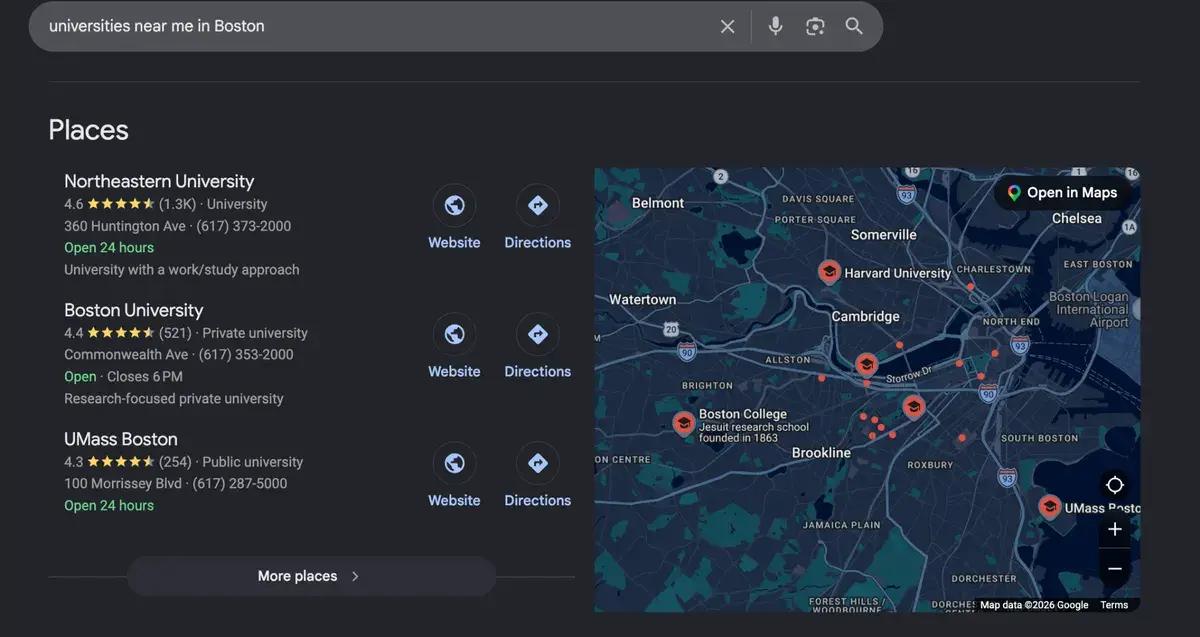
Local search results help prospective students discover nearby educational institutions.
1/ Google Business Profile for every campus
Accurate name, address, hours, and program information. A well-optimized GBP shows up in map-pack results before organic listings.
2/ City-specific landing pages
Don’t just have a page for your main campus city. A campus in Austin needs pages targeting students in Round Rock, Cedar Park, and Georgetown.
3/ Location-based keywords in program pages
“Nursing program Austin TX” ranks differently from “nursing program.” Both serve different students.
4/ Local schema markup
Structured data that tells search engines your institution’s name, address, and program offerings. This improves local rankings and feeds accurate data to AI-generated answers.
For institutions managing multiple campuses, SEO strategy for multiple locations covers how to handle this without creating content overlap that hurts all your pages.
Technical SEO for Educational Institutions: The Foundation That Content Can’t Fix
You can have the best program pages on the internet and still not rank if the technical foundation is broken.
For educational institutions with hundreds or thousands of pages, technical SEO matters more than for almost any other type of website. Here’s the foundation every institution needs:
| Technical Element | What It Does | Priority |
| Site speed (under 3 seconds) | Reduces bounce rate, improves crawl budget | High |
| Mobile responsiveness | Over 60% of searches happen on mobile devices | High |
| HTTPS security | Google ranks secure sites higher; students trust them more | High |
| Course schema markup | Helps Google understand program pages; feeds AI answers | High |
| XML sitemap | Tells search engines which pages exist and when updated | Medium |
| Clean URL structure | Makes page hierarchy readable to users and crawlers | Medium |
| Canonical tags | Prevents similar program pages from competing with each other | Medium |
| Broken link resolution | Broken links bleed crawl authority from your best pages | Medium |
Course schema markup deserves special attention. Marking up program pages with structured data lets Google surface your programs directly in search results, including course name, duration, cost, and provider. This increases click-through rates and feeds accurate data to AI Overview responses.
If you’re building or rebuilding your institution’s web presence, the SEO checklist for a new website covers the technical foundations to get right from day one.
How AI Search Is Changing Education SEO Right Now
Students don’t only use Google anymore. They ask ChatGPT which MBA programs have the best job placement. They ask Perplexity what nursing program admission requirements look like in Texas. They ask Google’s AI Overview which schools offer cybersecurity certifications for working professionals.
If your institution isn’t showing up in those answers, you’re invisible to a growing share of prospective students.
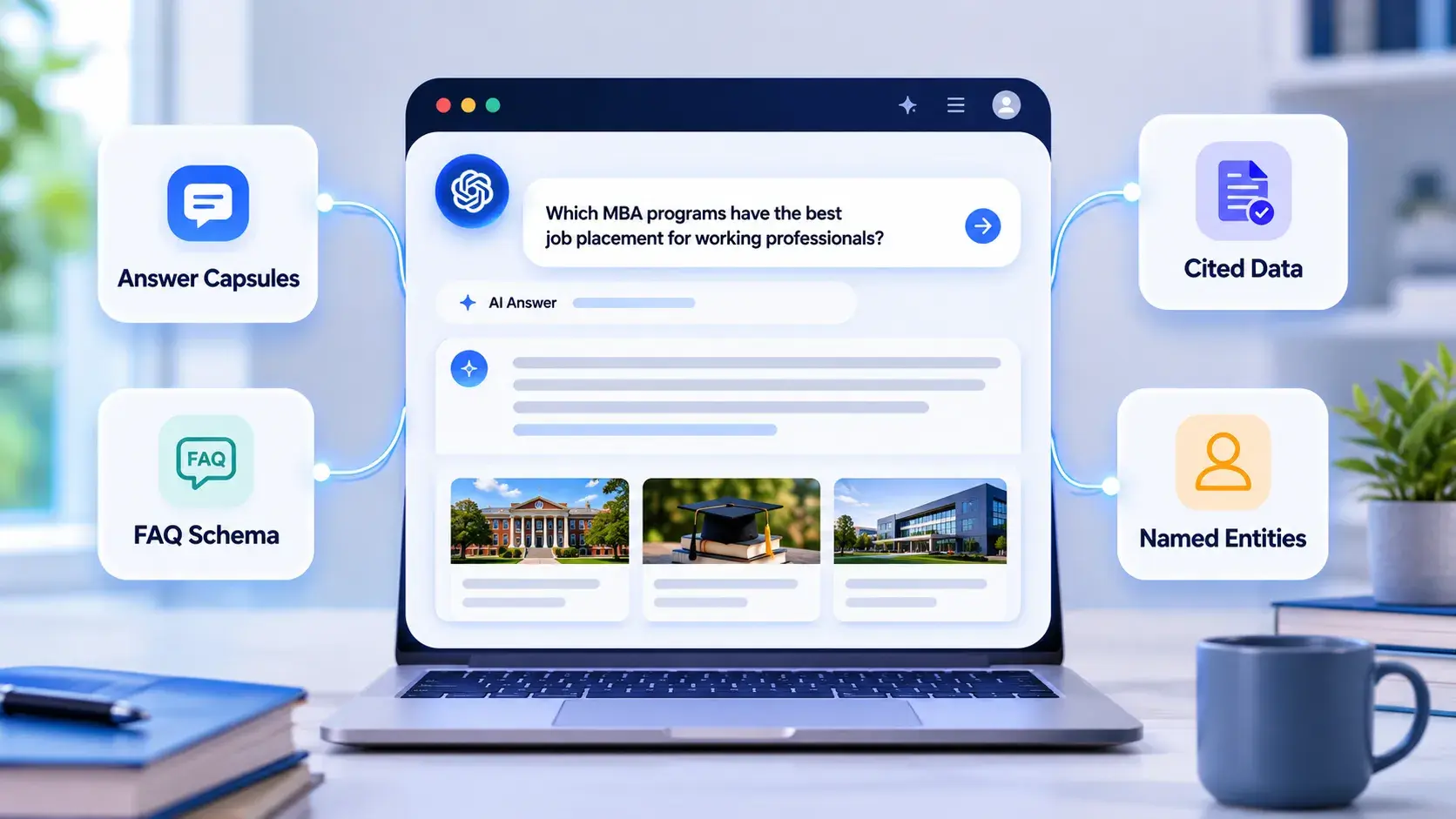
AI search engines prioritize content that is structured and easy to understand.
AI search engines pull from pages that answer specific questions directly, cite credible sources, and structure content in a way AI can parse. This is Generative Engine Optimization (GEO), and it’s becoming a parallel track to traditional SEO. Here’s what AI-ready content looks like:
1/ Answer capsule format
Start each section with a direct 1-2 sentence answer. AI engines extract these and use them in generated responses.
2/ FAQ pages with schema markup
FAQPage schema signals to AI engines that your content answers specific questions directly.
3/ Cited statistics and data
AI engines prefer pages that back up claims with verifiable sources. Pages with credible citations get pulled into AI answers more often.
4/ Named entities
Program names, faculty names, accreditation bodies, and specific outcomes. The more specific your content, the more likely AI systems can use it.
Understanding how an AI search monitoring platform improves your SEO strategy is useful if your institution wants to track both traditional and AI search visibility in one place.
Voice search follows the same logic. A student asking Siri “what are the best evening MBA programs near me” is using natural, conversational language. Institutions that optimize for those queries show up. Institutions optimizing only for head terms don’t.
How to Do SEO Keyword Research for an Educational Institution
Keyword research for higher education isn’t about finding high-volume terms. It’s about finding the terms your prospective students use at each stage of the decision.
Step 1: Start with program-specific terms
Every program needs its own keyword cluster. “Online MBA” is a keyword. “Online MBA with finance specialization for working professionals” is a decision-stage keyword.
Step 2: Layer in location modifiers
Every program keyword needs a local variant. Google Business Profile optimization can show you which location-based searches are already generating impressions for your institution.
Step 3: Map intent to content type
Informational keywords belong in blog content. Decision-stage keywords belong on program landing pages. Mixing these up is one of the most common keyword strategy mistakes in higher education.
Step 4: Validate volume and competition
Focus on keywords where your domain can realistically compete. A new regional college targeting “best MBA program in the US” will rank nowhere. The same college targeting “online MBA evening classes Dallas TX” has a real shot.
On-Page SEO for Educational Institutions: Getting Each Page Right
Finding the right keywords is half the job. Placing them correctly is the other half.
On-page SEO is the practice of optimizing individual pages for a target keyword. For institutions with hundreds of program pages, getting this right at scale separates a site that ranks broadly from one that ranks for nothing specific.
Here’s what on-page SEO looks like for a program page:
| On-Page Element | Best Practice for Education Pages |
| H1 Tag | Include program name, delivery format, and location modifier |
| Meta title | Target keyword within 60 characters, include institution type |
| Meta description | Mention program, outcome, and a reason to click within 160 characters |
| URL slug | Short, keyword-rich, no stop words (e.g. /online-mba-healthcare-management/) |
| First 100 words | Target keyword appears naturally within the opening paragraph |
| H2 subheadings | Cover admission requirements, career outcomes, fees, and accreditation as separate sections |
| Image alt text | Descriptive, includes relevant keyword where natural |
| Internal links | Link to related programs, campus pages, and supporting blog content |
| Content freshness | Update tuition, intake dates, and outcomes data every academic cycle |
One rule across every program page: one page, one keyword cluster. Don’t try to rank a single page for “online MBA” and “executive MBA” simultaneously. Each deserves its own URL. Checking your fundamentals against the most important on-page SEO tactics is a solid starting point before publishing or updating any program page.
Building Backlinks for Educational Institutions: What Actually Works
Backlinks tell search engines that other credible websites trust your content. For universities, brand trust already exists. But that trust needs to show up as actual links to translate into rankings.
The most effective backlink sources for educational institutions are:
1/ Research publications
When faculty publish research, every site that cites it is a potential backlink. Make it easy for publishers to link back to your institution’s page.
2/ Alumni networks and success stories
Alumni who write about their career outcomes and mention their institution create natural links. Encourage this through alumni content programs.
3/ Educational directories and accreditation bodies
Listings in recognized directories (Peterson’s, US News, College Board) carry strong domain authority and relevance.
4/ Local news and community coverage
Campus events, program launches, and faculty achievements generate press coverage. Local news backlinks are strong signals for local SEO specifically.
5/ Guest content on education publications
Faculty writing for education publications generates authoritative backlinks and builds the institution’s reputation as a knowledge source.
Quality matters far more than quantity. Ten backlinks from credible education and news sites outperform a hundred from unrelated directories. Understanding what citations in SEO actually mean and how to build them systematically is worth doing before launching any outreach effort.
How to Measure SEO Performance for Your Institution
The metrics that matter most for educational institutions:
| Metric | What It Tells You | Where to Track It |
| Organic sessions by program page | Which pages are driving traffic | Google Analytics 4 |
| Keyword rankings (branded vs non-branded) | Whether you’re winning new searches | Google Search Console |
| Inquiry conversions from organic traffic | Whether traffic is converting to leads | GA4 goals or CRM |
| Local search impressions | Whether GBP is generating visibility | Google Business Profile dashboard |
| AI Overview appearances | Whether you’re showing up in AI answers | Manual search checks or monitoring tools |
| Bounce rate by page type | Whether landing pages are matching intent | GA4 |
Check these every month. Quarterly trends are what matter for SEO, but monthly checks catch technical issues before they compound. The KPIs that should drive decisions are inquiry volume from organic traffic and cost per inquiry versus paid channels. If SEO is working, those numbers move consistently over 6 to 12 months.
How CometRank Builds a Scalable SEO System for Educational Institutions
Educational institutions running SEO manually hit a ceiling fast.
There are only so many program pages a content team can optimize, only so many city pages they can build, only so many keywords they can track. When you’re managing 200 programs across 10 campuses and 5 delivery formats, the manual approach breaks down before it scales.
We’re an AI SEO agency that runs this workflow using CometRank, our proprietary software. Six AI agents handle the full execution layer:
- The Analyst identifies high-intent keyword gaps across your program portfolio
- The Strategist maps the intent-to-page architecture
- The Creator builds optimized program pages and city-specific content at scale
- The Optimizer improves rankings and internal linking continuously
- The Authority Builder develops backlinks from credible education and industry sources
- The Quality Guardian ensures every page meets accuracy and brand standards
A human SEO captain oversees the strategy throughout.
For an institution with dozens of programs and multiple campuses, this means a complete SEO system running without pulling your internal team off their primary jobs. If you want to see what that looks like for your specific program mix and markets, book a demo, and we will map out the opportunity.
Conclusion
SEO for educational institutions is not a traffic problem. Most institutions that struggle with organic search aren’t failing to attract visitors. They’re failing to attract the right visitors at the right stage of the decision.
When your program pages are built for the student who is ready to apply, when your local presence covers the cities your students actually live in, and when your technical foundation lets search engines find and understand your content, the inquiry volume follows. That’s what intent-driven SEO does. It doesn’t bring more visitors. It brings the ones who actually fill out the application.
SEO for Educational Institutions: Frequently Asked Questions
1/ What keywords should an educational institution target?
Decision-stage and program-specific keywords drive the highest conversion rates. These include program name plus delivery format, location, specialization, and eligibility terms. Awareness-stage keywords like “best MBA programs” generate traffic but rarely convert to inquiries. The most effective keyword strategy layers program-specific terms with local modifiers and decision-intent qualifiers.
2/ Why is local SEO important for school, colleges and universities?
Yes, local SEO is critical even for nationally recognized institutions because Google increasingly prioritizes local results for campus-specific searches. Students searching for programs near their location see map-pack results and city-specific pages before national organic rankings. Institutions that claim and optimize their Google Business Profiles and build city-specific landing pages consistently outperform those relying only on main campus pages.
3/ How long does SEO take to show results for an educational institution?
Most educational institutions see measurable ranking improvements within 3 to 6 months of consistent SEO execution. Inquiry volume from organic traffic typically follows rankings by 4 to 8 weeks. Local SEO improvements, particularly Google Business Profile optimization, can show results faster because local rankings respond more quickly than national organic rankings.
4/ What is SEO for educational institutions?
Yes, SEO for educational institutions is a specific application of search engine optimization focused on ranking program pages, campus pages, and supporting content for the searches prospective students use when comparing and applying to schools. It differs from general SEO because it requires mapping content to the student decision journey, managing large and complex site structures, and balancing national brand visibility with local enrollment intent.
5/ How does AI search affect SEO for educational institutions?
AI search engines like ChatGPT, Perplexity, and Google AI Overviews pull from pages that answer specific student questions directly. Institutions with well-structured program pages, FAQ schema markup, and cited data are more likely to appear in AI-generated answers. As a growing share of students use AI tools for program research, visibility in AI answers is becoming a parallel track to traditional organic rankings.
6/ Does an educational institution need a separate page for each program?
Yes. Each program and specialization needs its own page targeting its own keyword cluster. Combining similar programs on a single page means none of those programs ranks well for its specific keyword. Individual program pages also convert better because they match the exact intent of a student evaluating that specific program.