Your winery has great wine, great views, and great reviews.
So why is your competitor’s website showing up first when someone searches “wine tasting near me”?
Most winery websites are beautiful yet invisible. They tell your story. But they don’t answer what searchers and website visitors are actually looking for. That’s the only reason your competitor outranks you.
This guide covers exactly how SEO for wineries works in 2026: from ranking on Google to appearing in ChatGPT and Perplexity when someone asks an AI for wine-tasting recommendations near them.
Why Winery Websites Don’t Rank (Even When the Wine Is Great)
Most winery websites have the same problem:
They’re built for brand, not search.
- Beautiful photography
- Vineyard history
- Award mentions
But when someone searches “private wine tasting Napa Valley for couples,” there’s nothing on the site for Google to match that query to. Google can only rank pages that exist. If you don’t have a page for a specific query, you don’t rank for it.
Here’s what those gaps look like:
- No pages targeting “wine tasting near [location]”
- No booking-focused landing page for tours or events
- No product pages optimised for DTC purchase queries
- No blog content answering questions wine buyers actually search
- Weak internal linking between experiences, products, and educational content
The fix? Implementing SEO for wineries’ strategies and building the right pages for the right searches.
How to Map Search Intent for Winery Customers
Search intent is what the person searching actually wants.
Every query falls into a bucket. Each bucket needs a different page type. Among all the powerful SEO for wineries tactics out there, this one drives the most.
Here’s the full map:
| Intent Type | Example Searches | Page You Need |
| Local visit intent | “winery near me open now”, “wine tasting Napa Valley” | Location landing page |
| Experience booking intent | “vineyard tour with lunch California”, “private wine tasting for two” | Booking/experience page |
| Purchase intent | “buy Cabernet Sauvignon direct from winery”, “organic shiraz online India” | Product/DTC page |
| Wine club intent | “best wine club for red wine lovers”, “wine club with free shipping” | Wine club sign-up page |
| Informational | “how wine tasting works”, “difference between Cabernet and Merlot” | Blog content |
Most winery sites have one or two of these covered. The ones that rank have all of them.
Building High-Intent Pages That Actually Convert
Ranking is only useful if the page converts. Here’s how to build pages that do both.
1/ Tasting and Experience Pages
Your tasting page is not your homepage. It deserves its own dedicated URL, its own keyword focus, and its own conversion path.
A high-performing tasting page includes:
- The specific experience type (private, group, corporate, couples)
- Duration, pricing, and what’s included
- Wine varieties and food pairings offered
- Location details and a map embed
- A booking CTA above the fold
- FAQs covering cancellation, dress code, and accessibility
Target one specific keyword per page. “Private wine tasting Sonoma for couples” converts far better than “wine tasting.” The more specific the query, the closer the searcher is to booking.
2/ Product and DTC Pages
Each varietal needs its own page. Dedicated URL, tasting notes, food pairings, awards, shipping info, reviews, schema markup. Wine now accounts for 53% of North America’s online alcohol sales. DTC pages built for search are how you capture it.
3/ Wine Club Pages
Wine club sign-ups are one of the highest-value conversions a winery can drive. Searchers want direct answers:
- What wines do I get and how often?
- How much does it cost per shipment?
- Can I customise my selection?
- What are the perks and how do I cancel?
Answer those questions on the page. Use keywords like “best wine club for red wine lovers” and “wine club with free shipping” in your content and metadata.
Local SEO for Wineries: Capturing the “Near Me” Searches
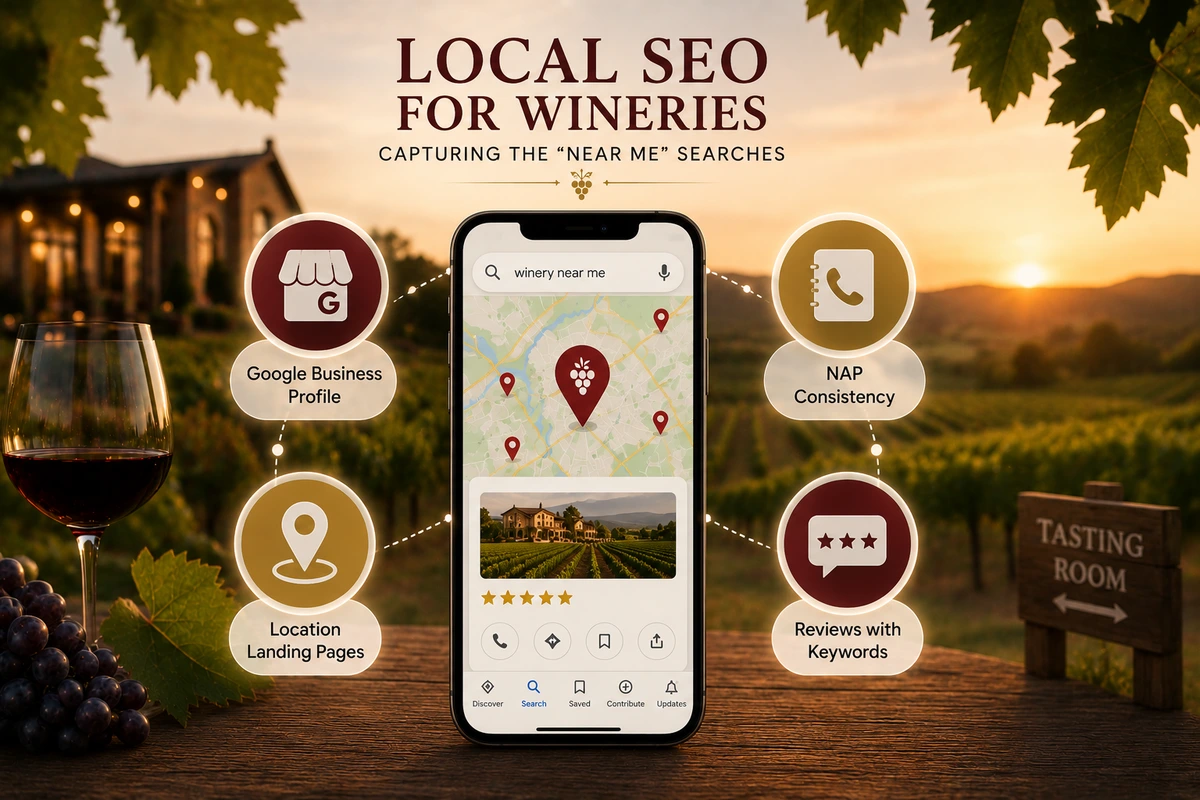
The four local SEO elements that help wineries rank in “near me” searches.
Local SEO for wineries is the highest-ROI channel for any winery with a physical tasting room. When someone searches “winery near me” or “wine tasting [city],” Google surfaces a local pack before the organic results. If you’re not in that pack, you’re invisible.
Here’s what local SEO for wineries actually involves:
1/ Google Business Profile
Your GBP determines whether you show up in “near me” searches and Google Maps. Keep it complete with accurate hours, high-quality photos, all experience types listed as services, and active review management.
Optimising your Google Business Profile for local SEO is one of the fastest ways to move from invisible to the top of the local pack.
2/ NAP Consistency
Your Name, Address, and Phone number must match exactly across every directory and social profile. Understanding what citations are in SEO and how to build them is the mechanical work behind every local ranking improvement.
3/ Location Landing Pages
Build dedicated pages for each location or region you serve. “Family-friendly winery near Nandi Hills Bangalore with outdoor seating” is the kind of specific, location-anchored page that ranks for hyperlocal searches.
4/ Reviews with Keywords
Encourage guests to describe the experience specifically. A review mentioning “the private tasting was perfect for our anniversary” does more SEO work than “great place, would recommend.” Google reads review content as a local relevance signal.
Technical SEO for Wineries: The Foundation That Makes Everything Else Work
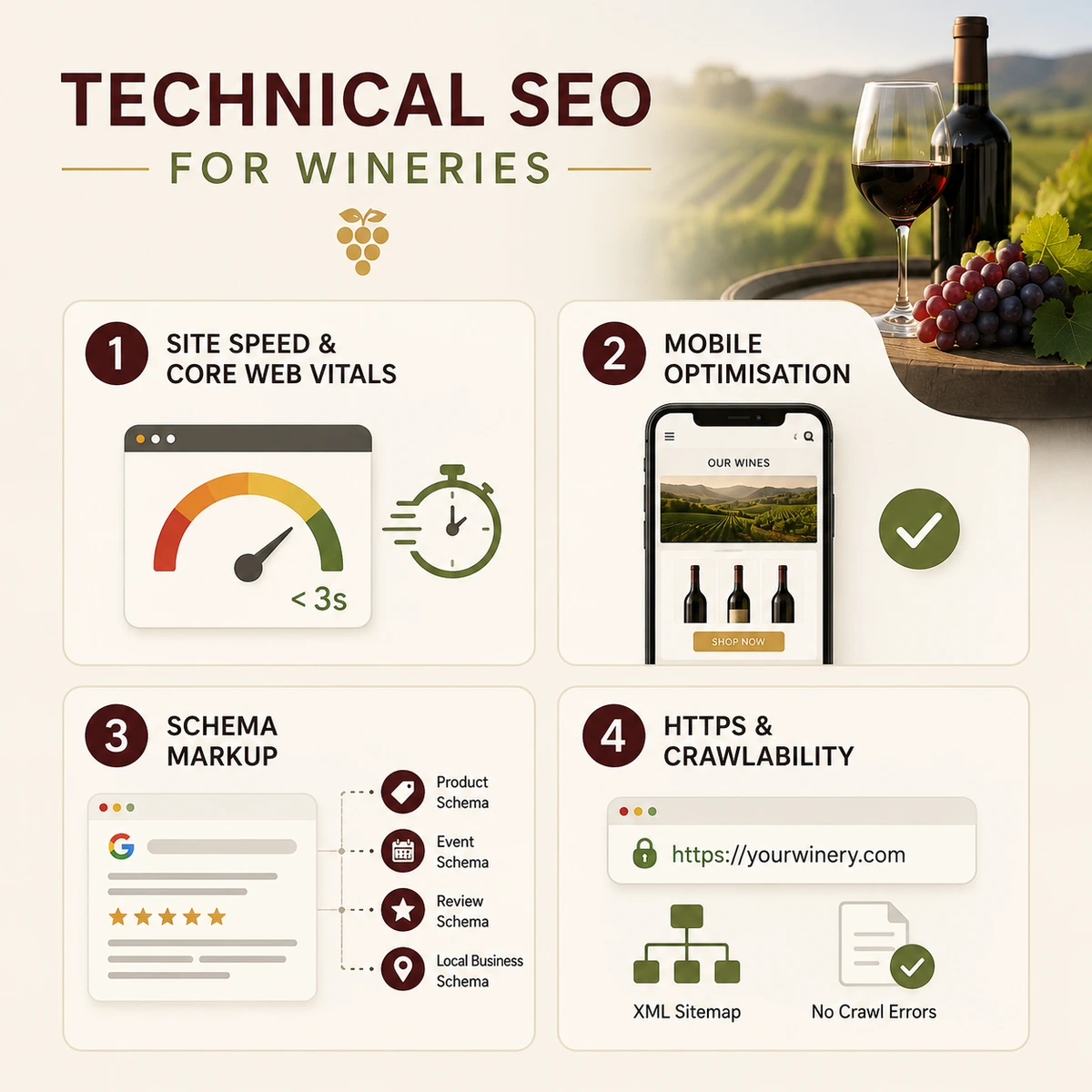
Technical SEO foundations that support winery rankings and website performance.
You can have great content and still not rank if your technical foundation is broken. This is the part most wineries skip, and it’s often why a solid site sits on page three.
1/ Site Speed and Core Web Vitals
Slow sites rank lower and lose visitors in seconds. Quick wins:
- Compress all images (especially the high-resolution vineyard shots)
- Use a content delivery network (CDN)
- Minimise unnecessary plugins and scripts
- Target a load time under 3 seconds on mobile
2/ Mobile Optimisation
Over 40% of wine eCommerce purchases happen on mobile. Google’s mobile-first indexing means your mobile site is what gets ranked.
3/ Schema Markup
Schema tells Google exactly what your page contains. For wineries:
- Product Schema: Shows pricing, reviews, and availability in results
- Event Schema: Gets tastings and events into Google’s event listings
- Review Schema: Shows star ratings directly in search results
- Local Business Schema: Reinforces address, hours, and category for local SEO
4/ HTTPS and Crawlability
Run on HTTPS. Submit an XML sitemap to Google Search Console. Check regularly for crawl errors and broken links.
On-Page SEO for Wineries: Getting the Details Right
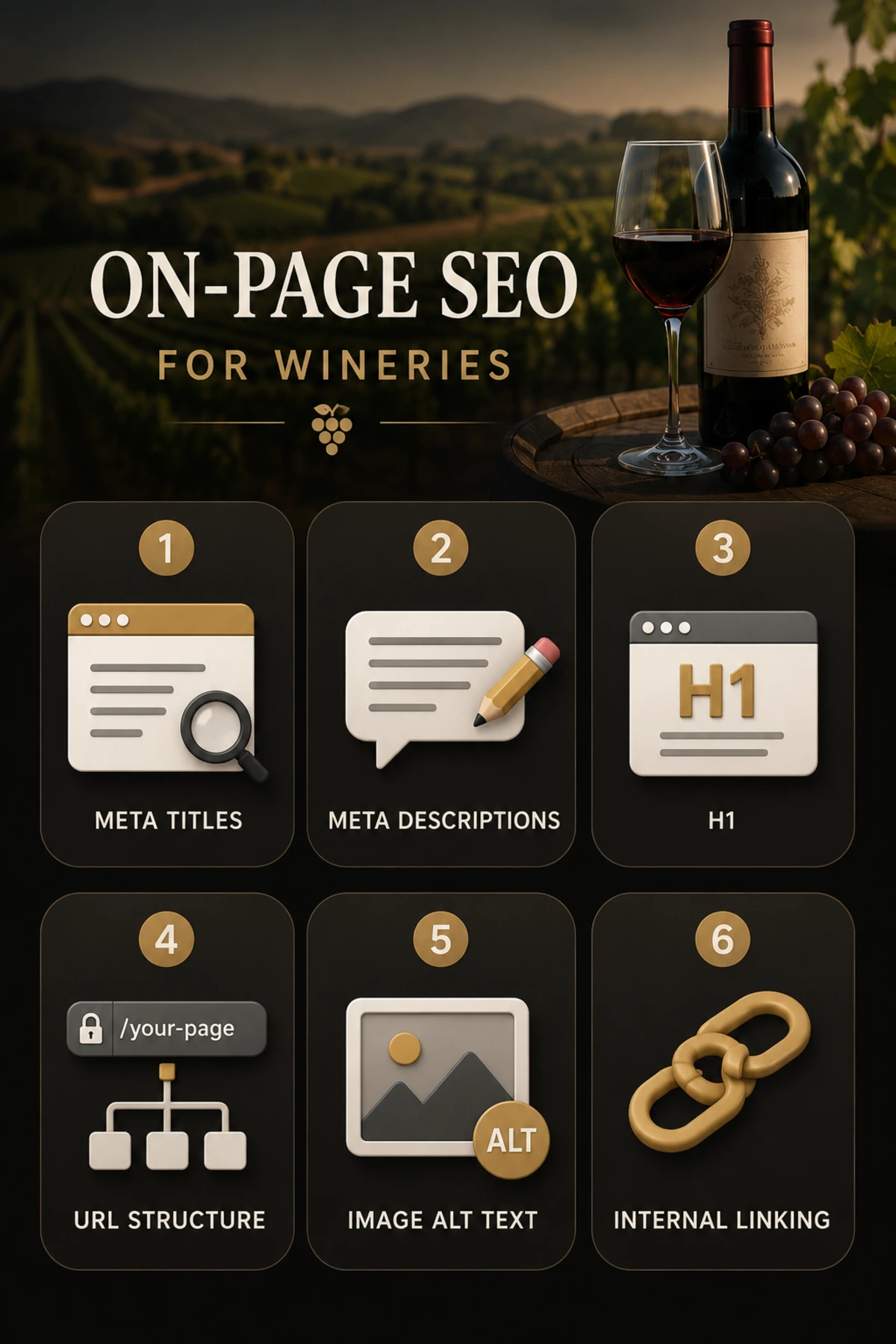
Core on-page SEO elements every winery website should optimize.
On-page SEO is what you control directly on every page. Most of the important on-page SEO tactics that move rankings apply directly to winery pages.
Here are the key on-page elements for every page:
1/ Meta Titles
Use this formula: Primary keyword + location + value signal.
Example: “Private Wine Tasting Napa Valley | Book Your Experience Today”
2/ Meta Descriptions
Write for the click, not just the summary and keep it under 160 characters.
Example: “Private wine tastings in Napa Valley. Curated pairings, stunning vineyard views. Reserve your spot today.”
3/ H1
Include your target keyword in your H1s. Example: “Private Wine Tasting Napa Valley” not “Welcome to Our Winery.”
Recommended Reading:
SEO H1 Tags Best Practices: The H1 Formula That Works in 2026
4/ URL Structure:
Clean and keyword-rich beats long and generic.
Example: /private-wine-tasting-napa-valley/ beats /experiences/page?id=47/
5/ Image Alt Text
Describe what’s actually in the photo. Google reads this. Visitors using screen readers do too.
Example: “Sommelier pouring Cabernet Sauvignon during private tasting at Napa Valley vineyard” beats “img-0032.jpg”
6/ Internal Linking
Link from every blog post to your tasting pages, product pages, and booking pages. This distributes ranking authority across your site and moves visitors closer to making a reservation or a purchase.
Blog SEO for Wineries: How to Turn Your Winery Blog Into a Consistent Lead Source
Wineries that rank consistently have topical authority. Google treats their site as the go-to source on wine, tastings, and vineyard experiences in its region.
You build it through content clusters:
- A core page targets the main query: “Wine Tasting Experiences in Napa Valley”
- Supporting blogs cover related searches: private vs group tastings, what to expect on a tour, wine pairings
- Internal links connect them all together
- Google reads the cluster as depth and authority
Individual pages don’t rank. Clusters do.
The questions your customers ask in person are the same ones they type into Google. Answer them in your blog. The same strategy that works for tour operators driving bookings through search applies almost perfectly to wineries.
Ranking on AI Search: The Winery SEO Opportunity Most Businesses Are Missing
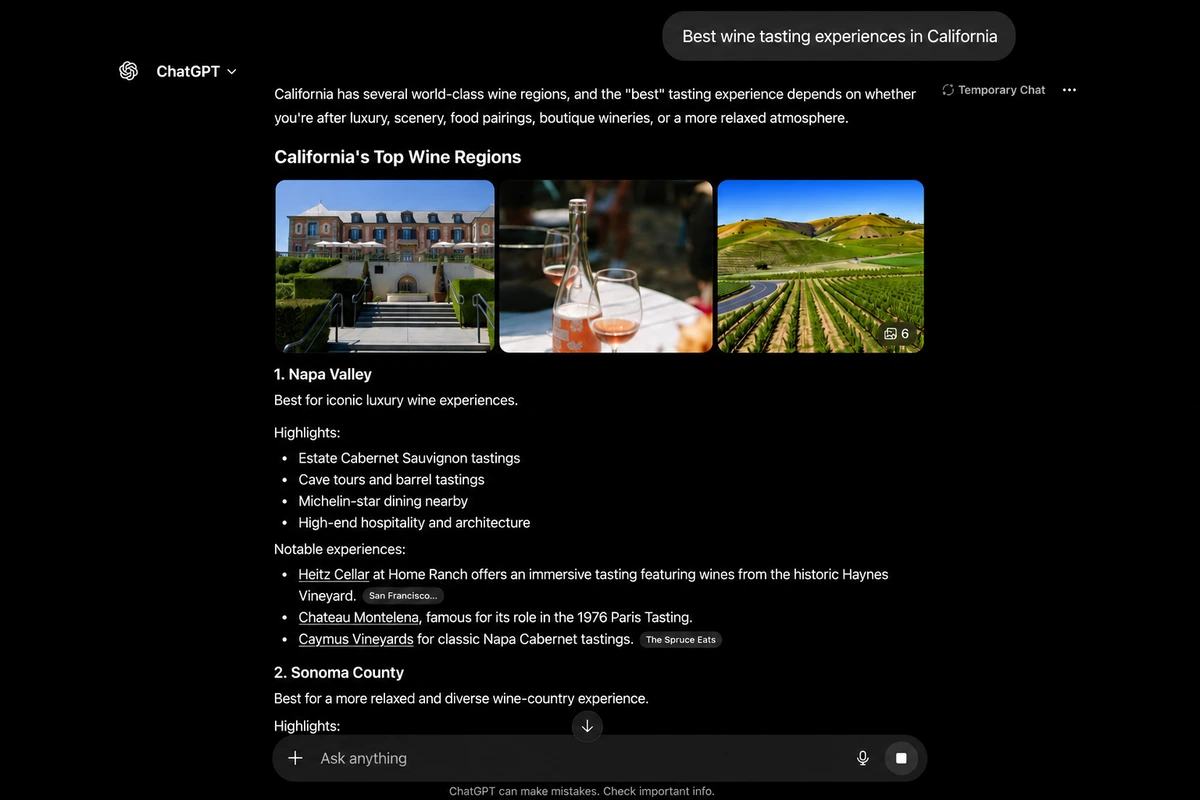
How AI search platforms surface winery recommendations and tasting experiences.
Google rankings matter.
But in 2026, your customers aren’t only searching on Google.
They’re asking ChatGPT, Perplexity, and using Google AI Overviews before they ever click a result.
Here’s what makes your winery AI-search-ready:
1/ Direct-answer formatting
Open each page section with a clear answer. AI engines extract these blocks directly.
2/ FAQ sections on every key page
Question-and-answer content gets cited more often by AI tools.
3/ Schema markup
AI crawlers read schema to understand and summarise your content.
4/ Detailed experience pages
AI answers to “which winery offers outdoor seating near me” come from pages that specifically describe it. Vague pages don’t get cited.
5/ Consistent NAP
AI tools cross-reference listings. Inconsistencies get you skipped.
Understanding what generative engine optimisation is and how it differs from traditional SEO for wineries is the starting point for any winery that wants to rank on AI platforms, not just Google.
Off-Page SEO for Wineries: The 5 Highest-Value Backlink Sources for Wineries
Backlinks signal authority. Google uses them to decide which sites rank for competitive queries. The best sources for wineries:
1/ Wine publications and media
A feature in Wine Spectator, Wine Enthusiast, or a regional wine publication does more for your authority than any directory listing ever will.
2/ Travel and tourism sites
Local tourism boards, weekend getaway guides, and “things to do in [region]” lists are where visitors discover wineries. Getting listed there earns relevant, high-trust links.
3/ Food and lifestyle blogs
Wine pairing posts, restaurant guides, and food tourism content attract the exact audience you want. A mention with a backlink from a credible food blog is a strong signal to Google.
4/ Influencer collaborations
Invite wine bloggers and food influencers for a tasting. When they write about the experience and link back to your site, that’s a backlink that also drives real traffic.
5/ Local business directories
Chamber of commerce listings, local event boards, and regional hospitality directories build the citation consistency that Google uses to verify your location and credibility.
Remember: One strong link from a trusted wine publication does more than 50 links from irrelevant directories.
How to Measure Winery SEO Performance
SEO without measurement is guesswork. Three tools cover everything:
1/ Google Search Console
Tracks which queries you rank for, clicks, impressions, and crawl issues
2/ Google Analytics
Tracks traffic, session quality, and conversions. Set up goals for booking submissions and purchases.
3/ Google Business Profile Insights
Shows local search impressions, direction clicks, and calls from your listing
Check monthly. Find which pages drive the most bookings and replicate what they’re doing. Find pages with traffic but no conversions and fix the CTA. SEO compounds. The winery that starts now will be significantly harder to displace in 12 months.
How CometRank Handles SEO for Wineries as a Complete System
Building all of this manually is where most wineries stall. Creating location pages, experience pages, blog clusters, and a backlink strategy while running a winery is not realistic.
We’re an AI SEO agency that delivers SEO services for wineries using CometRank, our proprietary SEO software. Six AI agents handle the execution. A human SEO captain reviews everything.
- The Analyst maps every tasting query, wine club keyword, and DTC purchase search in your region
- The Strategist builds the page architecture and cluster plan
- The Creator produces experience pages, product pages, wine club pages, and blog content optimised for both Google and AI search
- The Optimizer handles technical SEO, internal linking, and conversion elements
- The Authority Builder builds backlinks from wine publications and the sources AI tools actually cite
- The Quality Guardian checks every piece before it publishes
Ready to turn your winery’s search demand into bookings? Book a demo, and we’ll show you where the gaps are.
Final Takeaway
Ranking on page one is not the win. The win is a tasting room with a full calendar and DTC orders from people who discovered you on Google and never looked back. That is exactly what a strong SEO for wineries strategy builds over time. Not vanity traffic. A compounding search presence that quietly fills seats and grows your wine club without you chasing it.
Most wineries haven’t built that yet. The ones that do it now will be nearly impossible to displace later. Search rewards consistency, and every month you wait, the gap widens.
Frequently Asked Questions About SEO for Wineries
1/ How does SEO help a winery get more bookings?
SEO puts your tasting page in front of people who are already searching “private wine tasting near Napa” or “vineyard tour with lunch.” Those searchers are ready to book. Every booking that comes through organic search costs nothing per click. Over time it becomes your lowest-cost lead channel.
2/ How can a winery show up in AI search results like ChatGPT and Perplexity?
AI search tools pull answers from pages that are well-structured, factually clear, and formatted with direct answers. Experience pages need to describe what’s on offer in specific detail, FAQ sections need to match how people ask questions conversationally, and schema markup needs to be in place. Wineries appearing in AI recommendations made their content easy for both humans and machines to understand.
3/ What keywords should a winery target?
Four types: local queries (winery near me, wine tasting [city]), experience booking queries (private wine tasting for couples, vineyard tour with lunch), purchase queries (buy Cabernet direct from winery), and wine club queries (best wine club for red wine lovers). Each type needs its own dedicated page. One homepage cannot rank for all four.
4/ What schema markup should a winery use?
The most useful types are Product Schema for wine pages, Event Schema for tastings and tours, Review Schema to show star ratings in results, and Local Business Schema for location pages. Schema helps both Google and AI tools understand pages faster and surface them in relevant results.
5/ How long does winery SEO take to show results?
Most wineries see meaningful ranking movement within 3 to 6 months, with significant traffic and booking impact by month 9 to 12. Local SEO improvements, particularly Google Maps and GBP, typically show within 30 to 60 days. The more pages built and the faster they go live, the quicker results compound.
6/ Does a winery need separate pages for each wine variety?
Yes, each varietal should have its own product page with a dedicated URL, tasting notes, food pairings, shipping info, and reviews. A single shop page with a dropdown does not rank for specific searches like “buy Pinot Noir direct from winery California.” Individual pages rank. Generic category pages rarely do.
7/ Does social media help winery SEO?
Social media does not directly boost search rankings but supports SEO indirectly. Widely shared content attracts backlinks from wine bloggers and media. Active profiles drive traffic that improves engagement signals. And platforms like Instagram are where wine experiences get discovered first, driving branded searches that reinforce overall search presence.