
Why does Google keep ranking other auto repair shops above yours?
It’s not the size of their budget, and it’s not how long they’ve been in business. The shops at the top did something deliberate with their website that most shops never get around to.
In this article, you’ll learn exactly what those shops did differently, the SEO for auto repair shops moves that actually move rankings, and how to apply the same playbook to your own shop.
Why Most Auto Repair Shop Websites Fail to Rank
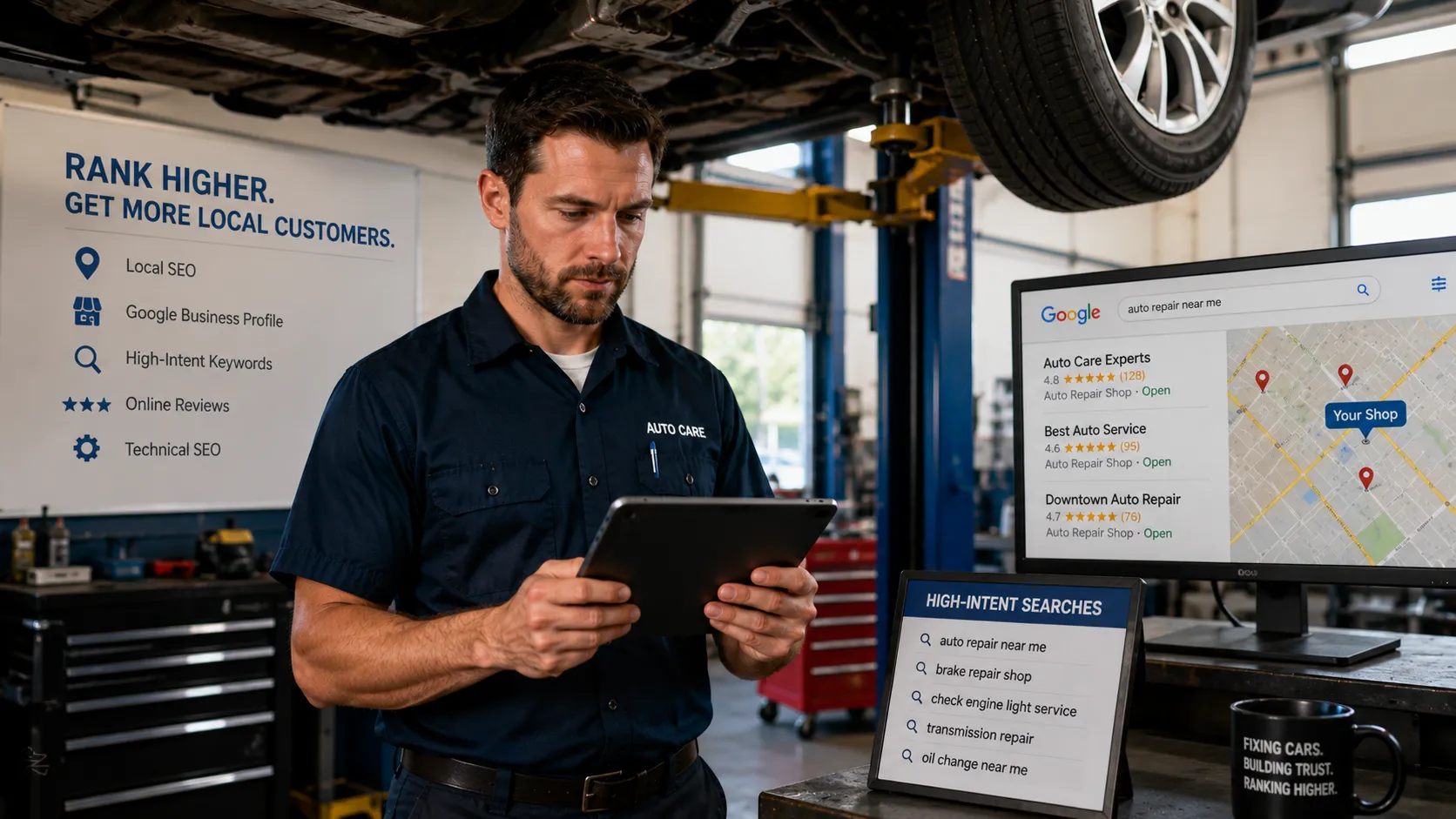
Most shop websites rely on one “services” page targeting broad terms like “auto repair,” “mechanic shop,” or “car repair services.” These terms are too generic. Google can’t tell which specific search the page is meant to answer, so it ranks the page for none of them well.
A shop targeting “auto repair services” competes with national directories, big chains, and generic content. A shop targeting “brake pad replacement mechanic in Dallas TX” competes for one customer who is ready to book.
That’s intent mapping, the real starting point for SEO for auto repair shops, and the single biggest reason smaller shops with weaker brand names still outrank established ones.
- Generic services page: competes with everyone, ranks for no one
- Dedicated service-plus-location page: competes for one searcher, ranks for that searcher
The fix isn’t writing more content. It’s writing the right content in the right place, since a homepage that mentions ten services in passing sends Google a confused signal.
Target High-Intent Local Keywords That Actually Convert
The best auto repair SEO traffic comes from problem-driven local searches. These combine a vehicle problem, a specific service, and a location, like:
- “brake pad replacement in Houston TX”
- “check engine light diagnostics mechanic in Tampa FL”
- “AC repair for cars in Phoenix AZ”
- “Toyota transmission repair specialist in San Diego”
Each of those queries is a customer who has already decided they need a repair. That’s a different shopper than someone searching just “auto repair,” who might still be comparing options or fixing the car themselves.
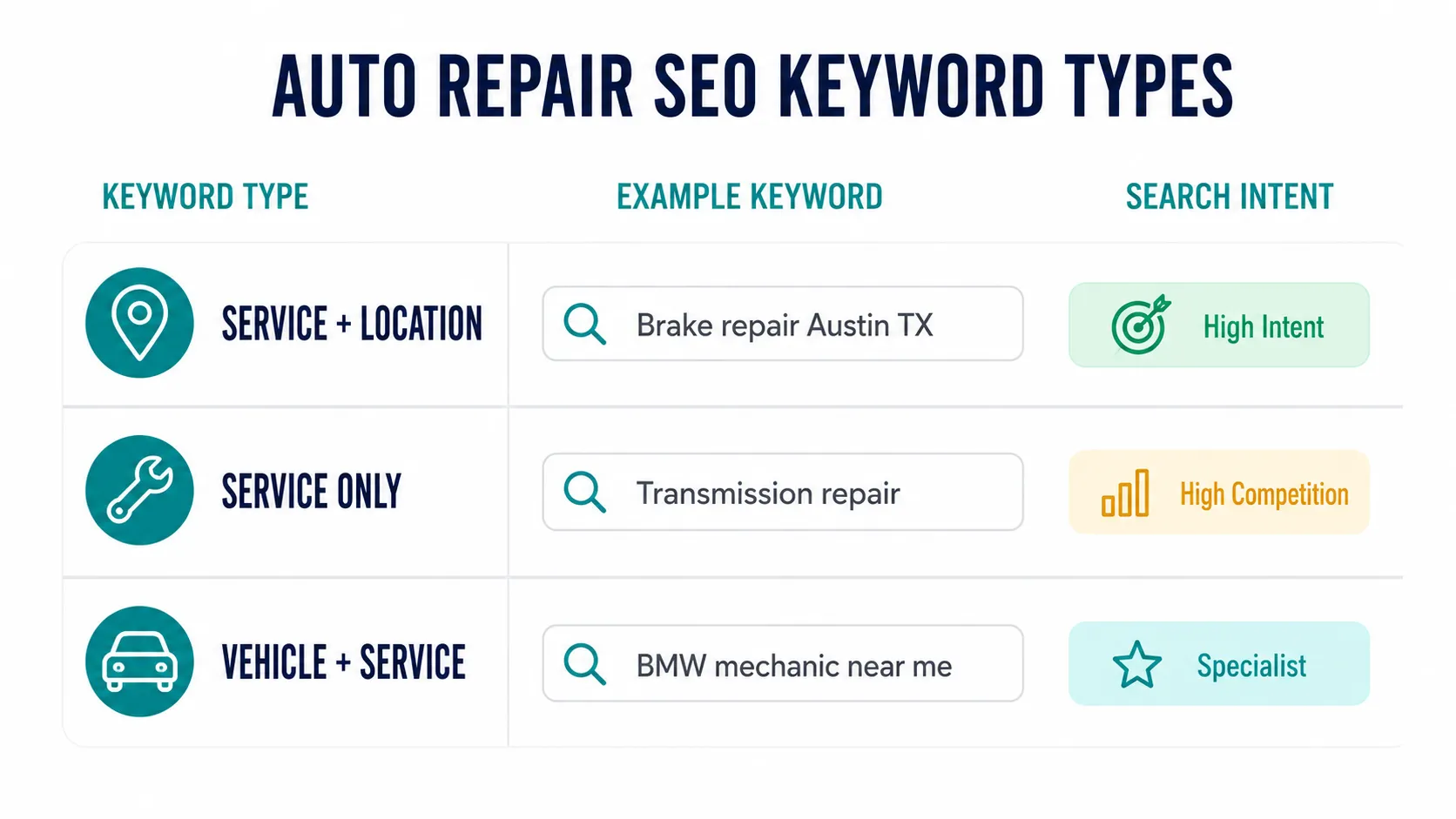
Build your keyword list in three layers:
| Keyword type | Example | Why it matters |
| Service + location | Brake repair in Austin TX | Highest intent, lowest competition |
| Service only | Transmission repair | High search volume, more competitive |
| Vehicle make + service | BMW mechanic near me | Captures owners who want a specialist |
Map each high-value keyword to its own page, not your homepage, since a homepage trying to rank for brake repair, AC service, and transmission work all at once ends up ranking for none of them.
Build a Dedicated Service Page for Each Repair Type
A core part of SEO for auto repair shops is replacing one services page with a dedicated landing page for every repair you offer. Each page should target one service plus one city.
A strong page for “brake repair shop in Austin TX” should cover:
- Signs your brakes need attention
- Brake pad vs. rotor replacement and what causes brake noise or vibration
- Cost of brake repair in your city
- Vehicles you commonly service and same-day availability
- A clear call to book
Each page focuses on one service and one market, which is what gives you a shot at ranking for the long-tail searches that actually convert into booked jobs instead of getting lost behind directories and national brands.
If you serve more than one city, build a location page for each one. A page for “auto repair shop in Mesa AZ” needs its own service coverage area, directions, and local testimonials, not a copy-pasted version of your main city page, since duplicate content tells Google your shop isn’t really local to either one.
Technical SEO for Auto Repair Shop Websites: What Google Actually Checks
Technical SEO is invisible to customers, but it decides whether Google can read your pages correctly in the first place. Most shop websites skip it entirely, which makes it the easiest gap to close fast.
1/ Schema markup
This is code added to your site that tells Google directly what your business is, where it’s located, and what services you offer instead of making Google guess from the page text. Add LocalBusiness schema to your homepage, AutoRepair schema to service pages, and FAQ schema to any question-and-answer content, since FAQ schema feeds Google’s AI Overviews and featured snippets directly.
2/ Page speed
A slow site loses customers before they read a word of your content. As load time goes from one second to three seconds on mobile, the chance a visitor leaves jumps significantly, and most repair searches happen on a phone. Compress your images, cut unused scripts, and turn on browser caching.
3/ Mobile usability
Drivers searching “check engine light near me” are usually standing next to a car that just made a bad noise. If your booking button isn’t reachable with one thumb, you lose that call to whichever shop made it easier.
Treat technical SEO as ongoing maintenance, not a one-time fix, since plugins slow sites down over time and schema can break after a website update. A quarterly check covering page speed, schema validity, and indexing status protects the rankings you’ve already earned.
Capture Customers Before They Search for a Shop
Many drivers search for symptoms before they search for a service. Someone whose steering wheel shakes when braking isn’t typing “brake repair near me” yet. They’re typing “why is my steering wheel shaking when I brake?”
Blog content captures that earlier search and walks the reader toward booking. A post targeting “why is my car overheating while driving” should cover the common causes, signs the radiator is failing, when to stop driving immediately, what radiator repair typically costs, and when it’s time to call a mechanic.
Every blog post should end with a link to the service page it supports. A post about overheating that never links to your radiator repair page brings in readers who never become customers.
Local SEO for Auto Repair Shops: Get Your Google Business Profile Right
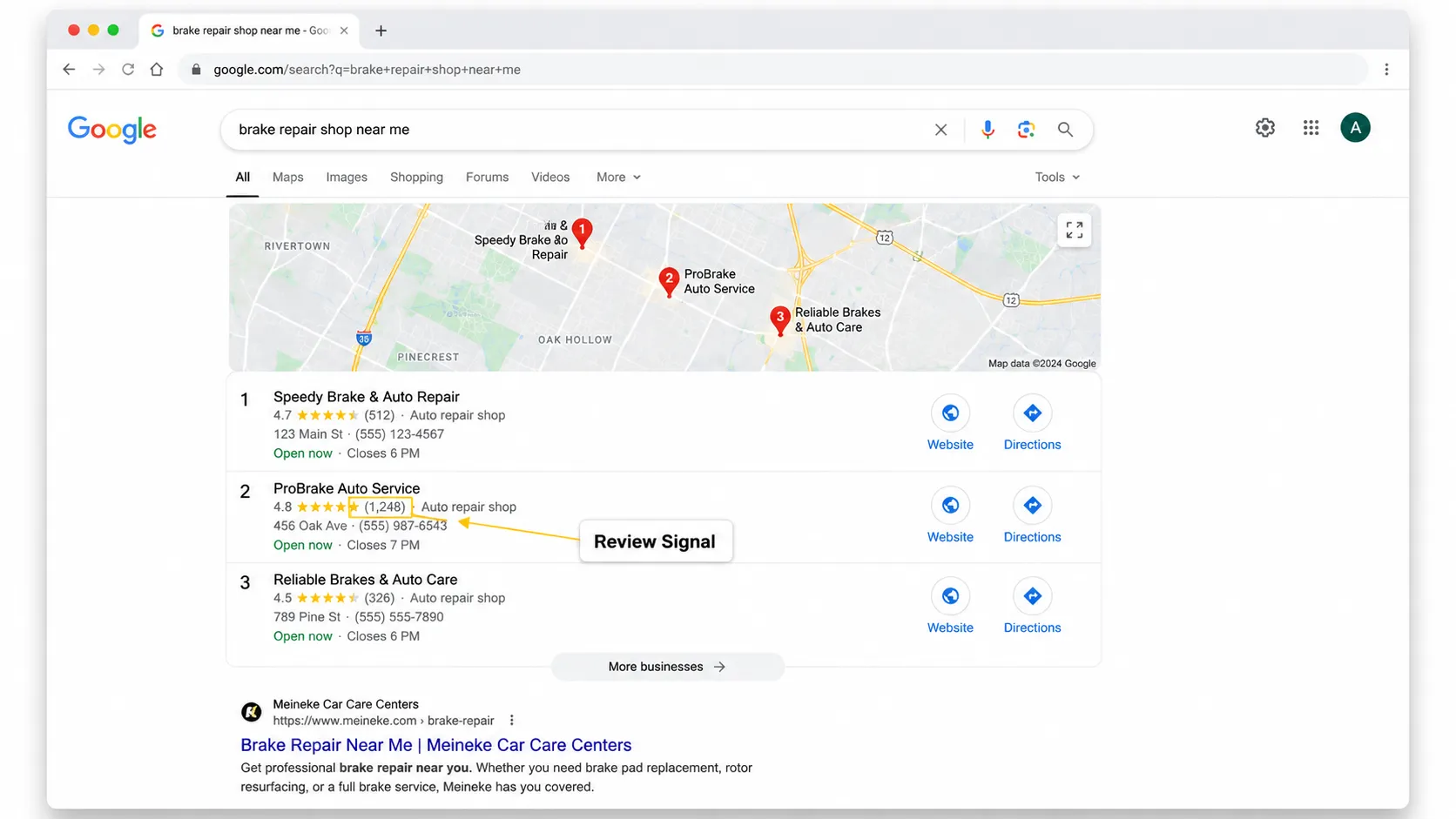
Most high-intent searches like “brake shop near me” or “mechanic open now” get answered by the map pack before a single organic result loads. That makes your Google Business Profile one of the highest-leverage assets you control, and it costs nothing to optimise.
Get the basics exact:
- Auto Repair Shop as your primary category, not just “Automotive”
- Every individual service is listed by name, not a single generic entry
- At least five current photos of your shop, team, and completed jobs
- Business name, address, and phone number match your website exactly
Then keep it active. Profiles that go quiet for 60 to 90 days lose map pack position to shops that post weekly, respond to reviews fast, and answer questions in the Q&A section. A profile is a ranking signal, not a one-time setup task.
Backlinks for Auto Repair Shops: Which Ones Help and Which Ones Hurt Rankings
Not every backlink helps your auto repair shop rank. Search engines weigh where a link comes from just as much as how many you have, and the wrong kind of link can actively work against you.
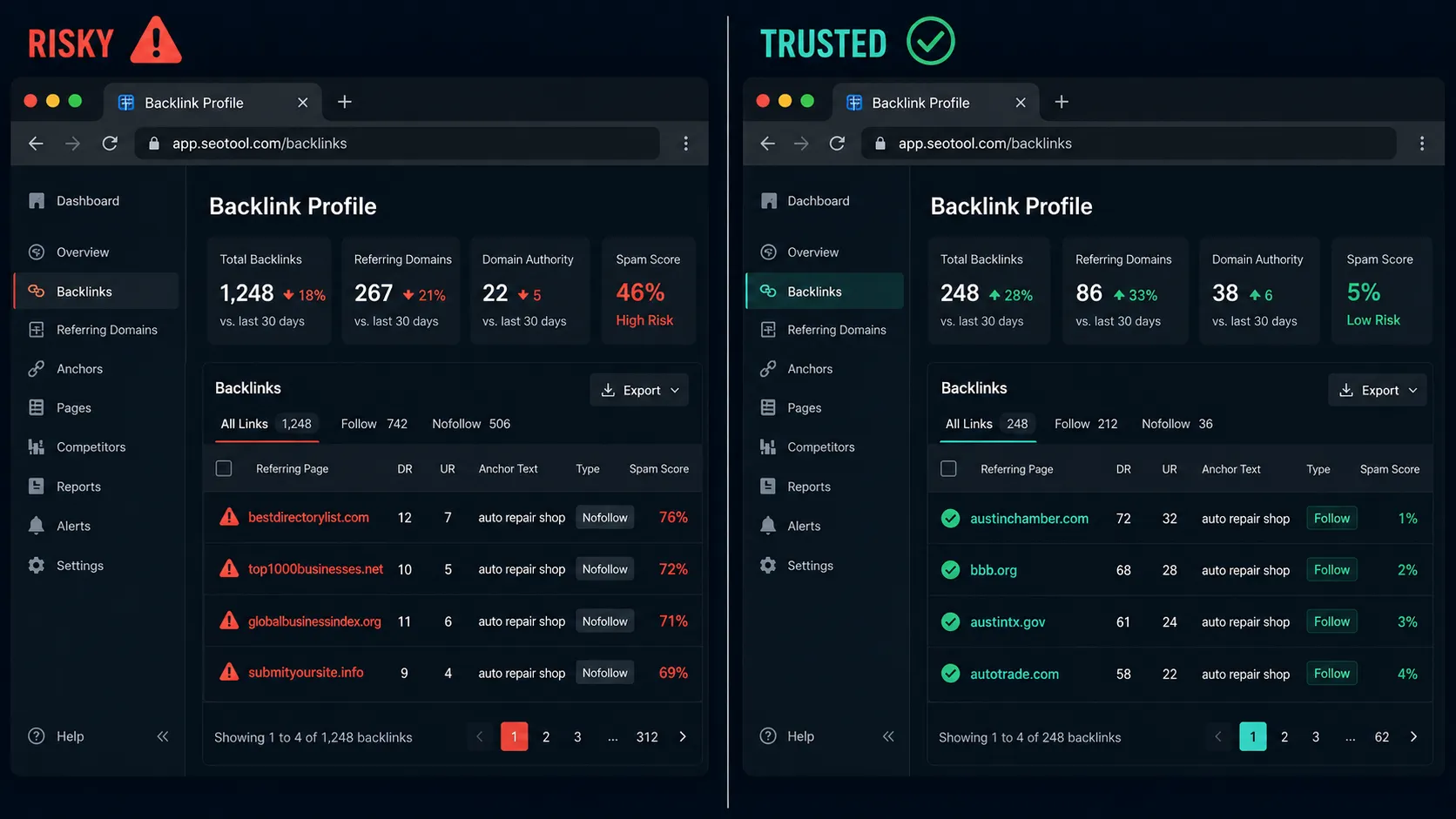
Helpful Backlinks for Auto Repair Shop SEO
The strongest backlinks for an auto repair shop come from sources that are genuinely local or genuinely relevant to the automotive industry:
- Automotive directories and industry associations
- Chamber of Commerce and community organisation listings
- Supplier and manufacturer certification pages
- Local news coverage or event sponsorships
- Tow company and complementary local business partnerships
A link from a tow company you partner with, or your local Chamber of Commerce, shows your shop is genuinely embedded in its community, which is exactly the local authority signal search engines weigh when ranking one repair shop above another. Keep your name, address, and phone number identical across every citation, since inconsistent business information across the web measurably weakens local search trust according to Think with Google’s local search research.
Auto dealerships face a similar problem when they lean too hard on third-party marketplaces instead of owning their own traffic, a tradeoff covered in more depth in why dealerships need their own lead engine.
Harmful Backlinks That Quietly Damage Auto Repair Shop Rankings
Bulk directory submissions, paid link networks, and links from unrelated foreign-language sites signal manipulation rather than genuine local relevance, and search engines increasingly discount or penalise sites that rely on them.
Buying links from a marketplace that sells “SEO backlink packages” is the clearest version of this mistake, since those links rarely come from automotive or local sources and put your site at risk if search engines flag the pattern.
Quality always beats quantity. A handful of relevant, local links outperforms dozens of generic directory listings and takes far less ongoing work to maintain.
Track the Numbers That Actually Predict Booked Jobs
Ranking position alone doesn’t tell you whether SEO is working. A shop ranking fourth for “brake repair” with forty monthly profile calls is making money. A shop ranking second with five calls has a conversion problem, not a ranking problem.
Watch these three numbers every month:
- Google Business Profile calls and direction requests. Pulled straight from your profile’s insights. This is the most direct line between visibility and a phone ringing.
- Search Console clicks by page. Shows which service pages are gaining impressions but not clicks, which usually means your title or meta description needs work, not your rankings.
- Organic traffic by landing page. Pages gaining sessions but producing zero phone clicks or form fills need a stronger call to action, not more traffic.
Thirty minutes a month reviewing these three numbers is enough to catch a slipping profile or a page that’s attracting clicks but not bookings before it costs you a full season of leads.
How AI Search Visibility Works for Auto Repair Shops in ChatGPT and Google AI Overviews
Drivers are starting to ask AI tools the same questions they used to type into Google, like what’s a fair price for a brake job nearby or whether a transmission should be rebuilt or replaced. If your shop’s content never gets cited as a source, you don’t exist in that answer.
AI engines pull from pages that answer a question directly in the first sentence and then expand with detail, which is why FAQ-style sections with a direct answer up top perform better in ChatGPT, Perplexity, and Google’s AI Overviews than long, unstructured paragraphs.
The shops that show up here aren’t necessarily the biggest. They’re the ones whose service pages are structured clearly enough for an AI system to extract a clean answer in seconds, a structure we break down in this overview of generative engine optimisation.
How CometRank Handles SEO for Auto Repair Shops
Executing this properly means building dedicated pages for every service and city you cover, fixing schema and page speed, keeping your Google Business Profile active every week, and building local citations on top of all that, at the same time. Most shop owners are running a business, not a content team, and most agencies move too slowly to make a dent before the next slow season hits.
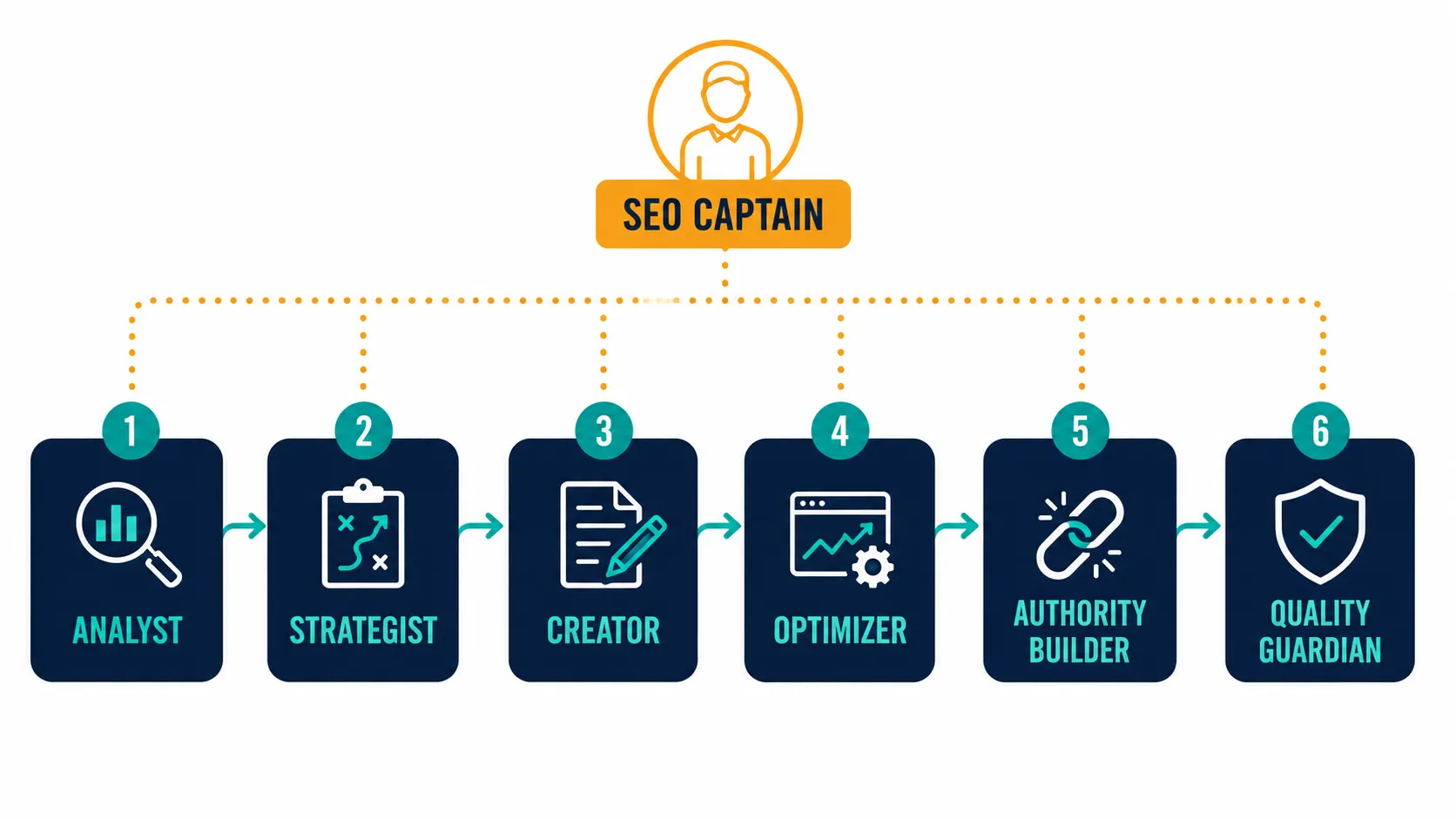
We’re an AI SEO agency that runs this entire workflow for clients using CometRank, our proprietary SEO software. CometRank runs six AI agents (Analyst, Strategist, Creator, Optimiser, Authority Builder, and Quality Guardian) across intent mapping, content creation at scale, technical optimisation, and authority building. A human SEO captain reviews everything before it goes live, so it’s never raw AI output going straight to your site.
To see how CometRank handles this for your shop, book a demo, and we’ll map out exactly which searches you’re losing right now.
The Bottom Line on SEO for Auto Repair Shops
Search behaviour for repair searches keeps moving toward problem-specific, local queries. Drivers want a shop that already proved it can fix their exact problem in their exact city, not a generic services page that lists everything and explains nothing.
The shops winning these searches did three things: built dedicated pages instead of one services page, fixed the technical fundamentals most competitors skip, and answered real questions before customers even searched for a shop. That’s the difference between SEO that drives traffic and SEO that drives booked jobs. Start with your three highest-revenue services, give each one its own page, and the rest of this strategy compounds from there.
SEO for Auto Repair Shops: Frequently Asked Questions
1/ How long does SEO take to work for an auto repair shop?
Google Business Profile fixes and citation cleanup can move your map pack ranking within 30 to 60 days. Dedicated service pages usually take 3 to 6 months to rank, depending on local competition. Backlinks and content compound over 6 to 12 months and strengthen every page at once.
2/ How much does SEO cost for an auto repair shop?
Professional SEO for independent shops typically runs $500 to $3,000 a month, depending on your market and how much content and link building are included. Basic fixes like Google Business Profile cleanup cost nothing beyond your own time.
3/ Does SEO work for small, independent auto repair shops or only big chains?
Independent shops actually have an edge in local search. Google’s map pack rewards proximity and local relevance over brand size, so a well-optimised independent shop regularly outranks a national chain branch for searches in its own area.
4/ Is local SEO different from regular SEO for an auto repair shop?
Yes. Local SEO covers your Google Business Profile, map pack visibility, and citation consistency. General SEO covers your website’s content, technical health, and backlinks. Repair shops need both, since most repair searches are local and high-intent.
5/ Do online reviews actually affect SEO for auto repair shops?
Yes. Google factors review volume, recency, and how often you respond into map pack rankings. Reviews also directly affect whether a driver calls you once they find you, so they influence both visibility and conversion.
6/ What keywords should an auto repair shop target first?
Start with your three highest-revenue services combined with your city: brake repair, transmission service, or AC repair, plus your location. These convert better than broad terms like “auto repair” because the searcher already knows what they need and where they are.