
Is your bankruptcy law firm invisible online while clients who need help right now are searching elsewhere?
Every day, people facing debt search online for a bankruptcy lawyer they can trust. If your firm isn’t on page one, those potential clients won’t keep looking. They’ll call a competitor instead.
This guide covers the SEO framework that gets bankruptcy lawyers found for high-intent searches and turns that visibility into consistent consultation bookings.

Why Bankruptcy Clients Search Differently Than Other Legal Clients
Bankruptcy SEO works when you understand who is actually searching. These aren’t people browsing options. They’re in crisis.
Someone searching “Chapter 7 bankruptcy lawyer in Phoenix AZ” isn’t doing research. They’ve already made the decision to file. They need to find someone they trust, right now. That urgency is the biggest SEO advantage a bankruptcy firm has, because it means the people landing on your site are ready to book.
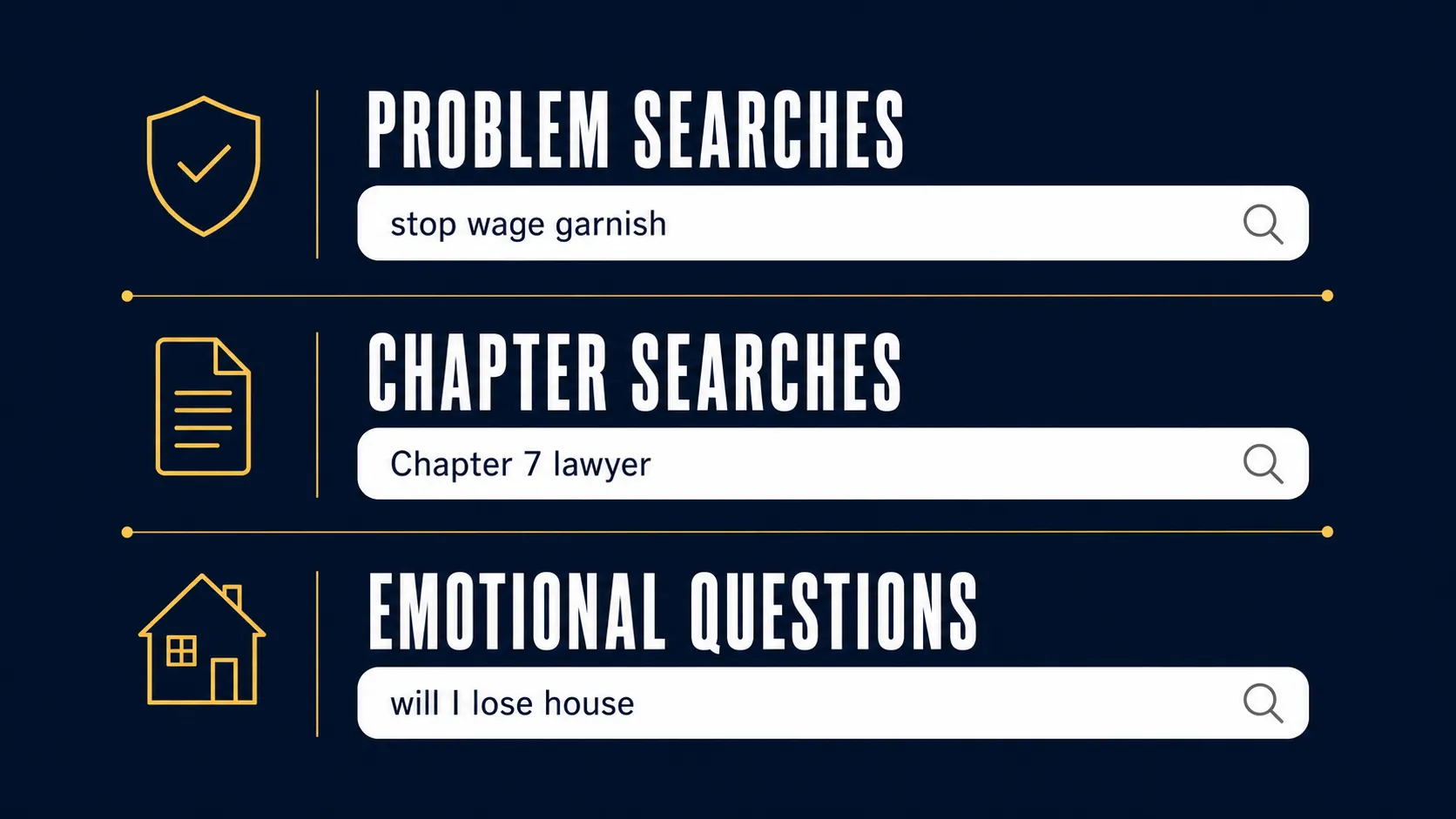
The search patterns reflect this:
- Clients search by the specific problem they’re facing: “stop wage garnishment,” “stop foreclosure,” “file bankruptcy before repossession”
- They search by bankruptcy chapter once they’ve done basic research: “Chapter 7 attorney near me,” “Chapter 13 payment plan lawyer Houston”
- They search emotional questions before hiring: “will I lose my house if I file bankruptcy,” “what happens to my car in Chapter 7”
Each search type needs a different page. A single “bankruptcy services” page won’t capture all three. Law firms that map these keyword types to specific pages consistently outrank firms running generic content.
Local SEO for Bankruptcy Lawyers: How to Win the Map Pack
Bankruptcy is federal law. But bankruptcy clients want a local attorney. Someone who knows their district, understands local trustees, and can meet them in person. Local SEO captures this intent, and it’s where most cases actually come from.
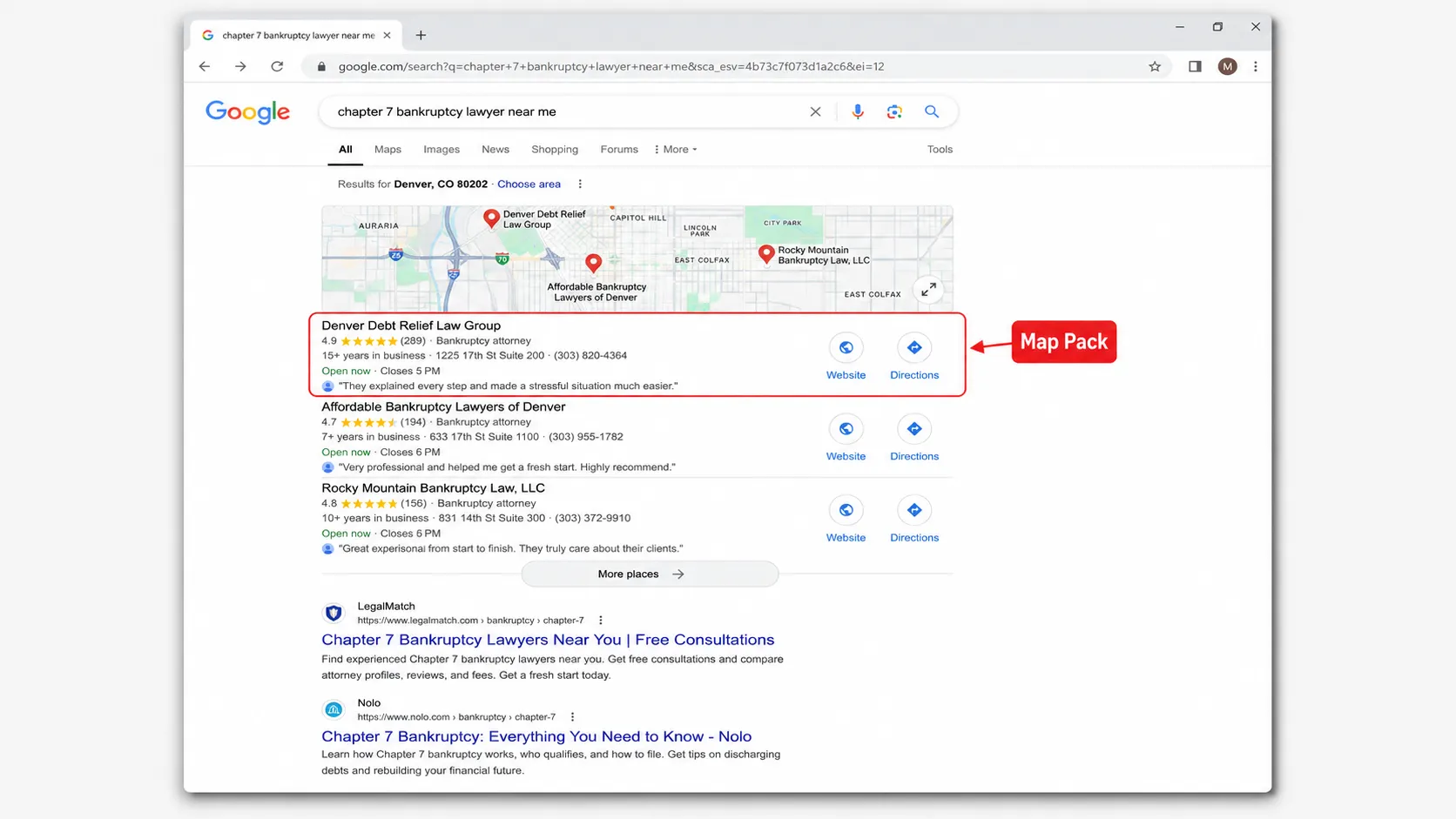
The map pack (the three firm listings that appear before organic results) gets more clicks than anything else on the page. Here’s what drives it:
1/ Google Business Profile Optimisation
- Select “Bankruptcy Attorney” as your primary category, not just “Lawyer”
- Add all service offerings: Chapter 7, Chapter 13, foreclosure defense, wage garnishment
- Post weekly updates: bankruptcy law changes, answers to common questions, client FAQs
- The Q&A section matters. Pre-answer “How much does it cost to file bankruptcy?” and “What paperwork do I need?” directly in the profile
2/ Reviews with context
- Generic five-star reviews don’t carry the same weight as reviews that mention specific outcomes: “stopped my wage garnishment,” “helped me keep my house,” “free consultation was clear and honest”
- Ask satisfied clients to mention the specific chapter or outcome in their review
- Respond to every review. It signals activity and professionalism to both Google and prospective clients
3/ Local landing pages
- Build a dedicated page for each city or metro area you serve: “bankruptcy attorney in San Diego CA,” “Chapter 7 lawyer in Dallas TX”
- Each page should reference the local bankruptcy court, district-specific filing procedures, and any local exemption amounts
- This isn’t about stuffing city names. It’s about demonstrating that you actually know the local system
For a deeper breakdown of how local citations and directory listings (Avvo, Justia, FindLaw, Martindale-Hubbell) strengthen this signal, see what citations in SEO actually do and how to build them at scale.
The SEO Content That Builds Trust Before a Client Calls
Most bankruptcy clients research for days before contacting an attorney. They’re embarrassed. They’re worried about judgment. They want to understand their options before admitting they need help.
The law firms that win those clients are the ones that answered their questions during the research phase.
Educational blog content that actually converts:
- “Will bankruptcy stop wage garnishment?” (Answer this clearly, explain the automatic stay, explain the difference between Chapter 7 and 13 on this point)
- “Can bankruptcy stop foreclosure in [State]?” (state-specific, time-sensitive, extremely high intent)
- “How long does Chapter 7 bankruptcy stay on your credit report?” (common fear, easy to answer)
- “What happens to my car if I file Chapter 7?” (most searched Chapter 7 concern)
- “How much does it cost to file for bankruptcy?” (top PAA question, almost never answered directly on law firm websites)
Each of these articles pulls long-tail traffic from people who aren’t ready to call yet but will be within weeks. When your content answers their question clearly, your firm becomes the one they think of when they’re ready.
The key to making this content rank is structure, not just information. Open each section with a direct answer (not a preamble), use short paragraphs, and end with a clear next step toward a consultation. Legal content written for E-E-A-T compliance also signals to Google that your content is authoritative for YMYL (your money, your life) queries, which bankruptcy firmly is.
Technical SEO for Bankruptcy Law Firms
Most bankruptcy lawyer websites fail on three technical basics.
1/ Page speed
Over 60% of bankruptcy searches happen on mobile, late at night. A site that takes more than three seconds to load loses those visits before they begin
2/ Mobile layout
Consultation forms, phone numbers, and CTAs must be visible on a phone without scrolling. Clients in crisis won’t hunt for a contact button
3/ Schema markup
Use LocalBusiness, Attorney, Organization, and Article schema to help Google better understand your firm, services, and content. Structured data strengthens your site’s relevance and supports better visibility in search, especially in competitive legal markets.
AI SEO for Bankruptcy Lawyers: How AI Search Is Changing Bankruptcy Lead Generation
Google now answers many bankruptcy questions through AI Overviews before showing traditional results. If your content isn’t structured to be extracted, you’re invisible to a growing share of searchers.
The firms appearing in law firm AI overviews do three things consistently:
- Open every section with a direct one-sentence answer, not a setup paragraph
- Answer specific questions (“Can Chapter 13 stop a foreclosure sale?”), not general topics
- Maintain consistent NAP (name, address, phone) across every directory listing
The same logic applies to ChatGPT and Perplexity. When someone asks “best bankruptcy lawyer in [city],” AI tools cite the firms with the most structured, consistently attributed content.
How to Do On-Page SEO for Bankruptcy Lawyers
On-page SEO determines whether Google can read a page clearly enough to rank it. These three elements decide most of the outcome.
1/ Meta Titles and H1 Tags
Every bankruptcy page needs a meta title built around one specific chapter or problem. “Chapter 7 Bankruptcy Lawyer in Austin TX” consistently outranks “Bankruptcy Services.” Your H1 should match the intent of the meta title. Mismatches split Google’s signal and suppress rankings.
- Format: [Chapter Type] Bankruptcy Lawyer in [City, State]
- Keep meta titles under 60 characters
- Never use the same title structure on two pages
2/ Internal Linking Across Your Practice Area Pages
Internal links tell Google which pages carry the most authority and guide clients deeper into your site.
- Your Chapter 7 page links to Chapter 13 (and explains when each applies)
- Foreclosure defense links to Chapter 13, since that’s the relevant filing
- Every blog post links to the most relevant service page
- No page should be more than two clicks from a consultation form
3/ URL Structure and Page Focus
Clean, keyword-specific URLs outrank generic ones. “/chapter-7-bankruptcy-lawyer-dallas” outperforms “/services/legal/page-3” because Google reads the URL as a relevance signal.
How to Do Off-Page SEO for Bankruptcy Lawyers
Off-page SEO is everything that signals authority from outside your website. For bankruptcy firms, three signals carry the most weight.
1/ Legal Directory Citations
Get listed on Avvo, Justia, FindLaw, Martindale-Hubbell, and your state bar directory. Every listing must show identical name, address, and phone number. Inconsistencies in NAP data suppress local rankings.
- Run a citation audit before building new listings
- Prioritize directories that Google actively pulls from in the legal 3-pack
- Your state bar association listing carries the highest trust weight
2/ Backlinks from Authority Sources
Links from financial counseling organizations, nonprofit debt relief sites, the American Bankruptcy Institute, and local legal publications move rankings. One relevant authoritative backlink beats twenty from unrelated directories.
A targeted outreach approach (identifying where competitors earn their links, then earning the same placements) is more effective than bulk link building.
3/ Reviews as an Off-Page Ranking Signal
Google treats review volume and recency as off-page authority signals. Firms with a steady stream of new reviews consistently outrank firms with older review profiles, even when the total count is similar.
- Build a follow-up process to request reviews after each resolved case
- Ask clients to mention the chapter type or outcome (not just a star rating)
- Respond to every review, positive and negative
How We Handle SEO for Bankruptcy Law Firms
Executing everything above requires keyword research, content production, local optimization, technical audits, review strategy, and schema, consistently over months. Most law firms can’t manage that alongside casework.
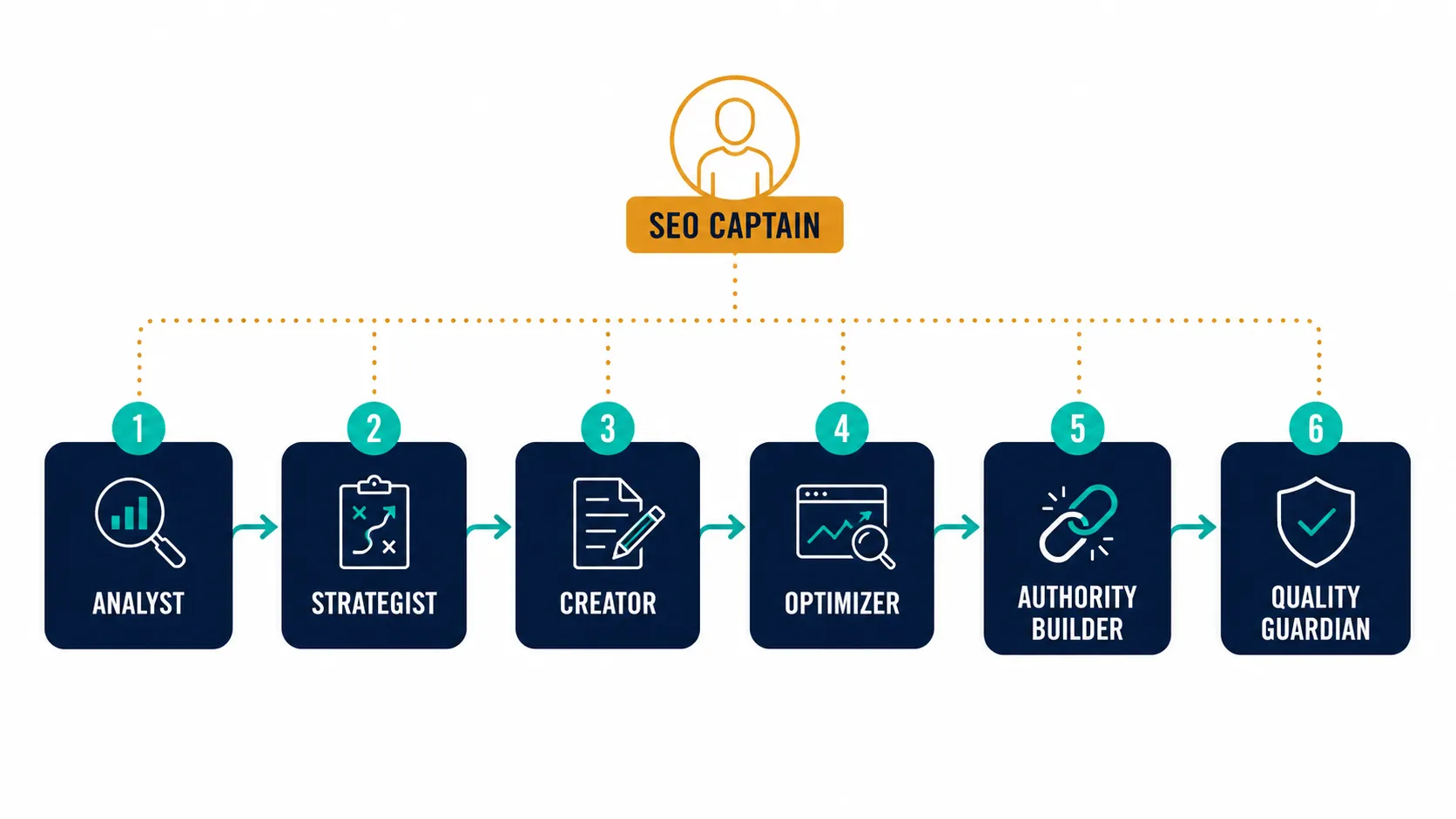
We’re an AI SEO agency that runs this entire workflow using CometRank, our proprietary SEO software. Six AI agents handle every layer: the Analyst maps what your bankruptcy clients search for, the Strategist prioritizes keywords that drive consultations, the Creator builds chapter-specific pages, the Optimizer handles technical SEO, the Authority Builder runs citation strategy, and the Quality Guardian reviews everything before it publishes. A human SEO Captain oversees the full workflow. It’s supervised execution built for lead generation, not just rankings.
For bankruptcy law firms, we run this through our AI SEO services for law firms and attorneys.
To see how CometRank handles this for your practice, book a demo, and we’ll walk you through the full workflow in one call.
Conclusion
Bankruptcy SEO is about being visible when potential clients need legal help the most. By building chapter-specific pages, strengthening your local presence, publishing helpful content, and maintaining a technically sound website, your firm can attract more qualified leads and turn search visibility into consistent consultation bookings.
SEO for Bankruptcy Lawyers: Frequently Asked Questions
1/ How long does SEO take to generate bankruptcy cases?
Most bankruptcy firms see measurable improvements in rankings and consultation requests within three to six months. Competitive terms like “bankruptcy lawyer [major city]” typically take six to twelve months to reach page one. Unlike paid ads, the results compound over time and don’t disappear when you stop spending.
2/ Can a solo bankruptcy attorney compete with large firms on SEO?
Yes. Solo practitioners often have an advantage: they can target niche-specific searches, build more authentic content around their actual client experience, and rank in sub-markets that larger firms ignore. The SEO strategy for solo lawyers differs from large firms, but it’s highly effective when executed correctly.
3/ Do online reviews actually affect bankruptcy SEO rankings?
Reviews are one of the strongest local ranking signals. They influence both your position in the map pack and your conversion rate once someone finds your profile. Reviews that mention specific outcomes like chapter type or problem solved carry more weight than generic positive reviews.
4/ How much should a bankruptcy firm spend on SEO?
Effective bankruptcy SEO typically starts at $1,500 to $3,000 per month depending on market competitiveness. For context, Google Ads for bankruptcy keywords cost $30 to $100 per click in major markets, and those leads stop the moment you stop paying. SEO builds owned visibility that compounds.
5/ Is Google Ads or SEO better for bankruptcy lawyers?
Both serve different needs. Our Google Ads vs SEO for lawyers is worth reading for the full comparison, but the short answer is: ads give you immediate visibility with no guarantee of cost efficiency, while SEO builds a lead channel you own. Most successful bankruptcy firms use both, with SEO gradually reducing their dependence on paid spend.