
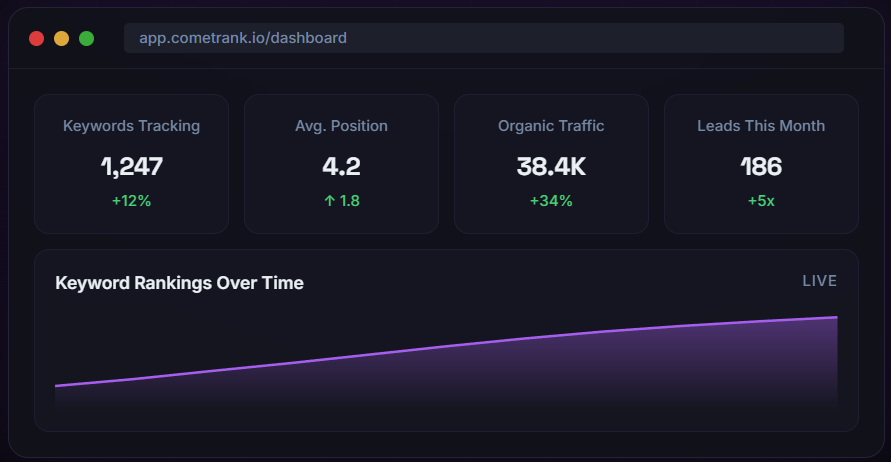
How are smaller clinics outranking established medical practices on Google?
It’s not credentials. It’s not years in practice. It’s page structure.
The clinics winning local search built pages that match exactly how patients search: condition plus specialist plus city. Most medical websites still target generic terms like “cardiologist” that never convert.

In this article, we cover exactly how local SEO for medical professionals works and the page structures that turn searches into booked appointments, so your clinic captures patients before a competitor does.
What Is Local SEO for Medical Professionals?
Local SEO for medical professionals is the process of optimizing a clinic’s website, Google Business Profile, and online listings so the practice appears when patients search for care in a specific area. It targets high-intent queries like “dermatologist for acne treatment in Dallas TX” where patients are actively ready to book.
These searches convert far better than generic ones. A patient typing “same day pediatrician appointment in Phoenix AZ” isn’t researching. They’re choosing.
That’s the whole game: showing up at the exact moment a nearby patient decides to book. Everything below builds toward that.
Why Do Most Medical Websites Fail to Rank Locally?
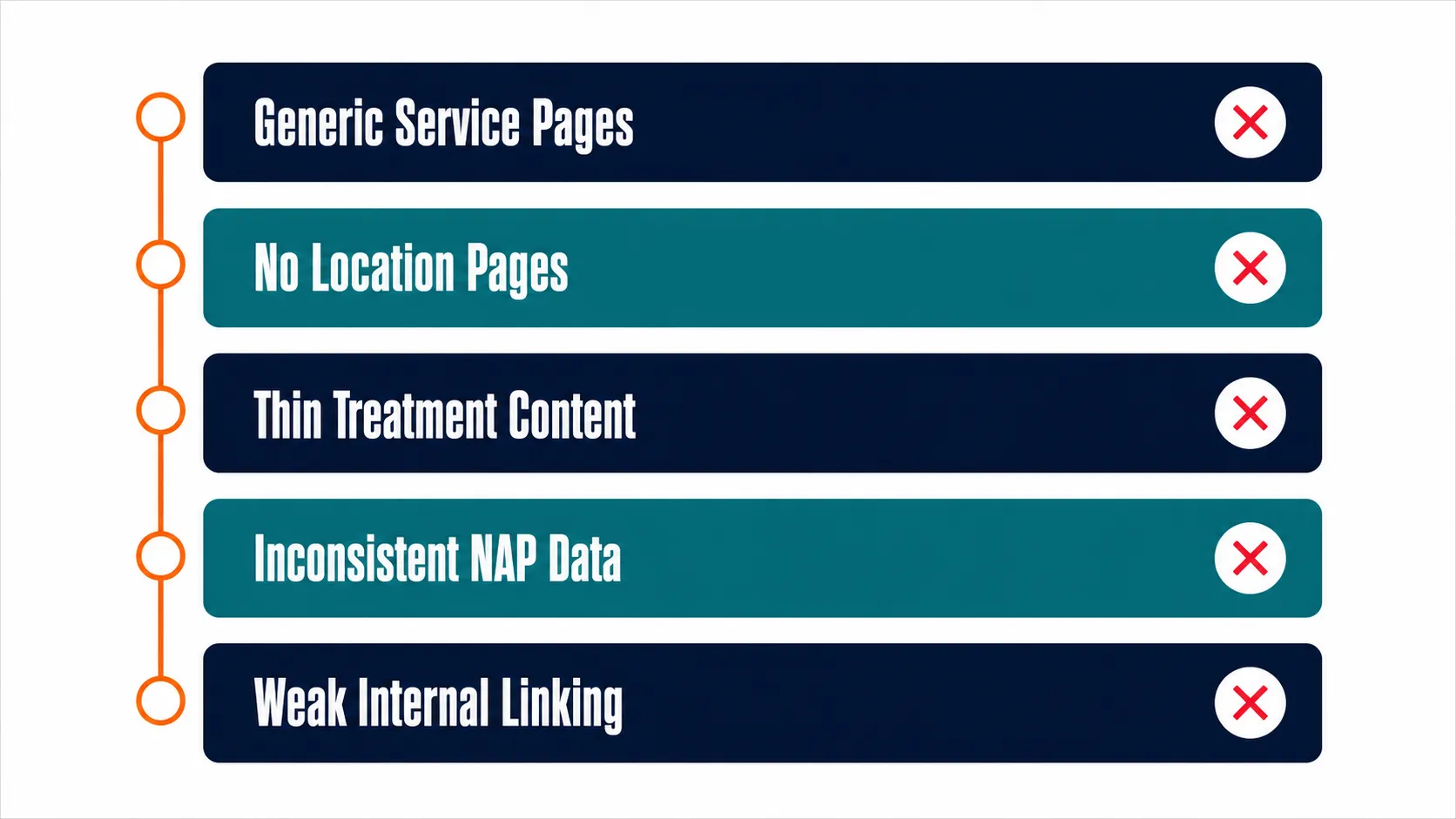
Most medical websites fail at local SEO because their content doesn’t match how patients search. They target broad terms like “orthopedic doctor” with generic service pages, skip location-specific landing pages, and leave their Google Business Profile half-finished. Google can’t confidently recommend a practice it can’t clearly understand.
The common failure points look like this:
- Generic service pages targeting broad terms like “orthopedic doctor”
- No location-specific landing pages for each city or clinic
- Thin content with no treatment details or conditions treated
- Inconsistent name, address, and phone details across directories
- Weak internal linking between services, conditions, and locations
Google rewards specific, location-aware medical intent. A page targeting “orthopedic surgeon for ACL reconstruction in Chicago IL” beats a generic “orthopedic surgery services” page because it matches a real patient query.
Fix the structure and the rankings follow. Ignore it and no amount of blogging saves you.
How Do Patients Actually Search for Doctors?
Patients search for doctors in predictable patterns: urgent need, condition plus specialist, treatment plus location, or practice type near them. Each pattern needs a different page type to rank and convert. Match the page to the pattern and you capture the patient at their exact moment of intent.
Here’s how the patterns map to pages:
| Search Intent | Example Query | Page to Build |
| Urgent care | “same day urgent care clinic in Houston TX” | Service landing page |
| Condition + specialist | “acne treatment dermatologist in Tampa FL” | Condition and treatment page |
| Treatment + location | “knee replacement surgeon in Phoenix AZ” | Dedicated service page |
| Practice + location | “pediatric clinic in Plano TX” | Location landing page |
| Provider by name | “Dr. Sarah Mehta cardiologist” | Provider bio page |
Provider pages are the one most practices skip. Patients search doctors by name after referrals, and Google treats a strong bio page with credentials, conditions treated, and locations served as an authoritative result.
One page type per intent. That’s the rule.
Building High-Intent Service and Condition Pages
Every core treatment deserves its own page. Not a paragraph on a services list. A full page built around one query, like “knee replacement surgeon in Phoenix AZ” or “acne treatment dermatologist in Tampa FL.”
The sections that make these pages rank and convert:
- Who needs the treatment and the conditions it addresses
- Techniques, medications, or procedures offered at your clinic
- Recovery timeline and success rates
- Before-and-after results where relevant
- Insurance coverage and consultation process
- Doctor credentials and a booking CTA
Each of those becomes an H2 that answers a patient concern. Urgent care pages are the one exception: they need logistics, not education, so lead with conditions treated same day, average wait time, insurance accepted, and clinic hours.
This is where practices win or lose. Search engines read these structured pages as proof of expertise. Patients read them as answers. A well-built page converts because it removes every reason to keep scrolling.
Location Pages for Multi-Clinic Practices
Medical groups operating in multiple cities need a dedicated landing page for every location. One “Our Locations” page listing five addresses ranks for nothing.
A page targeting “pediatric clinic in Plano TX” should cover:
- Pediatric services offered at that specific clinic
- Vaccination programs and same-day availability
- Doctor profiles for that location
- Clinic address with an embedded map
- Online booking
Each page must feel written for that community, not duplicated across cities with the city name swapped. These pages are how clinics enter the Google local pack, the map result block that appears above organic listings for “near me” searches. Practices running several clinics should treat this as its own system; the same principles behind a [multi-location SEO strategy] apply directly to medical groups.
How Do You Optimize a Google Business Profile for a Medical Practice?
Optimize a medical Google Business Profile by completing every field, selecting precise categories like “Dermatologist” instead of “Doctor,” posting weekly updates, uploading real clinic photos, and building a steady flow of fresh patient reviews. For many practices, the profile generates more patient calls than the website itself.
The essentials of Google Business Profile optimization for clinics:
- Select one precise primary category and relevant secondary categories
- Publish weekly health tips, service updates, or clinic news
- Upload photos of your team, treatment rooms, and exterior
- Answer patient questions in the Q&A section promptly
- Request reviews consistently after appointments
Reviews deserve their own discipline. Google research shows 94% of patients choose providers based on reputation, and fresh reviews carry more ranking weight than a large stack of old ones. Five new reviews a month beats five hundred from 2022.
Respond to every review within 24 hours, and keep responses generic to stay HIPAA compliant. Never confirm someone is a patient or reference their treatment. A structured approach to reputation management for doctors turns reviews into a ranking asset instead of a liability.
NAP Consistency, Citations, and Schema Markup
NAP stands for name, address, and phone number. Google cross-checks these details across your website, directories, and social profiles to verify your practice is real and located where you claim. Even small mismatches, like “Suite 200” on one listing and “Ste 200” on another, weaken trust signals.
Audit the listings that matter for healthcare:
- Google Business Profile
- Healthgrades and WebMD
- Vitals and Zocdoc
- Yelp
Skip the low-value directory spam; a handful of accurate healthcare listings outperforms hundreds of junk ones. Building [citations at scale] only works when every listing says exactly the same thing.
Then add schema markup, code that tells search engines what your pages mean. Use healthcare-specific types like Physician, MedicalClinic, and MedicalOrganization. Schema is what lets Google display your star ratings and hours directly in results, and it feeds the structured data AI search tools rely on.
Backlinks That Affect Your Medical Practice Rankings
Backlinks are links from other websites to yours. For medical practices, they work as trust votes, and the source matters more than the count.
Backlinks That Help Your Clinic Rank
- Hospital affiliation pages linking to your provider profiles
- Local chamber of commerce and community organization listings
- Health publications citing your doctors as expert sources
- Local news coverage of clinic events or health programs
- Professional association directories for your specialty
Backlinks That Hurt Your Clinic Rankings
- Bulk links from irrelevant directory farms
- Paid link schemes from low-quality health blogs
- Links from spammy sites unrelated to healthcare
A hospital privilege page linking to your surgeon’s profile carries more weight than fifty generic directory links. If a bad site links to you, disavow it. Quality protects rankings; volume without relevance erodes them.
AI Search Visibility for Medical Practices
Patients no longer search only on Google. They ask ChatGPT which clinic to visit, run Perplexity searches comparing specialists, and read Google AI Overviews before clicking a single result. If your practice isn’t cited in those answers, you’re invisible to a growing share of patients.
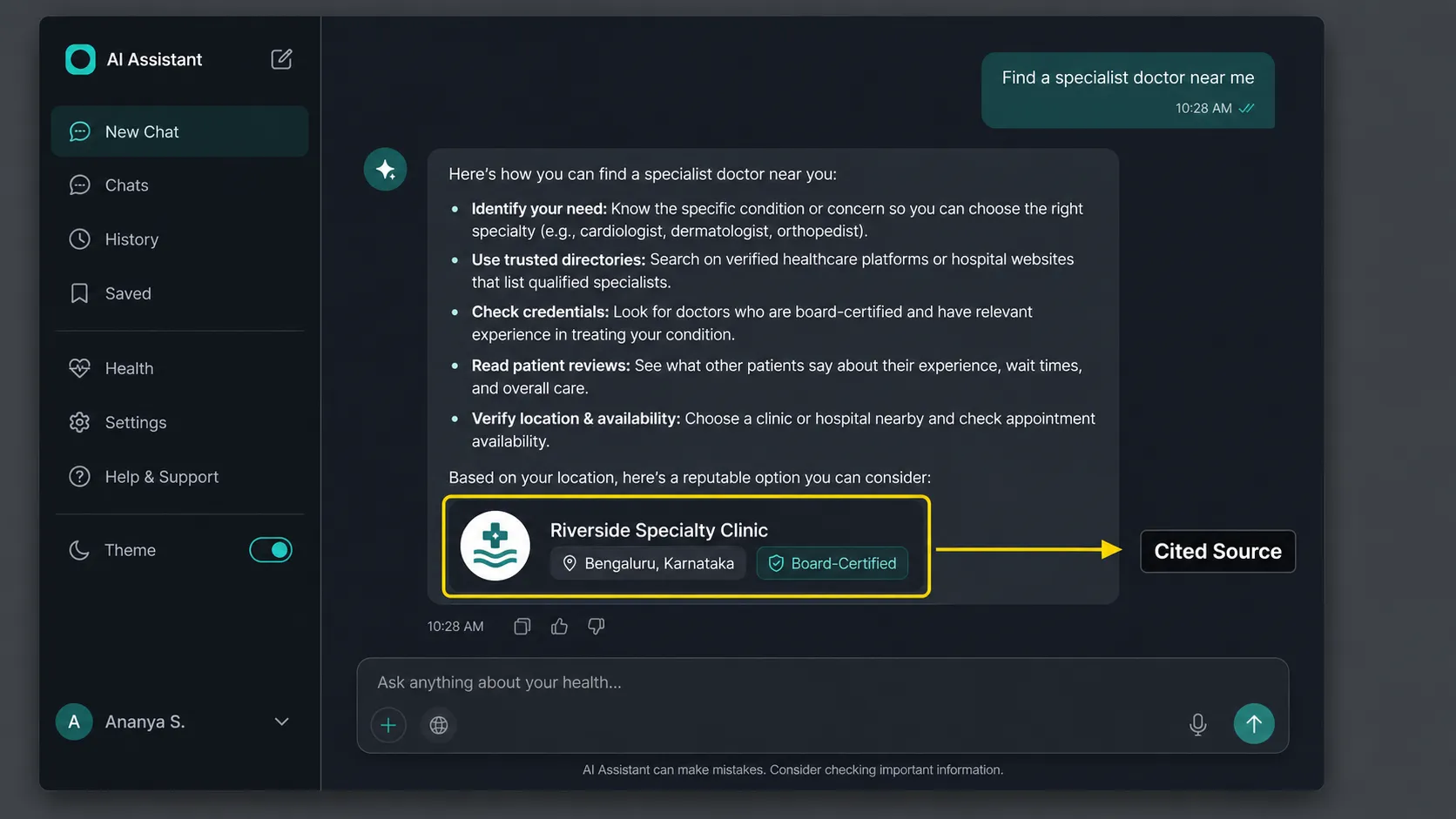
The same structure that wins local SEO wins AI visibility. To get cited:
- Open each page section with a clear, self-contained answer AI engines can quote
- Build structured condition pages and complete provider bios
- Add healthcare schema markup to every page
- Keep citations consistent so AI tools have verifiable facts to pull from
Content compliance matters here too. AI engines favor sources that demonstrate medical expertise and trustworthiness, which makes a HIPAA-compliant SEO strategy with credentialed authorship a visibility advantage, not just a legal requirement. Clinics that want this handled systematically can see how AI SEO for medical clinics structures pages for both Google and AI engines at once.
SEO vs Paid Ads for Doctors
Ads generate appointments this week. SEO builds a patient pipeline that compounds for years. That’s the honest trade-off.
Paid ads make sense for new clinics that need immediate volume or for promoting a new service line. But the cost per patient never drops; the moment you stop paying, the leads stop. Organic search works the opposite way. Each ranking page keeps producing patient inquiries at zero incremental cost.
Clinics running both channels see the strongest pipeline. For the full numbers, the Google Ads vs SEO ROI breakdown for medical clinics shows exactly where each dollar performs better.
How Do You Measure Local SEO Results for a Clinic?
Measure local SEO by tracking booked appointments, not traffic. The metrics that matter are phone calls by source, form submissions, direction requests from your Google Business Profile, and rankings for your money keywords. If those numbers aren’t moving, the strategy isn’t working, no matter what the traffic chart says.
Three free tools cover most of it:
- Google Business Profile Insights shows calls, direction requests, and website clicks from your listing
- Google Search Console shows which patient queries actually bring people to each page
- Google Analytics shows whether those visitors reach your booking flow or leave
Add call tracking numbers to your service and location pages so you know which page produced which patient. That single step tells you where to invest next.
Review the numbers monthly. Pages that rank but don’t convert need better CTAs and booking paths. Pages that convert but don’t rank need more authority. Treat it as a system you tune, not a report you file.
How CometRank Handles SEO for Medical Practices
Executing local SEO for a medical practice means building dozens of condition, treatment, and location pages while managing citations, reviews, and AI search structure all at once. Most clinics don’t have the bandwidth in-house, and most agencies move too slowly to make a dent.
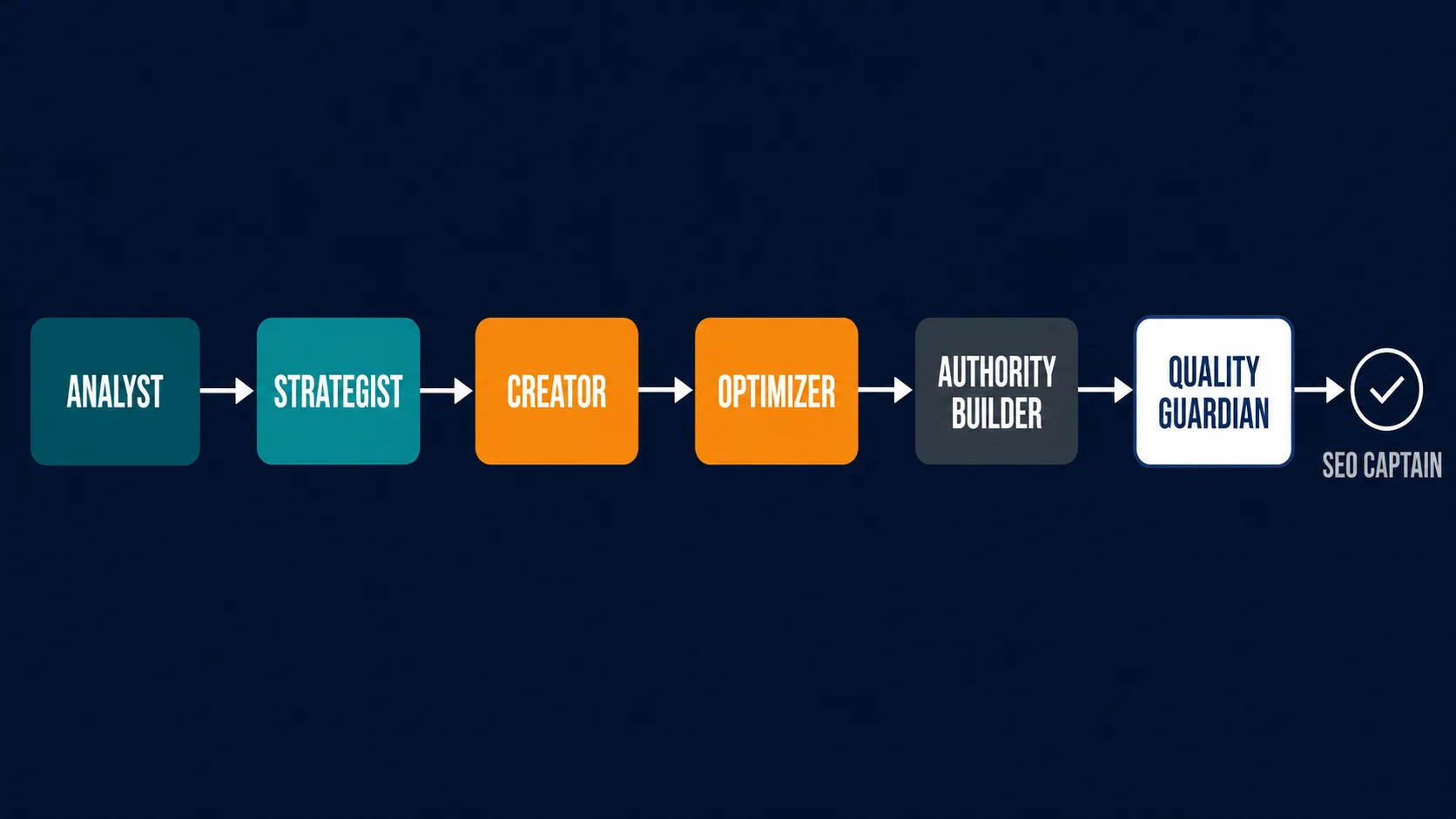
We’re an AI SEO agency that runs this entire workflow for clients using CometRank, our proprietary SEO software. CometRank runs six AI agents:
- Analyst studies your practice, competitors, and patients
- Strategist maps patient search intent
- Creator builds condition, treatment, and location pages
- Optimizer handles internal links and conversion paths
- Authority Builder runs citations and backlinks
- Quality Guardian checks every page before publishing
A human SEO Captain reviews everything before it goes live. If you’re looking for an AI SEO agency for healthcare services, this is what the execution actually looks like at scale.
To see how CometRank handles this for your clinic, book a demo, and we’ll show you exactly what we’d build for your practice.
Conclusion
The clinics outranking yours didn’t out-credential you. They out-structured you. They built one page per patient intent, kept their profiles accurate, and gave Google and AI engines clear facts to cite.
That’s the real work of local SEO for medical professionals: matching pages to the exact way patients search, then keeping every signal consistent. Start with one high-intent page this week. Pick your most profitable treatment, add the city, and build the page that answers everything a patient asks before booking. The practices that structure for patient intent will own local discovery. The ones chasing generic keywords will keep wondering where their patients went.
Local SEO for Medical Practices Frequently Asked Questions
1/ What is local SEO for doctors?
Local SEO for doctors is the practice of optimizing a clinic’s website, Google Business Profile, and online listings so the practice appears when nearby patients search for care. It targets location-specific searches like “pediatrician in Plano TX” rather than broad national keywords.
2/ How long does local SEO take to work for a medical practice?
Most medical practices see measurable movement in 3 to 6 months, with strong results by month 12. Google Business Profile improvements and review growth often show impact within weeks, while new service and location pages take longer to build authority.
3/ How much does local SEO cost for a medical practice?
Traditional agencies typically charge $1,000 to $5,000 per month for medical local SEO. AI-driven SEO systems deliver significantly more pages and coverage for less, often starting around $799 per month. The right comparison is cost per booked patient, not the monthly fee.
4/ Do online reviews affect local SEO rankings for doctors?
Yes. Reviews are one of the strongest local ranking factors, and 94% of patients choose providers based on reputation. Fresh, steady reviews outweigh a large count of old ones, and responding to reviews within 24 hours strengthens both rankings and patient trust.
5/ What is NAP consistency and does it still matter?
NAP consistency means the practice name, address, and phone number appear identically across every directory and listing. It still matters because Google cross-references these details to verify a practice. Mismatched listings weaken rankings and confuse patients.