
Most real estate agents build their early business through referrals. Past clients, friends, and local relationships often generate the first deals.
But referrals alone rarely create consistent growth.
Today’s top-performing realtors combine referrals with search visibility. They capture clients from their network andbuyers or sellers actively searching online.
Understanding how referrals and SEO work together is key to building a predictable real estate lead pipeline.
Why Referrals Alone Don’t Create a Predictable Lead Pipeline
Referrals are powerful because they come with trust. When a past client recommends you, the new prospect already believes you can deliver results.
However, referrals have limitations:
- They depend on past deal volume
- You cannot control when they happen
- New agents often have few referral sources
- Lead flow becomes inconsistent
Many agents eventually start researching how to get leads as a real estate agent because relying only on referrals creates unpredictable revenue.
To grow consistently, agents need a channel that generates demand on its own.
That’s where SEO becomes critical.
How SEO Captures Buyers and Sellers Already Searching
SEO works differently from referrals because it captures existing search demand.
People searching on Google already have a problem to solve. They may be trying to buy a home, sell a property, or find an agent in their city.
Typical real estate search queries include:
- “best real estate agent in Austin for first time buyers”
- “sell my house fast in Phoenix AZ”
- “condos for sale in Miami Brickell”
When your website ranks for these searches, you attract prospects who are already in the buying or selling process.
This is why many brokers work with specialized Real estate SEO companies to build long-term organic visibility and capture high-intent search traffic.
SEO doesn’t replace referrals—it expands your reach beyond your personal network.
Referrals vs SEO: The Core Difference Is Lead Predictability
The biggest difference between referrals and SEO is predictability.
| Channel | Lead Source | Predictability | Scalability |
|---|---|---|---|
| Referrals | Past clients, personal network | Low | Limited |
| SEO | Google search demand | High | Scalable |
Referrals happen occasionally. SEO works continuously.
For example, thousands of people search each month for queries such as:
- “real estate agent near me”
- “homes for sale in Scottsdale AZ”
- “best realtor in Tampa for waterfront homes”
If your website ranks for those searches, leads arrive consistently without relying on your past clients.
Over time, SEO becomes a compounding asset rather than a sporadic opportunity.
How Top Realtors Combine Referrals and SEO
The best agents don’t choose between referrals and SEO. They combine both strategies to build a balanced lead system.
Referrals provide trust-driven leads. SEO provides discovery-driven leads.
Referral-driven leads
Referrals usually come from:
- past clients
- community relationships
- local partnerships
- social networks
These leads typically convert faster because the relationship is already established.
SEO-driven leads
SEO captures people already searching for help.
For example, a service page targeting:
Keyword:
“sell my house fast in Dallas TX”
The page should include sections such as:
- Dallas housing market trends
- average days on market
- strategies to increase home value before listing
- agent marketing plan
- consultation CTA
Another example is a neighborhood page targeting:
Keyword:
“homes for sale in Buckhead Atlanta GA”
The page structure should include:
- neighborhood overview
- price ranges and property types
- schools and local amenities
- lifestyle insights
- property listings and inquiry form
These pages capture buyers and sellers actively exploring the market.
Why Many Realtors Compare Meta Ads and SEO
Paid ads are often the first marketing channel agents try. Platforms like Facebook or Instagram can generate leads quickly.
But paid ads stop working the moment the budget stops.
SEO behaves differently.
A well-ranked page can generate traffic and leads for years without ongoing ad spend.
This is why many agents compare Meta ads vs SEO for Real estate to understand which channel produces better long-term ROI.
Paid ads rent attention.
SEO builds lasting visibility.
SEO Opportunities in Commercial Real Estate
Commercial real estate professionals often overlook SEO, even though the search demand is significant.
Common queries include:
- “industrial warehouse for lease in Chicago”
- “commercial real estate broker in Dallas TX”
- “retail space for rent Manhattan NYC”
Creating structured pages targeting these searches can generate high-value investor or tenant inquiries.
A detailed strategy for this approach is explained in Commercial real estate SEO, where structured search pages help brokers attract qualified leads from investors and businesses.
Because commercial transactions are larger, even a few SEO-generated deals can significantly impact revenue.
The Future of Real Estate Lead Generation
Real estate marketing is shifting from purely relationship-driven sales to search-driven discovery.
Buyers and sellers increasingly begin their journey online:
- researching neighborhoods
- comparing agents
- evaluating property values
- exploring listings
Agents who combine referrals with search visibility capture both behaviors.
Referrals build trust.
SEO captures demand.
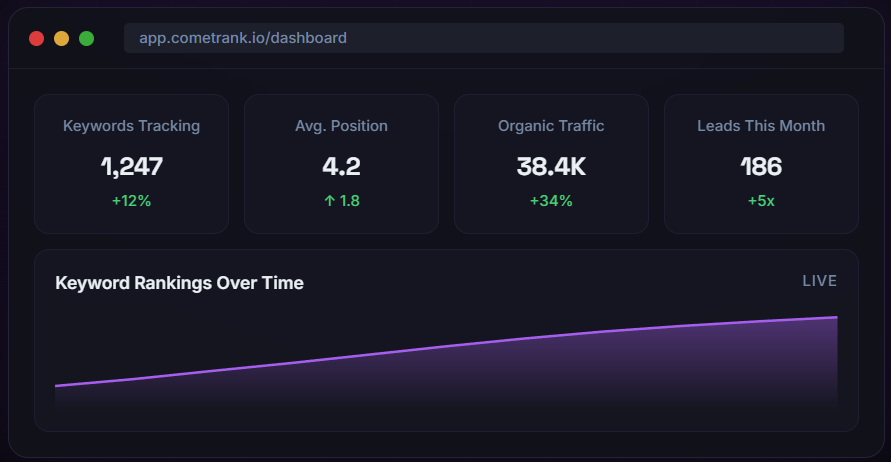
Platforms like CometRank help real estate professionals identify high-intent search opportunities, generate structured content, and build long-term search visibility that turns search traffic into qualified leads.
The Key Takeaway
The most successful real estate agents don’t rely on a single lead source.
They build a system.
Referrals create trust and relationships.
SEO creates consistent discovery.
When used together, they transform real estate marketing from unpredictable deals into a reliable pipeline of buyers and sellers.