
Generative search is changing how users discover information. Instead of clicking through a list of links, users increasingly get answers directly from AI systems like ChatGPT, Google AI Overviews, and Perplexity.
This shift means traditional SEO metrics—such as rankings and organic clicks—no longer capture the full picture. Companies now need to measure Generative Engine Optimization (GEO) performance: how often their brand, pages, and expertise appear inside AI-generated responses.
In this guide, we’ll break down the most important GEO KPIs and metrics, how to measure them, and how to turn AI visibility into real business results.
Why GEO Metrics Matter in the AI Search Era
AI search engines work differently from traditional search engines.
Instead of presenting a ranked list of websites, generative engines:
- Aggregate information from multiple sources
- Generate summarized answers
- Cite or reference authoritative sources
- Sometimes include brand mentions without direct links
This means companies must measure AI visibility, not just search rankings.
For example, a user asking:
“What are the best AI SEO platforms for SaaS companies?”
may see a generative answer that lists several platforms. If your company appears in that answer—even without a click—you have achieved GEO visibility.
Understanding how to track this visibility requires new metrics.
Core Generative Engine Optimization KPIs
The following KPIs are the foundation of GEO measurement.
1. AI Citation Rate
Definition:
The percentage of AI-generated answers that reference your website, brand, or content.
Why it matters:
Citations are the closest equivalent to “ranking #1” in AI search.
Example measurement approach
If you test 100 AI prompts like:
- “Best AI SEO platforms”
- “How to improve AI search visibility”
- “Tools for generative engine optimization”
and your brand appears in 18 answers:
AI Citation Rate = 18%
Higher citation rates indicate stronger topical authority and trust signals.
2. AI Brand Mention Frequency
Definition:
How often AI systems mention your brand within generated responses.
This includes:
- Named recommendations
- Comparisons
- Lists of tools or vendors
- Explanatory references
Example prompt:
“What platforms help improve AI search visibility?”
If the response includes CometRank, that counts as a brand mention.
Tools like an AI search grader help track this visibility across AI systems.
3. AI Visibility Share
Definition:
Your share of mentions compared to competitors within AI-generated answers.
Example prompt set:
| Platform | Mentions |
|---|---|
| Competitor A | 32 |
| Competitor B | 24 |
| CometRank | 18 |
AI Visibility Share = 18 / Total Mentions
This metric shows market presence within generative answers.
4. AI Query Coverage
Definition:
The number of relevant prompts where your content appears in AI-generated results.
For example, a SaaS SEO platform may track prompts such as:
- “AI SEO tools for SaaS companies”
- “How to improve AI search visibility”
- “Top generative engine optimization platforms”
- “AI tools for content optimization”
If your brand appears in 45 out of 200 tracked prompts, that becomes your AI Query Coverage score.
5. AI Traffic Attribution
Even though generative engines sometimes reduce clicks, they still drive traffic.
Track:
- traffic from AI search engines
- referral traffic from AI interfaces
- branded search increases after AI mentions
Example indicators:
- Increased searches for “CometRank AI SEO platform”
- Referral traffic from ChatGPT browsing sessions
- Traffic spikes after appearing in AI-generated lists
These signals indicate AI-driven demand generation.
6. AI Content Extraction Rate
Generative engines extract structured information from web pages.
Measure:
- how often AI systems quote or summarize your content
- how often your pages are used as source material
- which sections are being cited
Pages with structured sections like:
- definitions
- comparisons
- step-by-step frameworks
- data-driven explanations
tend to perform best.
Many strategies for improving extraction visibility are explained in generative engine optimization best practices.
Supporting GEO Metrics That Indicate Authority
Beyond direct AI mentions, several supporting metrics help improve generative visibility.
Topical Authority Coverage
Measure how comprehensively your site covers a topic cluster.
Example GEO cluster:
Topic: Generative Engine Optimization
Supporting pages:
- GEO strategy guide
- AI search visibility metrics
- GEO tools comparison
- AI search ranking factors
- GEO implementation playbook
The broader the topic coverage, the more likely AI models will treat your site as an authoritative source.
Structured Content Depth
AI models prefer pages with structured sections such as:
- definitions
- frameworks
- bullet lists
- tables
- examples
For instance, a page targeting:
Keyword: “generative engine optimization metrics”
should include sections like:
- GEO KPI definitions
- measurement frameworks
- example dashboards
- AI visibility tracking tools
This structure improves AI extractability.
Competitor Citation Gap
This metric compares AI citations between you and competitors.
Example:
| Brand | AI Citations |
|---|---|
| Competitor A | 35 |
| Competitor B | 28 |
| CometRank | 14 |
The gap reveals opportunities for content expansion and authority building.
You can also study how competitors appear in lists such as top software for AI visibility and generative engine optimization.
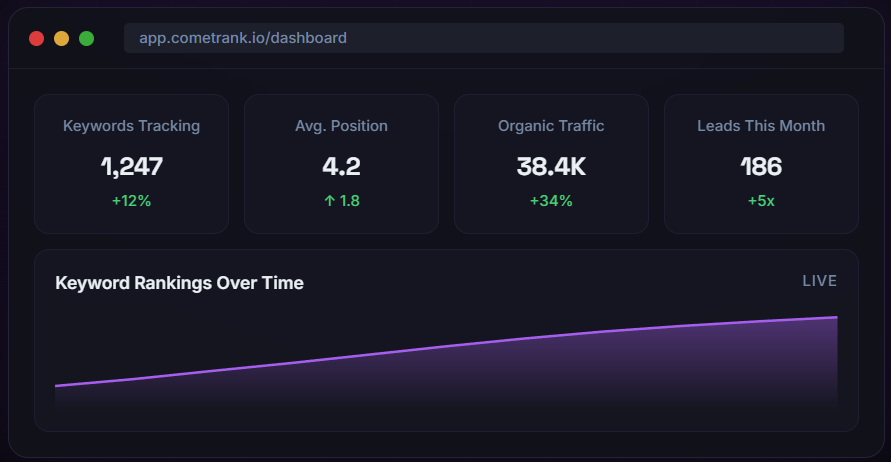
GEO KPI Dashboard Example
A typical GEO dashboard might track:
| KPI | Example Value |
|---|---|
| AI Citation Rate | 21% |
| AI Brand Mentions | 48 |
| AI Query Coverage | 72 prompts |
| AI Visibility Share | 16% |
| AI Traffic Growth | +28% |
| AI Content Extraction Rate | 34% |
This type of dashboard helps companies quantify their presence in AI search ecosystems.
How to Improve GEO Metrics
Improving GEO performance requires a combination of content strategy, authority signals, and structured information architecture.
Key actions include:
1. Build Topic Clusters Around AI Search Queries
Instead of publishing isolated articles, create clusters targeting related prompts.
Example cluster:
Topic: AI Search Visibility
Pages:
- “What is Generative Engine Optimization”
- “GEO KPIs and Metrics”
- “AI Search Ranking Factors”
- “GEO Tools Comparison”
This increases the probability of AI citation across multiple queries.
2. Structure Content for AI Extraction
AI systems prefer clearly structured information.
Include:
- H2/H3 headings answering specific questions
- short explanatory sections
- examples and frameworks
- comparison tables
This makes it easier for generative engines to summarize your content.
3. Publish High-Intent, Problem-Solving Content
Content that answers practical business questions performs better in generative search.
Examples:
- “How to measure AI search visibility”
- “Best GEO tools for SaaS companies”
- “How to optimize content for ChatGPT citations”
These queries reflect real user intent, which AI systems prioritize.
4. Use GEO Monitoring Tools
Because AI search is dynamic, continuous monitoring is essential.
Platforms like CometRank help companies:
- track AI search visibility
- monitor brand mentions in AI answers
- analyze citation opportunities
- optimize content for generative search engines
These systems provide visibility into how AI models interpret your content.
The Future of GEO Measurement
As AI search adoption grows, new metrics will emerge.
Expect to see measurement frameworks evolve around:
- AI answer influence (how strongly your content shapes responses)
- multi-engine visibility across ChatGPT, Google AI, and Perplexity
- AI recommendation rankings inside generated lists
- conversion attribution from AI discovery
Companies that start measuring these signals today will gain a significant competitive advantage as generative search becomes the dominant discovery channel.
Final Thoughts
Traditional SEO measured success through rankings and clicks.
Generative search requires a broader measurement framework.
The most important GEO KPIs include:
- AI citation rate
- AI brand mentions
- AI visibility share
- AI query coverage
- AI traffic attribution
- AI content extraction rate
Together, these metrics reveal how visible and influential your brand is within AI-generated answers.
Organizations that actively track and improve these signals will be best positioned to capture attention, authority, and demand in the AI search era.