
Many SaaS founders question whether SEO is still worth the effort in a world of AI search, paid acquisition, and social distribution.
The short answer: yes—but only if it focuses on high-intent searches and structured content coverage.
Most SaaS companies fail with SEO because they chase traffic instead of pipeline. Ranking for generic terms like “SEO tools” rarely converts. Ranking for buyer-intent queries like “AI SEO software for SaaS startups” or “programmatic SEO tools for B2B SaaS” can generate consistent inbound leads.
The difference is strategy.
Why Traditional SaaS SEO Often Fails
Many SaaS companies approach SEO with a blog-first mindset. They publish educational posts hoping traffic eventually converts.
Common problems include:
- targeting broad informational keywords
- publishing disconnected blog posts
- weak internal linking
- slow content production cycles
For example, a SaaS company may write an article targeting “what is SEO automation.”
Even if it ranks, the audience is mostly students, marketers learning basics, or people researching definitions—not buyers.
A stronger strategy would target commercial or evaluation intent, such as:
Keyword: “AI SEO automation software for SaaS”
Page type: product category or comparison page
The page should include sections like:
- what AI SEO automation does
- problems manual SEO creates for SaaS teams
- feature comparison
- use cases
- demo CTA
This structure captures people who are already evaluating solutions.
High-Intent SEO Still Drives SaaS Pipeline
Search remains one of the few channels where users actively look for solutions.
Examples of high-intent SaaS searches:
- “best AI SEO software for SaaS companies”
- “programmatic SEO tools for B2B SaaS”
- “automated SEO content platform for startups”
These searches happen when buyers are already in the evaluation or purchasing stage.
If your product appears when someone searches these queries, you capture demand that already exists.
Platforms like the AI SEO Platform focus specifically on identifying and targeting these types of high-intent opportunities.
The Real SEO Opportunity: Intent-Mapped Content
The most effective SaaS SEO strategies organize content around search intent, not just keywords.
Typical intent buckets include:
Product category intent
Users searching for the type of product you sell.
Example keyword:
“AI SEO platform for B2B SaaS”
Recommended page structure:
- what an AI SEO platform does
- problems it solves
- use cases for SaaS
- platform capabilities
- pricing or demo CTA
Comparison intent
Users evaluating tools.
Example keyword:
“Surfer SEO vs AI SEO automation tools”
Page structure:
- feature comparison
- pricing comparison
- ideal use cases
- limitations of manual SEO tools
Implementation intent
Users trying to execute a strategy.
Example keyword:
“programmatic SEO strategy for SaaS startups”
Page structure:
- explanation of programmatic SEO
- examples of SaaS programmatic pages
- internal linking strategies
- content scaling systems
A strong reference example is this programmatic SEO guide B2B SaaS 2026, which explains how SaaS companies can scale structured pages to capture long-tail demand.
Why AI Search Actually Makes SEO More Valuable
Many founders assume AI search will reduce the value of SEO.
In reality, structured content becomes even more important.
AI systems like:
- Google AI Overviews
- ChatGPT
- Perplexity
pull answers from clear, well-structured web pages.
Content that ranks well in traditional search and is organized into logical sections is more likely to be cited or summarized in AI-generated answers.
This means SaaS companies that build clear, intent-focused content hubs gain visibility across both search engines and AI tools.
The New SaaS SEO Model: Systems Instead of Blogs
The most successful SaaS companies now treat SEO as a content system, not a blogging activity.
That system includes:
- intent-based keyword discovery
- programmatic landing pages
- comparison pages
- use-case pages
- structured internal linking
- continuous optimization
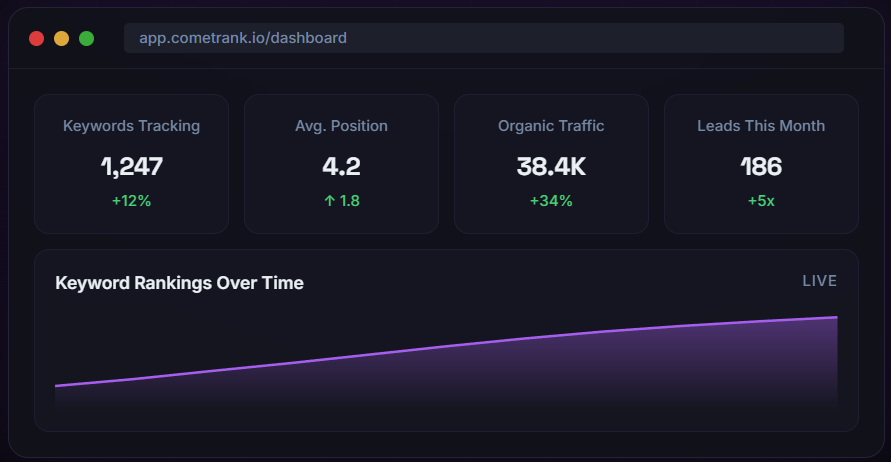
This is exactly the approach used by Cometrank, an AI-driven SEO command center designed to turn search visibility into qualified leads.
Instead of manually researching keywords and publishing occasional posts, the platform helps companies:
- identify high-intent opportunities
- generate structured landing pages
- scale content production
- improve internal linking
- build authority over time
The result is not just traffic—but a predictable inbound pipeline.
How Small SaaS Companies Should Approach SEO in 2026
For a small SaaS team, the most effective strategy is:
- Focus on high-intent commercial queries
- Build structured landing pages, not just blog posts
- Use programmatic SEO to scale long-tail coverage
- Create comparison and evaluation pages
- Continuously improve internal linking and authority signals
A startup publishing 200 low-intent blog posts will usually generate less revenue than one publishing 30 high-intent landing pages targeting buyer searches.
SEO still works—but only when it aligns with how buyers search.
The Strategic Takeaway
SEO in 2026 isn’t about writing more content.
It’s about owning the searches that signal buying intent.
Small SaaS companies that map content to real search demand can turn SEO into a durable lead channel. Those that treat SEO as a blogging activity will struggle to see ROI.
The companies winning today use structured, intent-driven SEO systems that scale.