
Someone in your city just searched “brake repair near me.”
They’re ready to book. They want a shop they can trust. And right now, a competitor’s name is showing up instead of yours. That’s what weak local automotive SEO costs you. Not just rankings, but:
- Missed appointments
- Lost revenue
- Zero reputation growth
This article breaks down the local automotive SEO strategies that consistently get auto shops and dealerships into the searches that convert, and explains why most shops stay invisible while a few dominate every city they serve.
What Is Local Automotive SEO?
Local automotive SEO is the process of making your shop or dealership visible in searches tied to your location and services. It connects your business to buyers searching for a specific repair, vehicle, or service provider near them.
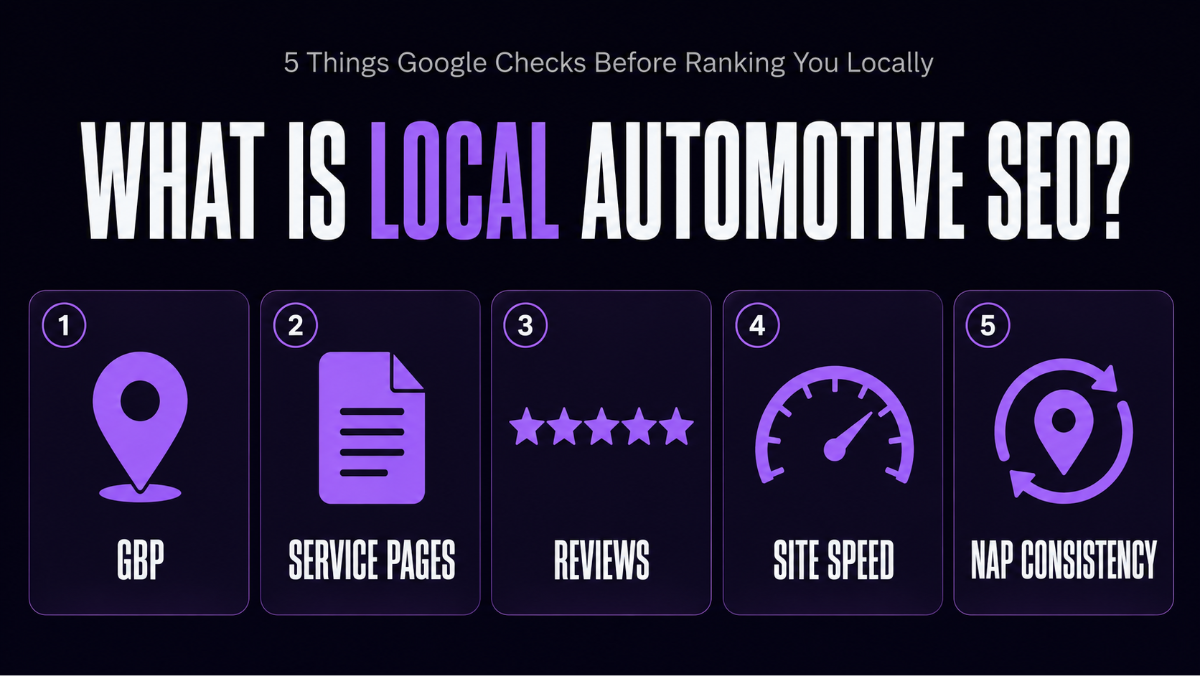
Miss any one of these and your dealership stays off the map pack, literally.
It covers everything Google looks at before ranking you locally:
- Your Google Business Profile
- Your service pages
- Your reviews
- Your site speed
- How consistently your business information appears across the web
Unlike general SEO, local automotive SEO targets buyers who are close to a decision. Someone searching “transmission repair Dallas” isn’t browsing. They need help now.
Why Generic Keywords Are Costing You Leads
Most auto businesses try to rank for broad terms like “car repair” or “auto mechanic.” These terms don’t convert. They lack the local and service intent that signals buying readiness.
Effective local automotive SEO strategies target long-tail searches instead. These map to buyers with a specific problem who want a nearby solution.
| Generic Keyword | High-Intent Local Alternative |
| auto repair | brake repair shop in Austin TX |
| car service | AC repair near me open today |
| mechanic shop | transmission rebuild Houston TX |
| oil change | same-day oil change Dallas TX |
| tire shop | flat tire repair near me |
Each high-intent keyword maps to a buyer who’s already decided they need the service. They’re choosing which shop, not whether to get it fixed.
7 Local Automotive SEO Strategies That Drive Appointments
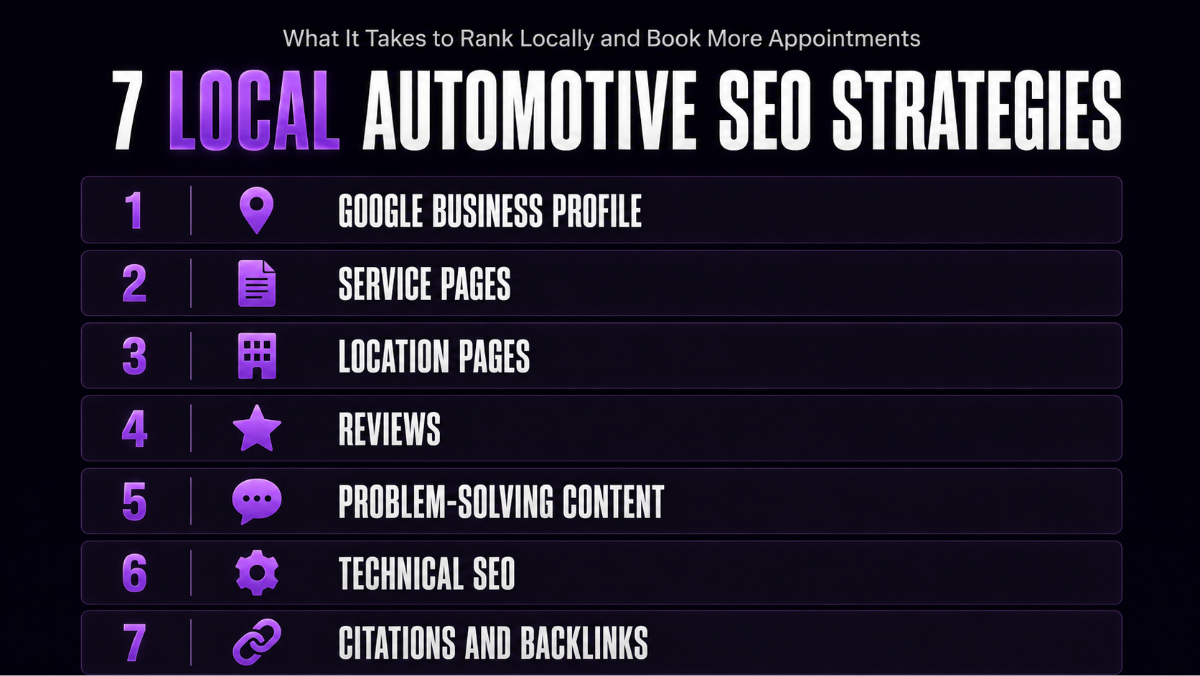
The seven tactics that determine whether your dealership ranks locally or gets buried.
1. Build a Google Business Profile That Works Like a Lead Page
Your Google Business Profile (GBP) is usually the first thing a buyer sees. Most auto shops treat it as a one-time setup task. That’s why most auto shops lose to competitors who don’t.
An optimized GBP should include:
- Specific service categories
- Real photos of your bays and team
- Consistent business name and address
- Weekly posts
- Prompt responses to every review
Google Business Profile for local SEO has a direct link to map pack rankings. Active, complete profiles consistently outperform competitors with better websites but neglected profiles. According to Google, consumers are 2.7x more likely to consider a business reputable if it has a complete Business Profile on Search and Maps.
2. Build Dedicated Service Pages for Each Repair
One “Services” page listing everything your shop does is one of the most common local SEO mistakes in the automotive industry.
Google cannot rank a single page for 15 different high-intent searches. You need a dedicated page for each service. Each page should include:
- The service name and location in the H1
- What symptoms indicate the need
- What the repair involves
- A cost range
- A clear booking CTA
A brake repair shop in Phoenix should have a page targeting “brake repair Phoenix AZ,” not just a line in a services menu. That one page, built correctly, generates consistent appointment requests for months.
3. Create Location Pages for Every City You Serve
If your shop serves multiple cities, each city needs its own page. Not a template with the city name swapped in. A real page that helps a buyer in that city understand why your shop is the right choice.
Strong location pages include:
- Services for that specific area
- Local driving context
- Customer testimonials from that neighborhood
- A clear booking option
Auto businesses that serve multi-area markets can see strong growth in local pack visibility once they build location pages with genuine local relevance. The shops winning “near me” searches are the ones whose pages answer the searcher’s actual question.
4. Fix Your Reviews Before You Fix Your Website
Reviews aren’t just reputation signals. They’re local SEO ranking signals. Google evaluates review count, frequency, recency, and sentiment when deciding which shops to show in the map pack.
A shop with 40 reviews from last year ranks below a shop with 15 reviews from last month. Freshness matters.
To keep review momentum going:
- Ask every satisfied customer within 24 hours of service
- Use SMS with a direct link to your Google review page
- Respond to every review
Responses signal to Google that you’re active. When customers naturally mention specific services or your city name, it creates additional relevance signals for local search.
5. Publish Problem-Solving Content That Pulls Buyers In Early
Most auto shop customers search before they book. They’re trying to understand whether their problem is urgent, how much it might cost, or whether it’s safe to drive another week.
Publishing content that answers these questions puts you in front of buyers before they decide where to go. Effective automotive content targets searches like:
- “why does my car shake when braking”
- “signs my transmission is failing”
- “how long can I drive with a cracked windshield”
Each article should include a brief answer, a cost range, and a clear next step. Buyers who land on your content already trust you more than a shop they’ve never encountered.
SEO tools for keyword research can surface exactly which problem-based searches your customers are using, sorted by volume and intent.
6. Fix the Technical Issues Quietly Killing Your Rankings
Technical SEO determines whether Google can find, read, and trust your site. Most auto shop websites have at least two or three issues suppressing rankings with no obvious symptoms.
The most common problems:
- Slow page speed. Sites loading in one second convert at triple the rate of sites loading in five seconds.
- No schema markup. LocalBusiness schema, Service schema, and Review schema tell Google exactly what your business offers and where.
- Mobile experience issues. More than 80% of automotive searches happen on mobile. A difficult mobile experience loses leads before they read a word.
- NAP inconsistency. Your name, address, and phone must be identical across Google, Yelp, Cars.com, and every directory. Inconsistency reduces ranking confidence.
A technical SEO site audit reveals exactly which issues are suppressing your local rankings.
7. Build Local Authority Through Citations and Backlinks
Local authority tells Google your business is real, established, and embedded in your community. It comes from two sources: citations and backlinks.
Citations are mentions of your business name, address, and phone number on other sites. Claim and keep current your listings on:
- Yelp
- Cars.com and Autotrader
- BBB
- Your local chamber of commerce
Backlinks from local sources add additional trust. Sponsoring a local sports team, contributing to a neighborhood site, or earning a mention in local press all strengthen local pack rankings over time.
What are citations in SEO explains how to build and clean up citation profiles at scale.
AI Search Is Changing How Buyers Find Auto Shops
Google’s AI Overviews and platforms like ChatGPT now answer questions like “best brake shop near me” before showing a list of websites. The shops getting cited in these AI-generated answers have one thing in common: structured, authoritative content that AI can extract and trust.
Your service pages, your GBP, and your review responses all feed into whether AI recommends your shop. Shops that treat SEO as a trust-building system show up in both traditional results and AI-generated answers.
Generative engine optimization explains exactly how AI search reads your content and what needs to change for it to cite you instead of a competitor.
What Outdated Local SEO Looks Like
Not all SEO effort drives leads. Some tactics waste time and suppress rankings.
| Outdated Tactic | Why It Fails |
| Generic city pages with just the name swapped | Google identifies thin content. Pages don’t rank. |
| Keyword stuffing service pages | Drops rankings and destroys trust |
| One-time GBP setup, never updated | Active profiles outrank stagnant ones |
| Chasing volume without local intent | Traffic comes in, nobody books |
| Ignoring reviews after getting a few | Fresh reviews signal active, trusted businesses |
Why SEO agencies fail breaks down why these shortcuts persist and why they cost auto businesses leads even when rankings temporarily improve.
How CometRank Runs Local Automotive SEO
Executing all seven strategies consistently is where most auto shops fall short. Not because the strategies are complicated. Because running them at the right speed and scale is a full-time job.
We’re an AI SEO agency that handles the full workflow using CometRank, our proprietary software. Six AI agents run in parallel:
- The Analyst maps your market and finds the searches worth ranking for
- The Strategist builds the keyword and content roadmap
- The Creator produces service pages, location pages, and blog content at scale
- The Optimizer handles internal linking and conversion readiness
- The Authority Builder runs your citation and backlink strategy
- The Quality Guardian checks every output before it goes live
A human SEO captain sits above all six and reviews everything before it touches your site.
If you want to know which local searches your shop is missing right now, book a demo and we’ll show you exactly where the gaps are.
Conclusion
Local automotive SEO isn’t about getting to page one for a generic keyword. It’s about showing up when a specific buyer in your city needs the specific service you offer, with enough trust signals to make them book on the spot.
The shops that win consistently aren’t the ones with the biggest ad budgets. They’re the ones whose GBPs are active, whose service pages answer real questions, and whose review profiles keep growing. Build that foundation and the appointments follow.
Frequently Asked Questions About Local Automotive SEO
1. How long does local automotive SEO take to show results?
Early improvements like GBP optimization and citation fixes can show within 4 to 8 weeks. Consistent ranking gains for competitive service keywords typically build over 3 to 6 months.
2. Is local SEO more important for sales or service departments?
Both benefit, but service departments usually see faster returns. Service searches like “brake repair near me” carry stronger local intent and more urgent buying behavior than broad sales queries.
3. Do auto shops need separate pages for new and used inventory?
Yes. Buyers search differently for new models, used vehicles, and certified pre-owned inventory. Separate pages with distinct keywords improve ranking coverage across all three segments.
4. Can a small auto shop compete with large dealerships in local search?
Yes. Smaller shops often outrank large dealerships by focusing on local relevance, consistent reviews, and specific service keywords rather than competing on inventory volume or brand name.
5. What’s the biggest local SEO mistake auto businesses make?
Treating GBP as a one-time setup. Active profiles with fresh photos, regular posts, and prompt review responses consistently outrank profiles that haven’t been touched since creation.
6. How does schema markup help auto shops rank locally?
Schema markup tells Google exactly what your business is and what it offers. LocalBusiness and Service schema help Google match your pages to relevant local searches and often improve click-through rates in map results.