
Most real estate agents depend heavily on platforms like Zillow for leads. At first, it works. Listings get visibility, inquiries come in, and deals happen.
But over time, many agents realize a core problem: they do not own the lead source.
Zillow controls the platform, the pricing, the visibility, and the customer relationship. Agents essentially rent attention instead of building a predictable pipeline.
Today there is an additional shift happening.
Buyers and sellers are no longer searching only on Google. Many people now ask questions directly inside AI tools like ChatGPT and Google Gemini.
If your business does not appear in those AI-generated answers, you lose visibility before a user even clicks a website.
This is why modern SEO for real estate agents is evolving into AI search visibility — and why real estate agents need their own lead engine.
The Zillow Dependency Problem for Real Estate Agents
Platforms like Zillow aggregate property listings and sell exposure to agents.
While this generates leads, it creates several structural issues.
Agents Compete Inside Zillow’s Marketplace
On Zillow, the platform controls visibility. Multiple agents compete for the same leads.
If a buyer clicks a listing, they often see several agents displayed, not necessarily the listing agent.
This means:
-
agents pay for leads they do not fully control
-
conversion rates depend on response speed and competition
-
lead quality varies significantly
Instead of owning the relationship, agents compete inside a platform-controlled lead auction.
Lead Costs Increase Over Time
As more agents advertise on Zillow, the cost per lead increases.
Many markets have seen:
-
higher monthly advertising costs
-
lower exclusivity
-
declining ROI
Agents become locked into a system where “turning off Zillow advertising means losing their primary lead source”.
This creates long-term dependency.
SEO Builds a Lead Engine Agents Actually Own
SEO works differently from marketplace platforms.
Instead of paying to appear on someone else’s website, agents build search visibility on their own domain.
When someone searches for:
-
“homes for sale in Austin with pool”
-
“best realtor for selling house in Phoenix AZ”
-
“condos for sale near downtown Miami”
Google sends those users directly to the agent’s website.
The result:
-
higher-intent traffic
-
direct contact with buyers and sellers
-
long-term lead generation without platform fees
SEO becomes a lead asset that compounds over time.
But modern SEO must now account for AI search platforms as well.
Why Appearing in AI Answers (ChatGPT, Gemini, AI Overviews) Now Matters for real estate agents
Search behavior is changing.
Instead of typing queries into search engines, many buyers now ask questions directly in AI tools like ChatGPT or Gemini.
Examples of real estate queries people now ask AI:
-
“Best neighborhoods to buy a home in Austin for families”
-
“Is it a good time to sell a house in Phoenix?”
-
“Top real estate agents in Miami Beach”
AI systems analyze web content and generate answers. If your website content is structured well and authoritative, your site can be referenced or summarized in these responses.
If not, large platforms like Zillow dominate those answers.
This means modern real estate visibility requires AI-search optimization, not just traditional SEO.
Well-structured content helps your business appear in:
-
Google AI Overviews
-
ChatGPT answers
-
Gemini search summaries
-
AI-powered search engines like Perplexity
Agents who optimize for these systems gain visibility even before users click search results.
High-Intent Real Estate Searches Agents Should Target
Most real estate SEO fails because agents target broad keywords like:
-
“real estate”
-
“homes”
-
“realtor”
These keywords are dominated by massive platforms.
Instead, successful SEO focuses on high-intent long-tail searches.
Local Buyer Intent Searches
These indicate someone actively searching for property.
Examples:
-
“homes for sale in Scottsdale AZ with guest house”
-
“townhomes for sale in Charlotte NC under 500k”
-
“new construction homes in Tampa FL near downtown”
Page type: neighborhood or property-type landing page.
Example page structure targeting
“townhomes for sale in Charlotte NC under 500k”
Sections could include:
-
current listings under $500k
-
neighborhoods where these townhomes are located
-
HOA details
-
financing considerations
-
CTA to schedule a viewing
These pages capture buyers already searching for specific property types.
Seller Intent Searches
Homeowners planning to sell often search for guidance.
Examples:
-
“how to sell my house fast in Dallas TX”
-
“best listing agent in Denver Colorado”
-
“what commission do realtors charge in Atlanta”
Page type: seller-focused service page.
Example structure for
“best listing agent in Denver Colorado”
Sections might include:
-
pricing strategy for Denver homes
-
marketing approach (MLS, photography, staging)
-
average days on market in Denver neighborhoods
-
case studies of homes sold
-
seller consultation CTA
These pages attract motivated sellers preparing to hire an agent.
Neighborhood Research Searches
Buyers often research neighborhoods months before contacting an agent.
Examples:
-
“best neighborhoods in Nashville for families”
-
“living in downtown Austin pros and cons”
-
“cost of living in Scottsdale AZ”
Page type: neighborhood guide.
Example structure targeting
“best neighborhoods in Nashville for families”
Sections could include:
-
school districts
-
median home prices
-
commute times
-
parks and amenities
-
housing inventory overview
-
CTA for available homes
These pages build early-stage buyer relationships.
Why Most Real Estate Websites Fail to Rank or Appear in AI Search
Many real estate websites struggle with both SEO and AI visibility because they lack structured, intent-driven content.
Common problems include:
Thin Listing Pages
Most real estate websites rely only on MLS listings.
Search engines and AI systems see hundreds of nearly identical listing pages with minimal context.
These pages rarely rank or get cited in AI answers.
No Intent-Based Content Strategy
Many sites only target broad keywords like:
-
“real estate agent Phoenix”
-
“homes for sale Miami”
But buyers and sellers search much more specifically.
Without pages targeting specific search intent, the site misses most demand.
Content Not Structured for AI Extraction
AI search systems prefer content that clearly explains topics and answers questions.
For example, a page targeting
“cost to sell a home in Phoenix AZ”
Should include sections like:
-
average realtor commission in Phoenix
-
closing costs for sellers
-
staging and photography costs
-
how pricing impacts days on market
This type of structured content is easier for AI systems to reference and summarize.
How AI SEO Platforms Help Real Estate Agents Scale Visibility
Traditional SEO agencies often struggle with the scale required for local search.
Creating hundreds of pages for neighborhoods, property types, and buyer questions takes significant time.
This is where modern AI SEO platforms change the equation.
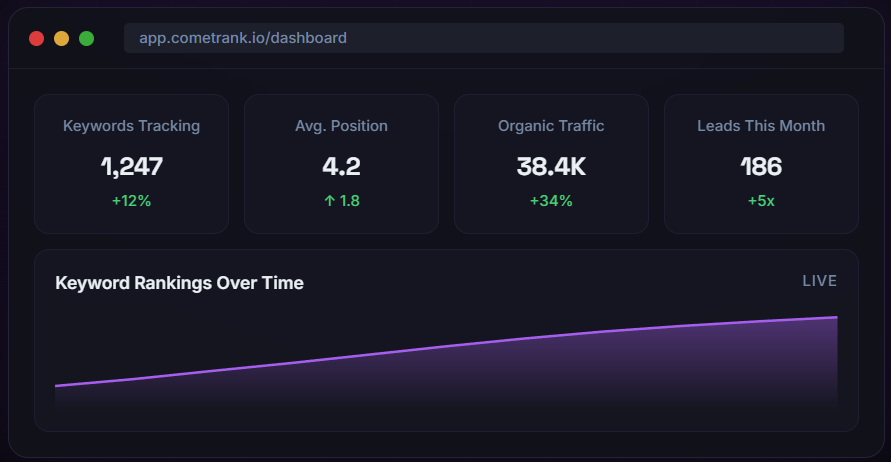
Platforms like CometRank, an AI SEO platform, automate large parts of the SEO process while maintaining strategic oversight.
CometRank uses a system of specialized AI agents.
The AI SEO Analyst
The Analyst identifies high-intent opportunities such as:
-
“homes for sale in Scottsdale with guest house”
-
“condos in Miami Brickell under 800k”
-
“sell my house fast in Tampa FL”
These keywords often convert because they reflect immediate buyer or seller intent.
The AI SEO Strategist
The Strategist organizes opportunities into topic clusters.
Example cluster for a real estate site:
Neighborhood cluster:
-
homes for sale in Austin TX Zilker
-
living in Zilker Austin guide
-
Zilker real estate market trends
-
Zilker school district information
This builds topical authority for both Google and AI search engines.
The AI SEO Content Creator
The Creator produces structured pages such as:
-
neighborhood guides
-
seller service pages
-
buyer education articles
-
property-type landing pages
Each page targets a specific query buyers or sellers actually search.
The AI SEO Optimizer
The Optimizer improves:
-
internal linking
-
ranking performance
-
topical coverage
-
AI-readability
This helps content perform well in search results and AI-generated answers.
The AI SEO Authority Builder
AI systems also rely heavily on trusted sources.
The Authority Builder strengthens credibility through:
-
backlinks
-
citations
-
local authority signals
This improves visibility in both Google rankings and AI-generated summaries.
Zillow vs SEO vs AI Search Visibility
The future of real estate marketing involves three lead channels.
Zillow
-
pay-per-lead marketplace
-
limited control
-
increasing costs
-
shared leads
Traditional SEO
-
owned traffic
-
direct buyer and seller inquiries
-
long-term search rankings
AI Search Visibility
-
appearances in ChatGPT answers
-
citations in Gemini summaries
-
inclusion in AI-powered search results
Agents who invest in SEO and AI visibility build a durable lead engine that does not depend on a single platform.
The Future of Real Estate Lead Generation
Search behavior is evolving quickly.
Buyers and sellers increasingly use:
-
Google search
-
AI assistants
-
voice search
-
AI-generated recommendations
This means the agents who build structured, intent-driven content today will dominate both search engines and AI answers.
Instead of competing inside marketplaces like Zillow, they become the source that AI systems recommend.
With AI SEO platforms like CometRank, building that visibility is becoming dramatically faster.
The agents who invest early build a long-term competitive advantage in search and AI discovery
